
EU Summit: Meloni says, ‘Industry at risk with the ETS’. Then a compromise. Seven-day extension of the Schengen travel ban with Spain
Italia, together with the Visegrad Group, has secured a commitment to assess all the impacts of ETS2, but not a postponement. On migrants, the call to put a stop to pull factors and discussions with Madrid
from our correspondent in Brussels Manuela Perrone
 Aggiungi Il Sole 24 Ore
ai preferiti su Google
Key points
- The flexibility challenge
- ETS, alliance with the Visegrad countries
- The warning about deindustrialisation
- The coldness of France and Germany
- The final compromise
- No to postponing the ETS2, yes to an impact assessment
- Rome-Madrid clash: Schengen suspended for a further 7 days
- The row with Spain over immigration
- The meeting with Abascal
- Today’s focus is on Ukraine: the issue of the single negotiator
- [Enter the key point]
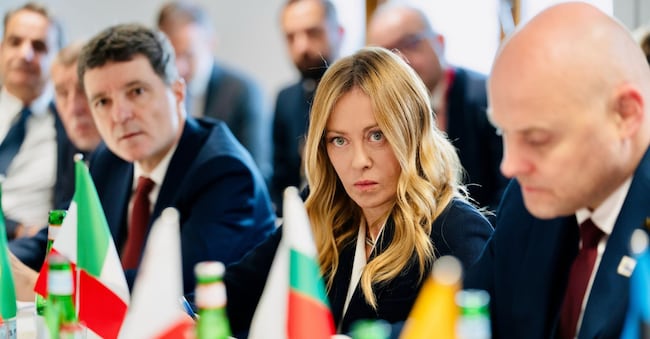
The ‘frugal’ states’ stance on the ETS. The clash with Spain over immigration. The additional flexibility linked to the inflation ‘emergency’, raised solely in conjunction with Greece. Giorgia Meloni went on the offensive on the first day of a European Council in Brussels, widely regarded as ‘difficult’. Even more so for Italy. And overnight she secured a compromise on the ETS, namely a commitment to ensure ‘a well-functioning carbon market’ and, above all, to ‘update all the impacts of ETS2, particularly with regard to its configuration and the relevant safeguards’. It is not the postponement of the entry into force that had been requested, but neither is it silence on the matter.
The flexibility challenge
The Prime Minister first raised with the leaders the issue of the additional flexibility called for in the name of a correct interpretation of the ‘relevant factors’ for compliance with the expenditure rule at the heart of the Stability Pact. Italian diplomatic sources reported that Ursula von der Leyen did not comment, but that ‘the Commission’s services are nevertheless examining the dossier’. The situation is complicated both by the need not to appear to be giving ground on public finances at a time of market turmoil and, above all, by Italy’s other request to be able to use the VAT windfall to alleviate the burden of the high cost of living on households and businesses, rather than allocating it to debt reduction.
ETS, alliance with the Visegrad countries
But it was over energy costs and the proposed revision of the ETS, put forward by the Czech Andrej Babiš, that the debate flared up. Meloni finds her only allies, particularly on the postponement of ETS2, within the Visegrad Group: Hungary, the Czech Republic, Poland and Slovakia. Together with Babiš, she presented two charts for discussion. The first, based on the European Environment Agency’s (EEA) EU ETS Data Viewer, plots the downward trend in CO₂ allowance emissions against the rising price since 2020. ‘ETS emissions are plummeting, but European industry is losing ground,’ reads the commentary. However, critics – who are opposed to extending a helping hand to those whose energy mix remains heavily reliant on gas and oil – believe this demonstrates that the mechanism is working: as the supply of emissions decreases, the price rises. It adds that suspicions of speculation have been refuted by ESMA, the European Securities and Markets Authority.
The alarm over deindustrialisation
The second chart, sourced from Eurostat, shows the declining share of industry (excluding construction) in total European GDP since 2021, with chemicals and fertilisers at -31 per cent, steel at -16 per cent and glass at -10 per cent. “Europe is becoming deindustrialised, especially in energy-intensive sectors”, is the assessment. In Meloni’s words, during a three-hour debate that was suspended and then resumed, this became a plea to stop the train before it derails, before industry is “slaughtered”.
The cold shoulder from France and Germany
Friedrich Merz and Emmanuel Macron remained non-committal. They did not launch an attack like Denmark, Sweden, Finland and the Netherlands, but neither did they support the Italian position. Whilst the Council was debating the multiannual budget (with the conditions set by Italia and Romania alongside the 17 ‘Friends of Cohesion’), news also emerged of an acceleration in the Franco-German agreement on the future of the automotive sector – an agreement that excludes Italy.


