Football & business

Euro 2032: the race for the stadiums enters its decisive phase – guarantees and a clear timetable are now needed

Veritice Abodi-Malagò to speed up the process. Certified proposals for the candidate facilities must be submitted by 31 July. There will be 9 or 10 facilities vying for five places

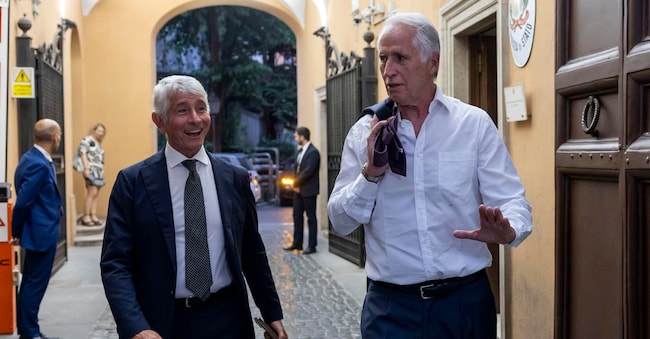
Il ministro per lo Sport Andrea Abodi e il nuovo presidente della Figc Giovanni Malagò dopo l’incontro escono dagli uffici del ministero a Largo Pietro di Brazzà per il punto stampa, Roma, 25 giugno 2026. ANSA / MASSIMO PERCOSSI

5' min read

Translated by AI
Versione italiana

5' min read

Translated by AI
Versione italiana

To understand just how much the institutional landscape surrounding Euro 2032 has changed, one need only look at a scene that, until a few months ago, would have seemed unlikely. Seated around the same table are the Minister for Sport, Andrea Abodi; the President of the FIGC, Giovanni Malagò; the new head of CONI, Luciano Buonfiglio; the Special Commissioner for Stadiums, Massimo Sessa; and Michele Uva, Executive Director of Euro 2032 Italia. They share a single goal: to transform a bid awarded by UEFA into a tangible infrastructural legacy for the country.

The summit held on 3 July at the minister’s offices marks a crucial step in the process that will lead to Italia identifying the venues set to host the 2032 European Championship. After years of delays, divisions and missed opportunities, the message coming from the institutions is one of full cooperation and ongoing coordination until the conclusion of UEFA’s evaluation process.

Loading...

“I am fully satisfied; the atmosphere is excellent,” explained Malagò at the end of the meeting, noting that the first key deadline is set for 31 July, by which date certified responses regarding the candidate venues must be received. This is a deadline that UEFA considers binding and which represents the first real test of the credibility of the Italia bid.

The roadmap to the final decision

The next three months will be crucial. By the end of July, candidate cities must submit the necessary documentation to the FIGC: project proposal, contract, financial backing and guarantees regarding the completion of the works. Additional documentation may then be submitted up until mid-September.

It will then be up to the FIGC to make the most delicate decision. In early October, the Federation will identify the five main venues to be included in the official bid dossier to be submitted to UEFA. Alongside these, a list of reserve venues will also be drawn up, ready to step in should any of the selected projects fall behind schedule or fail to meet the required standards.

This is not just a theoretical possibility. It has already happened in the past, for example during the preparations for Euro 2012 in Poland and Ukraine. For this reason, the Italian strategy aims to draw up not just a shortlist of five stadiums, but a genuine ‘extended shortlist’ of venues.

In the first week of October, UEFA will finally issue its ruling, assessing the projects’ compliance from a technical, financial and implementation perspective.

From emergency to competition between cities

Perhaps the most significant figure concerns how the situation has developed over the last twelve months. A year ago, the only stadium that already met all the necessary requirements was Juventus’ Allianz Stadium. Today, however, the picture has changed radically, and there are at least nine, perhaps ten, stadiums capable of submitting a structured bid within the required timeframe.

This acceleration has been driven by the introduction of the role of special commissioner, greater cooperation between the Government and the FIGC, and a widespread recognition that Euro 2032 represents an economic and urban development opportunity that would be difficult to replicate.

Estimates compiled in recent months suggest that the economic impact for each host city will exceed 500 million euros, taking into account investment, tourism, employment and urban regeneration.

The venues to be assessed include: the Allianz Stadium in Turin; the new San Siro in Milan; the Artemio Franchi Stadium in Florence; the Olympic Stadium in Rome; Roma’s new stadium; the new stadium in Palermo; the new stadium in Cagliari; the Diego Armando Maradona Stadium in Naples; and the Arechi Stadium in Salerno. Genoa could also be added to this list, as it is currently finalising its administrative and planning procedures.

The most interesting situation concerns Rome. The capital could, in fact, put forward two bids: the Olimpico, which currently represents the most immediate and established solution, and Roma’s new stadium, the plans for which continue to progress. Milan, on the other hand, is banking on the new San Siro project, considered one of the flagship projects of Italia’s infrastructure renewal.

UEFA’s ratings

The lesson learnt in recent years is clear: renderings and adverts are not enough. UEFA will focus above all on the feasibility of the projects. For this reason, the summit also addressed the issue of available financial instruments, including the portfolio managed by the Italian Sports Fund through the Institute for Sports and Cultural Credit. The objective shared by the Government, the FIGC and the commissioner is to submit bids based on projects that are genuinely fundable and can be completed within the timeframe required by the European body.

In other words, the challenge is not to design the most spectacular stadiums, but to prove that they will be ready by 2032.

For Euro 2032, UEFA is not only assessing the stadium itself, but the entire ecosystem surrounding it: accessibility, transport, security, hospitality, sustainability and the financial soundness of the project. This is precisely the area on which the FIGC, the Government and the special commissioner are currently focusing their efforts.

European candidacy and the requirements

To host the final stage of the European Championship, a total of 10 stadiums are required, divided into specific capacity categories: 1 stadium with a capacity of at least 60,000 (normally designated for the final); 1 stadium with a capacity of at least 50,000, preferably two; 4 stadiums with a capacity of at least 40,000; 3 stadiums with a capacity of at least 30,000.

In the case of Euro 2032, organised by Italia and Turkey, the two countries must each nominate five stadiums.

UEFA requires that stadiums be located in cities with adequate supporting infrastructure: efficient rail and airport links; public transport capable of handling large numbers of spectators; sufficient hotel accommodation; dedicated areas for fans and the media; training centres for national teams; and full accessibility for people with disabilities.

Stadiums must comply with UEFA’s highest standards in the following areas: CCTV surveillance; access control; emergency management; separate routes for supporters, teams, the media and officials; hospitality and corporate areas; and facilities for broadcasters and the international press.

In recent years, UEFA has introduced increasingly stringent criteria regarding: environmental sustainability; energy efficiency; emissions reduction; the future use of the venue after the tournament; and the economic and social impact on the local area.

In short, it is not enough simply to build a new stadium: we need to demonstrate that it will serve a sustainable economic and sporting purpose even after Euro 2032.

The most important requirement today: certainty that the project will be completed. In the case of Italia, this is probably the decisive factor. UEFA wants to receive projects that are funded; administratively approved; and capable of being completed within the specified deadlines. In other words, projects that can be ‘put on the building site’ by spring 2027.

Between 31 July and early October, a decisive battle will therefore be fought. Not on the pitch, but in the technical offices, at service committee meetings and around the negotiating table. It is there that it will be decided which cities will be included in the host cities for the next European Championship and which, on the other hand, will have to wait for another opportunity.For once, however, the most encouraging sign does not come from the projects themselves. It comes from sports policy. After years of conflicts and mutual vetoes, the institutions seem to have realised that the only way to win the Euro 2032 bid is to play as a team.

Copyright reserved ©
Loading...

Brand connect

Loading...

Newsletter

Notizie e approfondimenti sugli avvenimenti politici, economici e finanziari.

Iscriviti

Tutto mercato WEB