
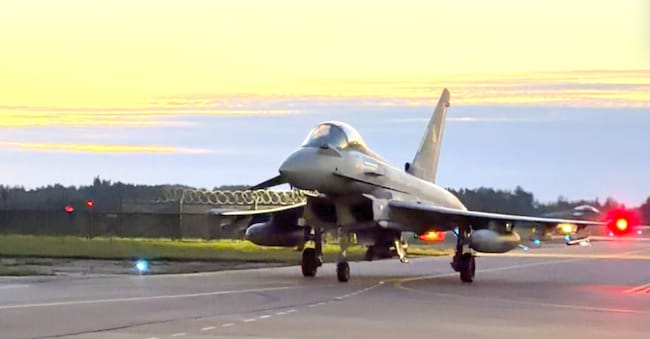
Eurofighter F-2000: here are the specifications of the fighter jet that shot down a drone over Latvia
Known as the “Eurofighter Typhoon”, it is an advanced 4th-generation multi-role fighter aircraft, developed by a European consortium comprising Italia, the United Kingdom, Germany and Spain

Key points
Two Eurofighter F-2000s from the Italian Air Force’s ‘Baltic Thunder III’ Air Task Force, deployed on the NATO air defence mission on the Alliance’s eastern flank, took off on Friday 14 August on a scramble (the procedure for immediate take-off following an alert) following a drone’s violation of Latvian airspace. The Italian crews intercepted the unmanned aircraft and shot it down in accordance with Alliance procedures. The downed drone is believed to be Ukrainian and is thought to have strayed off course due to Russian electronic jamming.
Fourth-generation multi-role fighter
The Eurofighter F-2000 (known internationally as the EF-2000 or Eurofighter Typhoon) is an advanced 4th-generation (4.5G) multi-role fighter, developed by a European consortium comprising Italia, the United Kingdom, Germany and Spain. In Italia, the official designation used by the Italian Air Force is F-2000A (for the single-seater version) and TF-2000A (for the two-seater version).
Features
The Eurofighter Typhoon has a wingspan of 14.74 m, a length of 15.96 m and a height of 5.28 m. Its maximum take-off weight is 23,500 kg. As for the propulsion system, it consists of two Eurojet EJ200 turbofans delivering 60 kN of thrust on dry power and 90 kN with afterburner. The maximum speed is 2,495 km/h; the maximum range is 2,900 km. The crew consists of one or two pilots. Finally, the armament: one 27 mm Mauser cannon, up to 6,500 kg of external payload (AIM-9L Sidewinder, AIM-120 AMRAAM, Iris-T and Meteor missiles; GBU series guided bombs; auxiliary fuel tanks and laser-aiming pods).
Italia’s provision of these fighter aircraft
As the Institute of International Affairs explains in a report on the GCAP, Italia has purchased a total of 118 Eurofighters, including the new Tranche 4 variants, which will remain in service until the 2060s and will be interoperable with the GCAP.


