European policies

Europe and culture: historic agreement between the EU institutions

However, the issue of resources remains a sticking point in the budget. From 1 July, the Irish Presidency will officially take the lead in negotiations on the Multiannual Financial Framework for 2028–2034
by Roberta Capozucca

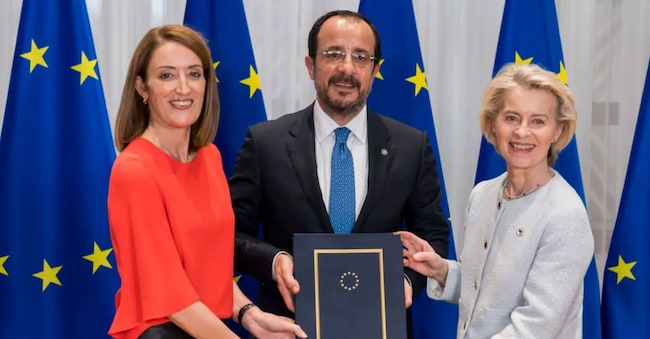
Ursula von der Leyen, Presidente della Commissione Europea, Roberta Metsola Presidente del Parlamento Europeo e Nikos Christodoulides, presidente della Repubblica di Cipro e alla guida della Presidenza del Consiglio dell’Unione europea fino al 1 luglio

5' min read

Translated by AI
Versione italiana

5' min read

Translated by AI
Versione italiana

For the first time in European history, the European Parliament, the European Commission and the Council of the European Union have signed a joint declaration on culture, making a shared and unprecedented political commitment to support the cultural and creative sectors. The document, entitled Europe for Culture, Culture for Europe”, adopted on 18 June 2026, recognises culture as a strategic component of the European project and reaffirms its role in promoting cultural and linguistic diversity, as well as in integrating cultural policies into the Union’s main areas of action. Among the most significant elements of the declaration are the recognition of artistic freedom as a strategic priority and the affirmation of access to culture as an essential prerequisite for democratic, inclusive societies founded on respect for cultural rights.

Behind the broad political consensus, however, the adopted text reveals some underlying tensions that reflect the debate currently taking place in Brussels on the future of European support for the cultural sector. During interinstitutional negotiations, in fact, one of the early versions of the declaration contained an explicit reference to the need to guarantee ongoing, dedicated funding for the cultural and creative industries. In the final version, however, that passage has been replaced by a more general reference to the sector’s sustainability, to be achieved through the diversification of funding sources and the exploration of new support mechanisms. This change goes far beyond mere semantics and takes on particular significance at a time when Brussels is engaged in defining the next Multiannual Financial Framework for 2028–2034.

Loading...

And, as it takes shape AgoraEU 2028–2034 takes shape – designed to build on the legacy of the current programmes supporting the cultural and creative sectors – it remains to be seen whether the political commitment set out in the joint declaration will be reflected in forthcoming budgetary decisions, ensuring that the cultural and creative sectors play an effective role amongst the European Union’s priorities.

What is AgoraEU?

With the proposal for the new Multiannual Financial Framework 2028–2034, presented on 16 July 2025, the European Commission aims to redesign the architecture of the EU budget with a view to simplification and the concentration of resources. Among the key new developments is AgoraEU, a new programme that will bring together the current Creative Europe and CERV (Citizens, Equality, Rights and Values) programmes under a single funding framework. The aim of this merger is not only to overcome the fragmentation of existing instruments, but also to create greater synergies between culture, media and civic participation, in the belief that these areas collectively contribute to strengthening European democracy and social resilience. This decision, which reflects a vision that has gradually taken shape in recent years, is fully articulated in the ‘Culture Compass for Europe’ the strategic policy document presented by EU Commissioner Glenn Micallef last November with the specific aim of guiding cultural policies for the next seven-year programming period. As stated in the text of the strategic guidance document, culture is not merely an economic sector, but a democratic infrastructure capable of fostering dialogue, pluralism and social cohesion. From this perspective, AgoraEU represents its practical implementation: a space in which culture, information and active citizenship contribute to strengthening the common European project through dialogue and participation.

With the approval of the European Council’s partial mandate in mid-May, the structure of the AgoraEU programme now appears to be taking shape, although financial issues are still being discussed as part of the negotiations on the Multiannual Financial Framework. The programme will be organised around three main pillars:

• Culture, dedicated to supporting cross-border cultural cooperation, the mobility of cultural professionals, access to culture and strengthening the competitiveness of the cultural and creative sectors.

• MEDIA+, which focuses on supporting the European audiovisual and video games industry, and on strengthening independent journalism, media pluralism and access to reliable content.

• CERV+, aimed at promoting fundamental rights, equality and civic participation, combating violence — including gender-based violence — and strengthening democracy and the rule of law.

Whilst the political framework underpinning AgoraEU appears consistent with the aim of strengthening the link between culture and democracy, certain operational decisions contained in the proposal are, however, causing concern amongst those working in the sector. Among the most controversial aspects of the new programme framework is the abolition of the cross-sectoral strand of Creative Europe, the component dedicated to cross-sectoral projects capable of linking different cultural and creative fields, addressing cross-cutting challenges such as the digital transition, media pluralism and social inclusion. This strand, which has undergone a significant repositioning over the course of the two cycles of the Creative Europe programme (2014–2020 and 2021–2027), saw the introduction in 2021 of the call Creative Innovation Lab, a particularly competitive call to which the European Commission has attached special importance.
In 2021, only 10 of the 43 proposals submitted passed the evaluation threshold, confirming the call’s initial selectivity. In subsequent years, however, the quality of applications has progressively improved, as demonstrated by the increase in applications, which rose from 43 in 2021 to 101 in 2023, with a total grant of approximately 20.5 million euros, and an average grant of 624,000 euros per project.

It is against this backdrop that the decision has been taken to adopt a programme aimed at fostering greater integration between programmes that have hitherto been separate, with the stated aim of encouraging cross-fertilisation between sectors. This approach, in the Commission’s view, should generate new synergies, but at the same time raises the risk of a reduction in the scope dedicated to the specific characteristics of individual creative sectors, which are now faced with a structure that is potentially less detailed than in the past.

The Multiannual Financial Framework

As part of the traditional interinstitutional dialogue — the so-called trilogue between the European Commission, the European Parliament and the Council of the European Union — the process of negotiating the Multiannual Financial Framework for 2028–2034 is now entering the most delicate phase of the negotiations.

Following the ambitious proposal put forward by the European Commission in 2025 for a budget of almost 2,000 billion euros, the European Parliament adopted its interim report on the MFF on 15 April, calling for an overall increase in the financial envelope to 2,14 thousand billion euros, representing an increase of around 10 per cent compared with the original proposal.

More recent is the position of the Council of the European Union, which, under the Cypriot Presidency, presented its ‘Negotiating Box’ on the multiannual budget on 18 June. The document does not appear to support the Parliament’s calls for an increase: the proposal in fact provides for an overall reduction in resources compared with the Commission’s initial position, amounting to approximately 2 per cent – or €32.8 billion – compared with the proposal presented by the European Commission in July 2025. With specific regard to AgoraEU, the allocation proposed by the Council would stand at 7,295 million euros, a level that would represent a reduction of around 33% compared with the European Parliament’s position, which had proposed an allocation of 10.72 billion, with an estimated impact of around 500 million euros less per year for the sectors concerned.

What happens next? From 1 July, the Irish Presidency will officially take the lead in negotiations on the Multiannual Financial Framework (MFF) for 2028–2034. Inheriting a Council that remains divided following the June summit, Dublin’s mandate will be to draw up a new compromise framework, accompanied by updated figures, with the aim of facilitating the achievement of a unanimous agreement by the end of 2026.

Copyright reserved ©
Loading...

Brand connect

Loading...

Newsletter

Notizie e approfondimenti sugli avvenimenti politici, economici e finanziari.

Iscriviti