
Europe, von der Leyen: no social media for children under 13. Canada becomes the first EU associate member
On AI: ‘We want it to create more value in a more responsible way, at a lower cost and with lower energy consumption. But, above all, we want artificial intelligence that leaves room for human action’
From our correspondent Beda Romano
 Aggiungi Il Sole 24 Ore
ai preferiti su Google
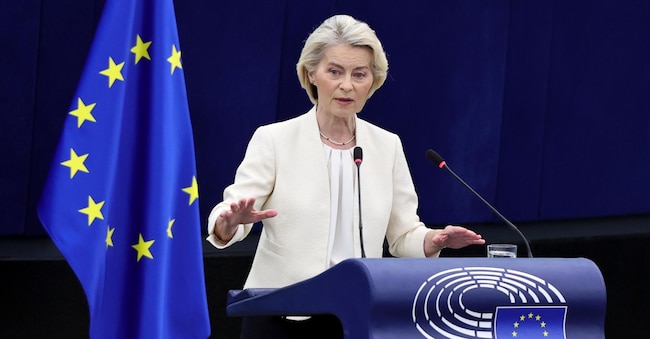
STRASBOURG – In an ‘openly hostile world’, the President of the European Commission, Ursula von der Leyen, today, Wednesday 16 September, presented a series of initiatives, all aimed at strengthening solidarity amongst Member States in the areas of climate, migration, security and new technologies. On this occasion, she announced her intention to strengthen cooperation with Canada, making the North American partner “the first country associated with the European Union”.
Ms von der Leyen told the European Parliament here in Strasbourg: ‘Do we want a strong and independent Europe, capable of defending its values around the world? Or shall we allow divisions and dependencies to hold us back? Do we want to unite around our European ideal, whereby we can decide our own destiny together? Or shall we allow our democracies to be undermined by the representatives and puppets of authoritarian regimes?’
From artificial intelligence...
The State of the Union address runs to 23 pages and covers a wide range of topics that are highly topical today, seeking to address the current challenges with approaches that are more community-based than national. On the subject of artificial intelligence, the President sees risks, but also opportunities. ‘We want artificial intelligence to create more value in a more responsible way, at a lower cost and with reduced energy consumption. But above all, we want artificial intelligence that leaves room for human action.’
The President pointed out that the AI Act is ‘a key element in putting safeguards in place’. She therefore proposed strengthening international cooperation, with ‘Canada, the United Kingdom and others’, to regulate this rapidly growing sector. The initiative comes at a time when there is debate, particularly in the United States, over whether to intervene to curb research and innovation, or instead to give free rein to new technologies which, it is feared, could backfire on humankind.


