
Europe aims at autonomy for access to space
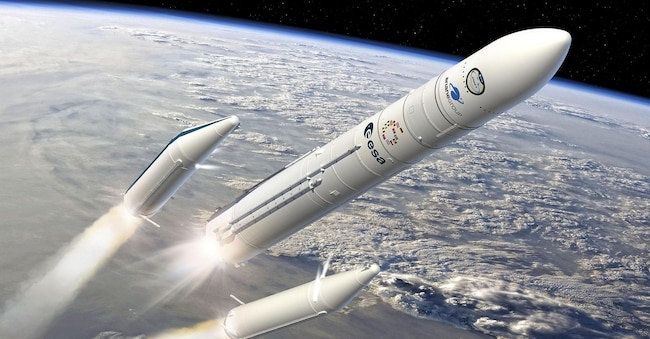
Ariane 6-4, upgraded with four developed engines, has proven that it can even carry some Kepler satellites into orbit

Key points
Europe is continuing its attempt to relaunch itself in the space field, following the important Esa interministerial meeting, November 2025 in Bremen, and the more recent 18th European Space Conference, January 2026 in Brussels.
In Bremen, the cornerstones were set for Esa in the near future, starting with the total funding of around EUR 22 billion, still little, but nevertheless the highest ever. The main objective, which has taken up the whole of 2025, is still the quest for autonomy in accessing space. Esa has always been at the top level as far as scientific satellites are concerned, but delays in the construction of the Ariane 6 heavy launcher and the stoppage of the Vega-C launcher, after the loss of the Ukrainian industrial partners, had led to a moment of deep crisis and to several European satellites being flown with SpaceX's Falcon.
The cost issue compared to Musk's Falcon
Now Europe, with Ariane 6-4, boosted by four engines developed in collaboration with the Italian company Avio, has proved that it can even put into orbit some Kepler satellites, the constellation of Jeff Bezos, the historical antagonist of Elon Musk and his Starlink. So good, even if the problem of cost remains: both launchers are not reusable and are expensive compared to Musk's Falcon, which last year made no less than 170 launches.
What is the role of Italia?
As a side note, we can say that Italia's commitment has also increased in financial terms, up to 3.5 billion, comparable with that of France, after Germany. This did not seem to be matched by a greater Italian presence in the designation of top positions in the Agency.
We have, however, brought home a possible Italian astronaut for the Artemis lunar missions, although it is not clear when the flight that will take the tricolour to the Moon will be, nor who will carry it.


