State of the Union

Europe, von der Leyen: no social media for children under 13. Canada becomes the first EU associate member

On AI: ‘We want it to create more value in a more responsible way, at a lower cost and with lower energy consumption. But, above all, we want artificial intelligence that leaves room for human action’

From our correspondent Beda Romano

Aggiungi Il Sole 24 Ore
ai preferiti su Google
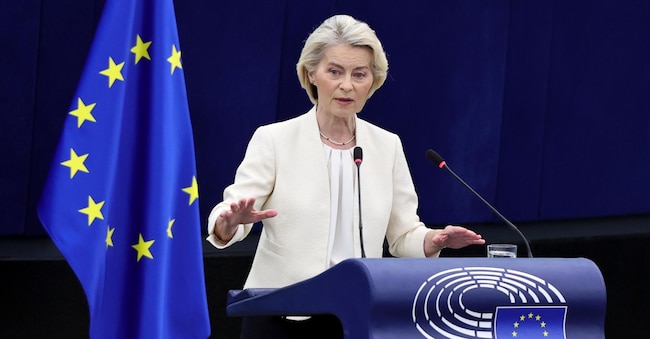
La presidente della Commissione europea Ursula von der Leyen mentre pronuncia  l’annuale discorso sullo Stato dell’Unione il 16 settembre 2027 dinanzi al Parlamento europeo a Strasburgo  EPA/RONALD WITTEK

4' min read

Translated by AI
Versione italiana

4' min read

Translated by AI
Versione italiana

STRASBOURG – In an ‘openly hostile world’, the President of the European Commission, Ursula von der Leyen, today, Wednesday 16 September, presented a series of initiatives, all aimed at strengthening solidarity amongst Member States in the areas of climate, migration, security and new technologies. On this occasion, she announced her intention to strengthen cooperation with Canada, making the North American partner “the first country associated with the European Union”.

Ms von der Leyen told the European Parliament here in Strasbourg: ‘Do we want a strong and independent Europe, capable of defending its values around the world? Or shall we allow divisions and dependencies to hold us back? Do we want to unite around our European ideal, whereby we can decide our own destiny together? Or shall we allow our democracies to be undermined by the representatives and puppets of authoritarian regimes?’

Loading...

From artificial intelligence...

The State of the Union address runs to 23 pages and covers a wide range of topics that are highly topical today, seeking to address the current challenges with approaches that are more community-based than national. On the subject of artificial intelligence, the President sees risks, but also opportunities. ‘We want artificial intelligence to create more value in a more responsible way, at a lower cost and with reduced energy consumption. But above all, we want artificial intelligence that leaves room for human action.’

The President pointed out that the AI Act is ‘a key element in putting safeguards in place’. She therefore proposed strengthening international cooperation, with ‘Canada, the United Kingdom and others’, to regulate this rapidly growing sector. The initiative comes at a time when there is debate, particularly in the United States, over whether to intervene to curb research and innovation, or instead to give free rein to new technologies which, it is feared, could backfire on humankind.

In this regard, Brussels intends to propose limits on the use of social media by young people. “We will adopt a gradual and differentiated approach,” explained Ms von der Leyen. Young people under the age of 13 will not be allowed to access social media. For those aged between 13 and 15, only ‘mini-accounts’ created and supervised by parents will be permitted, with limited functionality and time restrictions. For those aged between 15 and 18, platforms will be obliged to provide safe access.

...on the climate

On the climate front, following a scorching summer across much of the continent, the President of the European Commission has proposed setting up an alliance dedicated to climate risk insurance (Climate Insurance Alliance, in English). She also believes that Europe needs a European plan to combat heatwaves (Heatwave Plan, in English). According to the European Commission, this summer’s heatwave caused 35,000 additional deaths.

On the security front, Ms von der Leyen is convinced that the European Union must work to strengthen its defence systems. Brussels is set to present a European security strategy shortly. The model should be Article 4 of the North Atlantic Treaty, which states that ‘Member States may consult one another whenever, in the opinion of any one of them, the territorial integrity, security or political independence of any Member State is threatened’.
A future with Canada

As mentioned, the President of the European Commission has proposed that Canada become an ‘associated country’ of the EU. She told MEPs and the Canadian Prime Minister, Mark Carney, who was present in the chamber: ‘We see the world through the same lens: from artificial intelligence to climate change, from the Arctic to geopolitics. We believe that power does not belong to the strongest, the richest or those who shout the loudest, but to all of us.’ The reference is to the United States. The announcement prompted a standing ovation.

Loading...

There are currently numerous association agreements signed by the European Union (with countries such as Ukraine and those in the Mediterranean region), but the idea of allowing Canada to become an ‘associate member’ of the European Union seems to conceal a much deeper and broader partnership. On closer inspection, this is a response to the aggressiveness of the Trump administration, which in recent months has threatened to annex both Greenland and Canada.

To conclude, one final point taken from today’s speech in Strasbourg concerns relations with China. Brussels and Beijing are negotiating new forms of modus vivendi on trade and economic matters. ‘This dialogue,’ warned President von der Leyen, ‘must now lead to concrete results (…) Let me be clear: we will use every tool at our disposal to restore balance to our relations. Words are important, but actions are even more so.’

As mentioned, the State of the Union address comes at a delicate time. The energy crisis is jeopardising the economic future, whilst right-wing radicalism is on the rise in many countries. The President has kept her distance from these issues, not least because her own centrist majority is hanging in the balance, having shifted to the right on several occasions on issues such as the environment and immigration. In effect, her response was to propose a new Congress of Europe (the last one dates back to 1948), 70 years on from the signing of the Treaties of Rome.

Copyright reserved ©
Loading...

Brand connect

Loading...

Newsletter

Notizie e approfondimenti sugli avvenimenti politici, economici e finanziari.

Iscriviti