
European elections: Fdi at 28.8%, Pd at 24%, Fi ahead of Lega. Turnout under 50%. Europarliament: Ppe and right wing grow

Key points
- European elections: turnout at 49.6% with 430 sections to go
- France, Le Pen's party overwhelms, Macron collapses
- Italy, 40.8% of voters voted in the European elections
- Europe Elects: total turnout at 38.7%, down from 2019
- European, Europe Elects in 8 States: to the EPP 186 seats, S&d 136 and Renew 89
- Germany seat projection: 29 popular, 17 Afd, 14 Spd and 5 Bsw
- Exit poll Austria, far-right party in the lead
- In France turnout at 45.3% at 5pm, +2 points on 2019
Europe: EP group meetings start on 18 June
With the polls closed for the renewal of the European Parliament, the elected MEPs will have until 15 July to organise themselves into political groups within the Chamber. Indicatively, says the Euro Chamber, the constitutive meetings of the political groups will start on 18 June with the European People's Party (EPP). This will be followed on 19 June by the EU Greens, the Socialists & Democrats (S&D) and the Left will meet on 25 June. This will be followed by the Liberals of Renew Europe and the Conservatives and Reformists of Ecr on 26 June. Closing the list will be the Right of Identity and Democracy (Id) on 3 July. In order to form a group in the Europarliament, 23 MEPs from at least seven EU countries are needed. The new legislature will be kicked off by the first plenary session in Strasbourg from 16 to 19 July.
Meloni over 2.3 million votes, Decaro first among the Dems. Vannacci pushes League, Salis elected
The geography of the vote: Fdi, first in the North-East. Pd first in the South. Fi flies in Sicily.
Avs brings Ilaria Salis to the European Parliament. The centrists stay out
France elections: Bardella triumphs, Macron dissolves Chamber
Renzi: 'It went wrong, we will continue to fight for our idea of Europe'
"Nothing, it went badly. Unfortunately, the United States of Europe list narrowly missed out on the European Parliament. I am very sorry, and I would like to embrace the volunteers who put so much effort into this idea: you were wonderful. The gratuitousness of your service enlarges the heart. One by one, I would like to embrace the thousands of people who wrote my name on the ballot paper: I am truly honoured to still represent the hope of so many people even if I would have preferred a few more votes for the list'.
Matteo Renzi wrote this on social media. "I am grateful to Emma Bonino and to all the political leaders who believed in it. But politics is a great school of life even when you do not win. And so I cannot be sad dear friends. Because I am very convinced that it was right to make this proposal at this time: today's crazy world needs a United States of Europe and it was good to state the reasons for a dream against the tide. We fought, we expressed ideas in which we believe, we put ourselves on the line. We did not make the quorum, what a pity. But we will not stop fighting today for this idea of Europe, the only one in which Italy can play a leading role. We will find ways to insist on the cultural and values battle for a different Europe,' assures the leader of Italia viva.
"The absurd break-up of the Third Pole weighs on the Italian result: we could have had seven reformist MEPs together. Instead it is zero. What madness. But the citizens have chosen and the citizens are always right: I wish the elected representatives honouring their commitment in Strasbourg with my sincerest congratulations. We, from the Italian Parliament and from our roles of responsibility, will continue to do our part with the smile of those who know that it is better to risk and lose an election than to live and lose a challenge. That is how we are made - we men in the arena, Roosevelt would have said - and we will never change, not for anything in the world. Long live the United States of Europe! Good night, dear friends,' Renzi concluded.
The reactions and comments of the leaders of the main Italian parties
During the night, Meloni, Schlein, Tajani, Conte and Fratoianni commented on the result. They made an analysis of the results and the future prospects of their parties. The reactions are summarised in this article.
European elections: turnout at 49.6% with 430 sections to go
For the European elections, a total of 49.65% of the eligible voters voted when the data from 430 sections (61,220 out of 61,650) are still missing. So for the first time - according to Viminale data published on the 'Eligendo' portal - less than 1 Italian in 2 voted to elect MEPs. The 50% threshold was exceeded in the North-Western, North-Eastern and Central constituencies, but not in the Southern and Insular constituencies. In Rome, only 43.58% voted (but the 50% threshold was not reached even in the past European elections in the capital), while in Milan the 50% threshold was exceeded, but only just.
In the Baltics, the right does not break through, clear majority for the EPP-Renew
The European elections in the Baltic States saw the partial confirmation of the governing parties, favoured by a very low turnout (37.7% in Estonia, 33.7% in Latvia and 28.4% in Lithuania). In Estonia, the centre-right opposition party Isamaa gathered the most votes (21.5%), followed by the Social Democratic Party (19.3%). Only third, with 17.9% of the vote, was the Reformist Party of Prime Minister Kaja Kallas, followed by the Eurosceptic populists EKRE (14.9%) and the Centre Party (12.4%). In Latvia, New Unity, the party of Prime Minister Evika Silina, was confirmed in first place (25.1%), followed by the right-wing National Alliance (22.08%). Further behind were the liberals from For the Development of Latvia (9.36%), Lista Unita (8.18%), the centre-leftist movement The Progressives (7.42%), First Latvia (6.16%), the Social Democratic Party-Armonia (7.14%) and Latvia in First Place (6.16%). The elections also brought confirmation in Lithuania, where Premier Simonyte's Patriotic Union-Christian Democrats took first place with 20.9% of the vote. In second place were the Social Democrats with 17.64%, followed by the Alliance of the Agrarian Party and the Greens (8.96%), the Freedom Party (7.93%), the For Lithuania movement of former Prime Minister Saulius Skvernelis (5.84%), the Electoral Alliance of Poles of Lithuania (5.67%), the Fatherland and Justice League (5.35%) and the Liberal League (5.3%). The seats from the Baltic States will be added mostly to Renew (6) and the EPP (6), followed by S&D (5), ECR (4), Greens/EFA (3) and Identity and Democracy (1), while two seats remain unaffiliated.
Tajani: from FI extraordinary result dedicated to Berlusconi
'An extraordinary result, Forza Italia is growing compared to all the last elections. A victory that we dedicate to President Silvio Berlusconi, to all those who have never stopped believing in our flag. As of tonight, the centre-right and the EPP are stronger'. This was stated on social media by FI leader Antonio Tajani.
Projections: Fdi at 28%, Pd at 23.6%.
According to an average of early projections elaborated by YouTrend for Sky Tg24, Fratelli d'Italia is the most voted party in the European elections in Italy with 28% of the preferences. It is followed by the Partito Democratico with 23.6%. Third place for the 5 Star Movement with 10.8%, then Forza Italia at 10.1%. The League is at 8.4%, Avs at 6.8%. Sue at 3.9% and Action at 3.6%.
Meloni, Fdi confirms first party and overcomes politics
"Fratelli d'Italia is confirmed as the first Italian party, surpassing the result of the last political elections,". Prime Minister Giorgia Meloni writes this on social media, posting a photo in which she makes the victory sign with her hand.

Un'immagine pubblicata dalla premier Giorgia Meloni sul suo profilo Instagram, corredata dal seguente post: ''Fratelli d'Italia si conferma primo partito italiano, superando il risultato delle scorse elezioni politiche''.
The EPP rises again, Ursula majority to 409 seats
In the fourth projection on the composition of the next Europarliament, the European People's Party (EPP) rises again, compared to the previous projection, from the current 177 MEPs to 191. Compared to the previous projection, the Socialists (S&D) are stable at 135 seats, while the Renew Liberals rise to 83 MEPs. The Ursula majority thus reaches 409 seats.
Projections: Fdi at 27.2 per cent, Pd at 23.2 per cent
New estimate by YouTrend for Sky Tg24, average of Opinio, Tecné, Swg and Youtrend projections: Fratelli d'Italia 27.2%, Pd 23.2%, M5s 11.7%, Forza Italia 9.8% and Lega 8.4%.
European elections: historic drop in turnout, falls short of 50 per cent
At the close of polling stations, the turnout for the European elections was 49.49% when the data from 54,238 out of 61,650 sections arrived. So, for the first time, for the European elections less than one Italian in 2 went to vote. With the exception of 2004, when the final figure was 71.7 per cent, and 1999 with 69.8 per cent, turnout for the Europeans has seen a steady and progressive decline. In 2014, 57.22% of those eligible voted at the close of polling stations, while in 2019, when voting was only on Sundays, 54.5% went to the polls.
Centre-right opposition wins in Estonia
The centre-right opposition party Isamaa won the European elections in Estonia (21.5%), followed by the Social Democratic Party (19.3%). Only third, with 17.9% of the vote, was the Reformist Party of Prime Minister Kaja Kallas, followed by the Eurosceptic populists EKRE (14.9%) and the Centre Party (12.4%). Based on the results, Isamaa and the Social Democrats got two seats each, while the remaining three formations will each get one seat. The Estonian seats will mostly be added to the ranks of Renew (3). The remaining seats will be divided between S&D (2), Identity and Democracy (1) and the EPP (1).
Bonelli-Fratoianni, Ilaria Salis is an MEP
"We have heard many of them. We were accused of using candidates for instrumental purposes. We did well to act. Ilaria Salis is an MEP as of tonight'. This was said by Sinistra Italiana leader Nicola Fratoianni at the Avs election committee in Rome. 'From here we send a big hug to Ilaria, the battle for democracy starts today but it will be even stronger,' added Green Europe spokesman Angelo Bonelli.
Schmit, 'no collaboration with anti-EU forces'
"There is no possibility for us social democrats to collaborate with those who want to dismantle, to weaken this Europe we have been trying to build for decades". This was said by Nicolas Schmit, candidate of the European Socialists for the presidency of the EU Commission. "As the second largest group, which keeps the number of seats" it had "we are willing to negotiate an agreement for the coming years to make Europe stronger, more democratic, stronger, more social and stronger economically".
Metsola, 'the pro-EU centre has held, let's move forward together'
"We have to balance the impact of the results and the responsibility of the groups to find a majority. What we see is that the pro-European centre has held, and it is with that centre that we have to go on working." This was said by the President of the Euro Chamber, Roberta Metsola, speaking at the election marathon in the hemicycle of the Euro Chamber.
Conservatives win in Greece, detached Syriza
With 97% of the polling stations counted in Greece, the conservatives of Nea Dimokratia are at 28.04% and elect 7 MEPs. The main opposition force, Syriza, is at 14.94% (with 4 MEPs). It is followed by Pasok with 12.85% (it gets 3 representatives to the EU Parliament), the ultranationalists of Elliniki lisi ('Greek Solution') with 9.43% and 2 MEPs. The Kke communists obtained 9.28% and elected two representatives in Strasbourg. The ultra-orthodox party, Niki ('Victory in Greek') also gets one MEP with 4.40%, as does the populist party Plefsi eleftherias ('Route of Freedom') which secures one representative with 3.41% of the vote.
European elections: first data, turnout around 48%
For the European elections, at the close of polling stations at 11pm, approximately 48% of those eligible voted. This is what emerges from the first Viminale data published on the 'Eligendo' portal, which arrived almost an hour after the polling stations closed and related to less than half of the 61,650 sections. In the previous European elections, in 2019, the final turnout had been 54.5%.
Third Eurocamera projection, the EPP grows again
In the third projection on the composition of the next Europarliament, the European People's Party (EPP) grows again, from the current 177 MEPs to 189. Compared to the current composition of the hemicycle, the Conservatives also rise from 68 seats to 72. The Identity and Democracy (Id) group, on the other hand, is down by one seat, from the 59 seats it has held so far to 58, not counting the 17 AfD MEPs who are currently among the non-attached. The Socialists and Democrats (S&D) lose five seats, from the current 140 to 135, while the Greens go from 72 MEPs to 52. Sharp decline also for the Renew Liberals, from 102 to 80 seats. The projection also shows a patrol of as many as 98 MEPs among the non-attached and the 'others' still looking for a group, which could significantly affect the size of the individual constituencies that make up the hemicycle. The current Europarliament has 705 MEPs, which will rise to 720 in the new legislature.
Conservative opposition in Slovenia ahead
In Slovenia, the conservatives of the Democratic Party (Sds), the main opposition force led by former Prime Minister Janez Jansa, won four MEPs out of the former Yugoslav country's total of nine in the European Parliament, while two went to Movimento Libertà, the liberal party of Prime Minister Robert Golob. One seat each went to New Slovenia (Christian Democrats), Vesna/Verdi, and the Slovenian People's Party. The Social Democrats and Left (Levica), who support the majority coalition, remained empty-handed. The figure is based on the counting of a little more than half of the ballots, as reported by the president of the National Election Commission, who explained that the counting of ballots was proceeding slowly, as the ballots for the referendum questions were counted first.
Setback for Orban,first at 43.7% but down 8%
Setback for Hungarian Prime Minister Viktor Orban in the European elections. Fidesz, Hungary's ruling party, came first with 43.7 per cent of the vote but down about eight percentage points from five years ago. Tisza, the party of former Fidesz leader Peter Magyar, who in a few weeks has become the rising star of the opposition in the country, won 31.07% of the vote.
European elections: YouTrend-Sky estimate, Fdi 22 seats, Pd 18
According to an initial estimate by YouTrend for Sky Tg24, Fratelli d'Italia would take 22 seats in the European Parliament, compared to 18 for the PD. The 5 Star Movement would take home 10 seats, Forza Italia and Lega 7, Avs 6, Sue 5, Svp 1. No seats, according to first estimates, for Azione.
Instant YouTrend-Sky: European elections; Fdi at 26.5%, Pd at 23%.
In the first exit poll for the European elections 2024 Fdi is the first party with 26.5%, followed by Pd with 23%. These are the instant/Prevision Youtrend - Sky TG24 data. Third party is the 5 Star Movement with 12.5%. In the centre-right, Fi at 9.5% is ahead of the League, which reaches 9%. For the other parties, Avs at 5.5%, Sue 4.5% and Action at 3.5%.
EU Greens, commitments on Green Deal to support von der Leyen
"The Green Deal and the strengthening of European democracy will be crucial for us. If the European Council puts forward Ursula von der leyen's name for a second term at the head of the European Commission this must be at the heart of what she wants to achieve but we need commitments from her to get our support". This was stated by EU Green co-chair Philippe Lamberts, speaking in the hemicycle of the European Parliament in Brussels. Lamberts admitted that from the first results "tonight is not a victory for the Greens, but the Green Deal would not have happened" without the group, he said, appealing "to democrats, conservatives and liberals" not to turn to the far right to seek "stability" for a majority.
Analysts, Cdu-Csu wins due to weakness of the centre-left
The victory of the German Christian Democratic and Social Union (Cdu-Csu) in today's European elections in Germany is also due to the poor reputation of the left-of-centre coalition consisting of the SPD, the Greens and the FDP, even though confidence in the political capabilities of the main opposition party is also low. This is the result of an analysis by the demoscopic research institute 'Forschungsgruppe Wahlen' summarised by the Dpa agency. According to this analysis, the poor performance of the coalition parties has harmed them: 66% of the citizens are dissatisfied with the federal government. However, only 30% believe that the Cdu-Csu - if it were in government - would do better. On a personal level, the Union also fails to convince: neither Cdu president Friedrich Merz nor Csu leader Markus Söder can clearly distinguish themselves from chancellor Olaf Scholz (SPD) in terms of reputation.
EU Socialists, 'no coalition with ultra-right Ecr-Id'
"We absolutely respect the principle of the Spitzenkandidat". This was said by the Vice-President of the EU Socialist Group, Pedro Marques, congratulating Ursula von der Leyen, when commenting on the European election projections. Now 'the important thing is to shape a programme for the Commission' that works for us. "We are talking about policies and it is on this that our support for the Commission presidency will depend. It is crucial that there is no coalition with the extreme right: no coalition with Ecr and Id. Should other groups be called to the negotiating tables, they must be pro-European and democratic'.
EPP, 'we invite Socialists and Renew to a pro-EU alliance'
"The EPP is again the largest group in the EP, we won the elections and among the main parties we are the only ones who have grown. Our candidate is Ursula von der Leyen, she did a great campaign'. This was said by Manfred Weber of the EPP, speaking from the hemicycle of the Euro Chamber. "The question is what the majority will be, and I invite the Socialists and Renew to join us for a pro-European alliance," Weber added, calling for "respecting the results of the European elections" in the composition of the EU top jobs.
Renew, 'no pro-EU majority will be possible without us'
"Renew europe is once again the third group in the Eurochamber and an important group for the future of European governance. No pro-European majority will be possible without Renew Europe, we will be at the centre of the majority to come'. This was said by Renew Europe Vice-President Iskra Mihaylova, speaking at the election marathon in the Euro Chamber. "Let's not talk about names yet, it's too early, but in the near future after the group is established we will decide how to work with a pro-EU majority," Mihaylova explained, responding to a question about Renew's possible support for a possible encore of Ursula von der Leyen at the helm of the EU Commission.
Ursula majority at 401 seats, the only one viable at the moment
Ursula's majority, according to the second projection released by the Euro Chamber, is at 401, a reassuring margin compared to the necessary threshold of 360 MEPs. In fact, the EPP is on its way to taking 186 seats, nine more than the current number. The Socialists could take 133, seven fewer than the outgoing EP. The Liberals, on the other hand, have suffered the most obvious drop, falling from 102 to 82 seats. Compared to the composition of the outgoing EP, the majority composed of the EPP, Socialists and Renew loses 18 MEPs, but remains the only viable option: if, in theory, the EPP were to turn exclusively to the Ecr and Id groups (together they would reach 130 MEPs, to which the delegations of Fidesz and Afd would have to be added), the threshold of 360 would not be reached. Similarly, even an (unlikely) alliance between the EPP, Conservatives and Reformists and Liberals would be far from a majority, reaching 318. To this pattern, however, must be added the main numerical novelty coming from the projections of the European results, the large front of non-attached members. This would be a patrol of 100 elected members, some of whom - like the Germans of Afd or the Orbanians of Fidesz - certainly belong to the extreme right but others, like the Dutch Farmers' Party or the opposition coalition in Hungary, very close to joining the Populars. In short, the right-wing and far-right front can count as mentioned on 130 seats, plus Afd's around 17 and those that Fidesz will gain. To them must be added some small ex novo parties, such as the Cypriot extreme right and the Romanians of Aur. But the front of the pro-Ukraine parties remains firm: to the Ursula majority must be added the Greens, a firm supporter of aid to Kiev. The Greens can count on 53 seats, nineteen fewer than the 72 in the Parliament that is about to close its doors.
European elections: Belgium, Prime Minister De Croo announces resignation
"Tomorrow I will resign as prime minister". This was announced by Belgian Prime Minister Alexander De Croo, admitting the defeat of his party Flemish Liberals and Democrats (Open Vld) in the European elections. With almost 90 per cent of the votes counted, Open Vld is currently at 5.9 per cent in the federal elections (8.1 per cent in the regional elections), down 2.7 per cent and 5 per cent respectively from the previous elections. "But the Liberals are strong, we will be back," he added. It is the practice in Belgium that after elections the prime minister submits his resignation so that the king can start talks to form a new government. De Croo should then serve as interim prime minister.
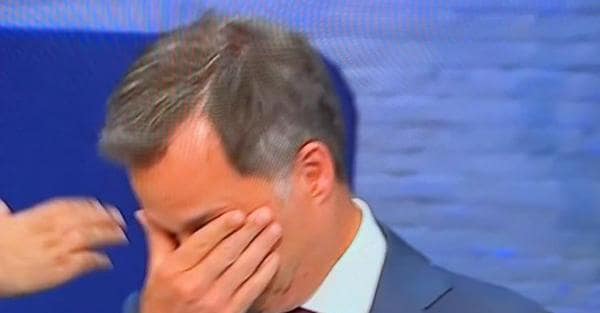
“Da domani sarò un premier dimissionario". Lo ha detto il capo del governo belga Alexandre De Croo alla luce dei risultati delle elezioni legislative nazionali che si sono svolte insieme alla consultazione per l'Europarlamento. L'annuncio è stato fatto da un De Croo visibilmente emozionato che si è addirittura asciugato le lacrime mentre parlava alla platea dei militanti liberali del suo partito della sconfitta elettorale subita e delle sue conseguenze (foto X/ EL PREGONER)
Vox celebrates advance of sovereignist forces and Le Pen victory
Vox's spokesman José Antonio Fuster celebrated the 'undoubted advance' of the 'patriotic and sovereignist European forces' and highlighted above all the victory of French far-right leader Marine Le Pen, who led France into early elections. "I wish others would follow the same path here in Spain," Fuster claimed in statements to reporters at the national headquarters of the party led by Santiago Abascal. The spokesman would not comment on exit polls that would confirm Vox as the third political force, with around 10 per cent and between six and eight seats. He claimed that French President Macron "understood that this is not the way to govern in France", after the affirmation of Le Pen's party, and called on Socialist Prime Minister Pedro Sanchez to follow suit and call early elections in Spain.
Ecr, 'dialogue with von der Leyen? Will depend on the programme'
"In the past nothing has prevented us from talking to Ursula von der Leyen, it all depends on the programme." This was said by the vice president of the Ecr group in the European Parliament Assita Kanko. "Another important thing is to wait for the final results," she added. To the group of European Conservatives and Reformists belongs Fratelli d'Italia.
Successful alliance of social democrats and liberals in Romania
In Romania, the polls closed at 10 p.m. local time (9 p.m. Italian time) for the European elections and the administrative elections, with a turnout of over 50% (one hour before the polls closed). There was a clear victory for the National Coalition (Cn) formed by the Social Democrats and the Liberals, who, according to the first exit-polls, collected around 54% of the preferences. In second place, however, the extreme right-wing Aur party trailed by 40 percentage points (14%).
From France to Germany to Austria: the extreme right celebrates
In France, Marine Le Pen's party, led by Jordan Bardella , overcame and demanded and won new legislative elections. In Germany, the Cdu holds, but the Afd is the second party. In Austria, on the other hand, relative success went to the nationalist FPÖ party with 27% of the vote. Here are images.
Weber, 'von der Leyen will still lead the EU, it is up to us to decide'
The European People's Party wants 'a democratic Europe' and 'this means that the winner of the elections now has the right to appoint the president of the European Commission', which 'for the next five years will be Ursula von der Leyen'. This was said by the president of the EPP, Manfred Weber, at the party's election evening at the Stanhope hotel in Brussels. "The big worry was that many politicians would come to the Euro Chamber who want to destroy our Europe" but "looking at the figures I am proud of the strong EPP, this is the best message against the extremists," Weber stressed.
The turnout for the European elections at 51%.
The turnout for the European elections stood at 51% compared to 50.7% in 2019. This was announced by EP spokesman Jaume Duch, pointing out that data from some countries including Italy were still missing.
In Germany likely record turnout
The turnout in the European elections in Germany may have been the highest ever since reunification. According to 8.35 p.m. projections released by the Dpa news agency, between 64.0 and 65.0 per cent of the eligible voters went to the polls. In the first European elections in unified Germany in 1994, the turnout had been exactly 60.0 per cent, while in subsequent elections it had fallen to between 40 and 50 per cent. The turnout in 2019 was 61.4 per cent.
Conservatives win European and legislative elections in Bulgaria
In Bulgaria, the Gerb conservatives won both the European and parliamentary elections, which were held together today. Tonight's early parliamentary exit polls, the sixth in three years, again portend difficulties in the search for a solid political majority and a stable government in the Balkan country. Predictions of a clear victory for the Gerb, the conservative party of its leader Boyko Borissov, which has ruled Bulgaria for almost ten years in the past, are confirmed.
Ultra-right Sweden retreats but does not lose seats in the Euro Chamber
In Sweden, the moderate party (which is in the EPP) rises to 17.3% (16.83% and 4 seats in 2019). The Christian Democrats (in the EPP) drop to 6.1% (8.62% and 2 seats in 2019), while the Liberals (in Renew) remain essentially stable at 4.2% (4.13% and 1 seat in 2019). The EPP and Renew thus reserve 5 and 3 seats respectively in the Euro Chamber. The three parties are in government with the external support of the Sweden Democrats, an ultra-right-wing formation in the Ecr group, which for the first time sees its steady growth in an election come to a halt: Sd is projected at 13.9% with a projection of 3 seats in the Euro Chamber (up from 15.34% and 3 seats in 2019). The Social Democrats go to 23.1% with 5 seats (up from 23.48% and 5 seats in 2019. The Greens go to 15.7% (3 seats). Left at 10.7% (2 seats).
Second EP seat projection, EP holds, S&D falls
According to the second projection on the composition of the next Europarliamentary assembly that has just been released, the People's Party would rise from the current 177 MEPs to 186. The Socialists, on the other hand, would fall from the current 140 MEPs to 133 and the Renew Liberals from 102 to 82. The Ecr conservatives would grow from 68 to 70 and the ID sovereignists from 59 to 60. For the Greens the decline would be from 72 to 53 and for the EU Left from 37 to 36. But the projection also shows a patrol of as many as 100 MEPs among the non-attached and the 'others' still looking for a group, which could significantly affect the size of the individual constituencies that make up the hemicycle.
The projection is based on the partial results of 15 countries. Namely Austria, Bulgaria, Croatia, Cyprus, Denmark, France, Germany, Greece, Malta, the Netherlands, Poland, Portugal, Romania, Spain and Sweden. For a more complete picture, data from Belgium, the Czech Republic, Estonia, Finland, Hungary, Ireland, Italy, Latvia, Lithuania, Luxembourg, Slovakia and Slovenia are still missing.
Le Pen, ready to come to power
'It is a real thrill to see this great popular force rising up across the country', 'the president (Emmanuel Macron ed.), responding to Jordan Bardella's call, announced the dissolution of the National Assembly. I can only welcome this decision', 'we are ready to exercise power if the French have confidence in us'. Thus Marine Le Pen, leader of the French far-right, speaking after Emmanuel Macron announced the calling of legislative elections in France following the results of the European elections. In today's vote, Marine Le Pen's far-right Rassemblement National (RN) party, with Bardella as its leader, came in first place, garnering around twice as many votes as Macron's party.
Germany, new projections confirm first
Infratest dimap projections of 8.37 p.m. released by the Tagesschau website, the news programme of the first public channel Ard mark deviations of less than one point from the first ones and confirm that the Cdu-Csu would get 30.3%, the Afd 16.0%, the Spd 13.9 and the Greens 11.9%. Among the other parties, the Bsw is now expected to get 6.0%, the Fdp 5.0% and the Linke 2.7%. For the distribution of seats, Ard projections at 21:17 essentially confirm those of 18:57, denoting only a gap of one more seat for the German Christian Democratic Party, which raises the Cdu-Csu Union to 30.
Macron, 'France needs a clear majority'
"France needs a clear majority in order to act in serenity and concord," said Emmanuel Macron, after he surprisingly announced the dissolution of the National Assembly. Elections will be held on 30 June and 7 July, the president announced in this historic message to the nation after the victory of the Rassemblement National nationalists in the European elections.
In Poland Tusk ahead of the Pis sovereignists
In Poland, Tusk's Civic Coalition (Ko) is ahead of Law and Justice (PiS) in the first exit polls of the European elections: Populars at 38%, Conservatives at 33.9%.
Macron calls elections
French President Emmanuel Macron took the floor to announce - immediately after the announcement of the European results - the dissolution of Parliament and the convocation of new elections on 30 June and 7 July.
Populars first in EU, Ursula majority holds
First projection of the new European Parliament: first the European People's Party, second the Socialists, third the Liberals. The Ursula majority currently holds despite the Liberals' sharp decline, thanks to the growth of the Populars and the Socialists' substantial hold. To the EPP go 181 seats (from 176), to the Socialists 135 (from 139), Renew Europe (Liberals) 82 (from 102), Ecr 71 (from 69), Identity and Democracy 62 (from 49), Unaffiliated 51. As for the Italian parties, it should be noted that Fratelli d'Italia is in the Ecr group while the Lega is in Identity and Democracy.
France, Jordan Bardella calls for early elections
Jubilation at the headquarters of the Rassemblement National, Marine Le Pen's party, where sympathisers jump to the rhythm of the chorus 'on a gagné', 'we have won', after the first exit polls were released showing the party clearly in the lead, 16 points ahead of Renaissance's Macronian. "A wind of hope has risen over France and it is only just beginning": so Jordan Bardella, candidate of the Rassemblement national (RN), who, according to the first projections, would have obtained more than 30% of the votes. 'The French have given their verdict and it is final,' he added, emphasising the 'desire for change' in the country. After the first results gave him a clear lead with more than 30% of the vote, Jordan Bardella of the Rassemblement national (RN) called on French President Emmanuel Macron to dissolve the National Assembly and demanded 'to organise new elections'. "The president cannot remain deaf to the message sent by the French people tonight," he added in a short speech from the RN headquarters.
Spain, exit polls: Pp ahead, Psoe holds, Vox grows
In Spain, according to exit pools, the Pp is ahead of the Psoe. The Populars get 21-23 seats, the Psoe 20-22, and Vox 6-7. According to the exit polls of the Spanish public TV station Tve, in Spain the Popular Party would be in the lead with 32.4% of the vote, equal to 21-23 seats, up sharply from the current 13. The Psoe of Pedro Sanchez is holding on, with 30.2% of the vote, and a range of 20-22 seats compared to the current 21. Vox grows with 10.4% of the vote, equal to 6-7 MEPs, at least two more than the current 4. Yolanda Diaz's Sumar would have collected between 3 and 4 seats and Podemos between 2 and 3 seats.
According to exit polls, Ahora Repúblicas, a coalition composed of the nationalist parties of Catalonia, the Basque Country and Galicia, Erc, EH Bildu and Bng, would get 4.3%, equal to 2-3 seats. The list of the anti-system Alvise Pérez, Se Acabó la Fiesta, would get 3.9% of the vote and could get 2-3 seats. Junts, the party of Carles Puigdemont would get 2.1% of the vote, dropping from 3 to 1 seat. Ciudadanos would leave the Euro Chamber.
France, Le Pen's party overwhelmingly wins: doubled Macron
Le Pen's party wins in France, Macron collapses. According to the first exit polls, Jordan Bardella and Marine Le Pen's Rassemblement National (31.5%) would double the votes of Renaissance (15.2%) and thus of Valérie Hayer, President Emmanuel Macron's majority candidate. In contrast, Raphaël Glucksmann (Socialist Party-Place publique) would get 14%. France insoumise led by Manon Aubry would get 8.7 per cent while François-Xavier Bellamy (Les Républicains) would get 7.2 per cent. Marion Maréchal (Reconquête), would get 5.5%. Marie Toussaint (Europe Ecologie-Les Verts) would follow with 5.2%. Turnout is up at 52.5%, 2 points higher than in 2019. This is according to Ipsos estimates for France Televisions, Radio France, France 24/Rfi, Public Senat/Lcp.
Italy, 40.8% of voters voted in the European elections
For the European elections in Italy, 40.84% of the eligible voters have voted so far. This is what emerges from Viminale data published on the 'Eligendo' portal and relating to 61,366 sections out of 61,650. The turnout at 12 noon was 25.1 per cent.
Europe Elects: total turnout at 38.7%, down from 2019
The aggregator Europe Elects estimates the total turnout recorded so far in the EU-wide European elections (excluding Greece) at 38.7 per cent. This is, according to Europe Elects' estimates, 0.5% lower than in 2019, when the highest final turnout since 1994 was recorded.
Malta estimates: 3 seats to S&D and 3 to Ppe
According to estimates released by the European Parliament, based on exit polls and other unofficial data published in the respective countries, the 6 seats that Malta is entitled to in the Strasbourg Chamber for the 2024-29 legislature would be equally divided: 3 to the S&D (Labour Party) with 44.67% of the votes, the other 3 to the Ppe (Partit Nazzjonalista) with 42.52%. Malta is the smallest country in the EU; the President of the European Parliament, Roberta Metsola (Ppe) is Maltese.
Germany, Spd president: Scholz remains chancellor
Despite the disaster for the SPD in the European elections, Olaf Scholz will remain chancellor, as social democratic party co-chairwoman Saskia Esken declared. "The Federal Chancellor is the head of this government, which we formed together with three parties, and he will continue to be," Esken told the first public channel Ard as reported by the Dpa news agency. 'He has our full confidence. The SPD is united, and you can count on that,' the social democratic leader said again.
Croatia estimates: 6 seats to the EPP, 4 to S&D
The Hdz, a centre-right party affiliated with the EPP, has reportedly won half of Croatia's seats in the European Parliament for the 2024-29 term. According to estimates published by the European Parliament, based on exit polls and other unofficial data, the 12 Croatian seats would be divided as follows: EPP 6, S&D 4, Greens/Ale 1, others 1. The category others includes the newly elected not affiliated with any EU political group. The Hdz would get 33.7%, the Koalicija Sdp (centre-left) 27.8%.
Bulgaria estimates: 6 seats to Ppe, 5 to Renew, 2 to S&D
According to estimates published by the European Parliament, based on exit polls and other unofficial data, Bulgaria's 17 seats in the Chamber for the 2024-29 legislature would be divided as follows: Ppe 6, Renew 5, S&D 2, others 4. The category others includes the newly elected not affiliated to any EU political group.
Greece estimates: 8 seats to the EPP, 4 to the Left, 3 to S&D
Nea Dimokratia, the party of Prime Minister Kyriakos Mitsotakis affiliated with the European People's Party (EPP), is reported to have won 30 per cent of the vote in today's European elections in Greece, taking eight of Athens' 21 seats in the European Parliament. This is according to estimates published by the Parliament in Brussels, based on exit polls and other unofficial data. The Left, with Syriza, would have won 4 seats (16.8%), while the S&D (Pasok, 12.4%) would have taken 3. The remaining seats are divided between Ecr (2), Non-attached (2) and Others (2). The category Others includes the newly elected members not affiliated to any EU political group; Non-attached are members of political forces already present in the Chamber but not belonging to any group, such as Kke, the Communist Party of Greece.
Von der Leyen: right and left-wing extremists punished
'The people have punished the extremists of the right and the left'. This was said by the leading candidate of the European People's Party, Ursula von der Leyen, speaking by video link to the representatives of the Christian Democratic Union gathered in Berlin, after the first exit polls of the European elections in Germany that see the Cdu-Csu in the lead with 29.6% of the votes.
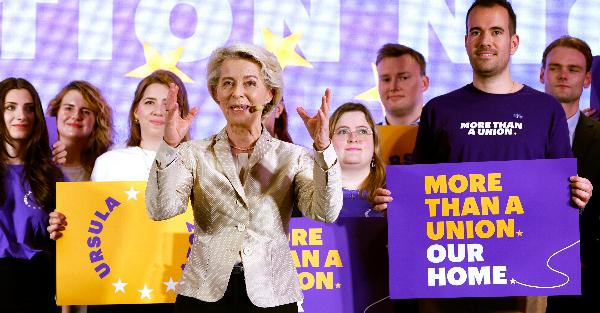
L’attuale presidente della Commissione europea (e principale candidata) Ursula von der Leyen, nella sede del Ppe a Bruxelles (Associated Press / LaPresse)
In Italy at 19.2% turnout
For the European elections at 7pm, 39.2% of the eligible voters voted. This is what emerges from the first Viminale data published on the 'Eligendo' portal and relating to about half of the 61,650 sections. The turnout at 12 noon was 25.1%.
Europe Elects: at 19.7% total turnout
According to an estimate compiled by Europe Elects, an independent aggregator of election data and forecasts, the total turnout recorded so far across the EU is 38.7% (excluding Greece). This represents a decrease of 0.5 points compared to 2019, when the highest final turnout since 1994 was recorded.
IL PARLAMENTO EUROPEO DAL 1979 AD OGGI
Loading...Austria estimates: 6 seats to Id, 5 each to S&D and Ppe
The extreme right-wing Fpoe (Identity and Democracy Group) would be in the lead in the results of the European elections in Austria, according to estimates released by the European Parliament a short while ago, based on exit polls and other unofficial data published in the member states. Vienna's 20 seats in the European Parliament would be distributed as follows: six to Id, five each to S&D and Ppe, two each to Greens/Ale and Renew. The Fpoe would get, according to these estimates, 27% of the votes, followed by the Oevp Populars (23.5%) and the Spoe Social Democrats (23%); the Gruenen are at 10.5%, as are the Neos Liberals.
In Greece 4 parties risk not exceeding 3 per cent
According to exit polls released at the close of the polls in Greece, there are four parties that might not pass the 3% threshold. The ultra-conservative party Niki ('Victory' in Greek), is given between 2.9 and 4.9 per cent, the populist Plefsi Elefetherias (Route of Freedom) is between 2.6 and 4.6 per cent; Mera25, founded by former minister Yanis Varoufakis, is given between 2 and 3.4 per cent. The 'patriotic' party Fonì Logikìs ('Voice of Reason'), is given between 2.2 and 3.6 per cent. Also according to the exit polls, the Nea aristerà (New Left) party, born from the split with Syriza after the election of its leader Stefanos Kasselakis, is not expected to enter the Europarliament and is given between 1.3% and 2.7%.
Second Europe Elects projection: Ursula majority holds
According to the second projection of the European elections by Europe Elects, an independent aggregator of polls and data, with the first post-election results from eight countries, the centre-right of the PPP is projected at 186 seats, up 8 from the +6 in the first estimate. S&D's centre-left goes to 136 (-4), Renew's Liberals go to 89 (-13, they were -14 in the first estimate). The Conservatives of Ecr have 73 seats (+5). The Right of Id 67 (+8), Greens/Ale 55 (-17, was -16 in the first projection), Left goes to 34 (-3, was -1 in the first estimate). Unchanged from the first projection are the non-attached: 80 seats (+31). With these figures, the current Ursula majority could count on 411 seats out of the total 720 in the Eurochamber, well above the majority.
Exit poll, in Holland Labour-Greens lead over Wilders
The Labour-Green coalition led by Frans Timmermans is ahead of the extreme right of Geert Wilders in the European elections in the Netherlands. According to exit polls released by the European Parliament and processed by Ipsos, the pro-European alliance would gain 8 seats compared to the 7 assigned to the Party for Freedom (PvP). The exit polls confirm what was indicated immediately after the Dutch vote on Thursday.
Exit poll, in Slovakia Fico party second, opposition in the lead
In Slovakia, according to early forecasts, the left-liberal opposition party Progressive Slovakia could count on almost 28% of the votes. This would be three percentage points more than the left-wing populist party Smer (Direction) of Prime Minister Robert Fico. In third place is the far-right nationalist party Republika with 12.5%, followed by the left-wing party Hlas (Voice) at 7%. The Slovak National Party (SNS), also in government, falls in the forecasts and does not even reach two per cent. The elections in Slovakia were overshadowed by the assassination attempt on Prime Minister Fico, who was severely injured by multiple gunshots in mid-May.
European elections: 38.35% turnout in Spain, 11 points lower than in 2019
In Spain, the turnout recorded up to 6 p.m. for the European elections was 38.35 per cent; postal votes are not counted in the total. This is a drop of 11.09 points in participation compared to 2019. However, it should be considered that the previous electoral round coincided in the Iberian country with voting for municipal and regional elections. At 2 p.m., the turnout stood at 28.01%, 6.73 points lower than in the last round.
European elections: Macron meeting at the Elysée Palace from 7.15pm
Meeting this evening at the Elysée Palace for the announcement of the European election results. According to Bfm TV, President Emmanuel Macron will follow the situation from 7.15pm alongside the Prime Minister, Gabriel Attal, and the Interior Minister, Gérald Darmanin. The latest polls before yesterday's electoral silence confirm an unbridgeable gap between the probable winners, the Rassemblement National of Jordan Bardella, Marine Le Pen's dauphin (33%) and the Macronians of Renaissance, led by Valérie Hayer (14.50%).
German Green leaders: 'No reason to be happy'
"There is no reason to be happy tonight". This was said by the federal head of the Greens, Omid Nouripur, commenting on the result of the German Greens in the European elections, which according to exit polls only took 12% compared to 20.5% in 2019. "We did not run this election campaign with this goal in mind and together we will work it out," co-chair Ricarda Lang added.
Europeans, Europe Elects on 8 States: to the EPP 186 seats, S&d 136 and Renew 89
New seat allocation projection of the polling aggregator Europe Elects for 8 states: EPP: 186 (+8), S&D: 136 (-4), Renew Liberals: 89 (-13), ECR Conservatives: 73 (+5), ID Sovereignists: 67 (+8), Greens/ALE: 55 (-17), Left: 34 (-3) and Non-Republicans: 80 (+31).
Germany, Afd leader sings victory: 'Record result'
"The game is over and we have a super result, a record result. We have almost 50 per cent new voters in Europe'. This was said by Tino Chrupalla, the leader of Germany's Afd ultra-right, commenting on the first exit polls, which give Afd overtaking the Social Democrats on 14 with 16.5 per cent. "We are ahead of the chancellor's party, ahead of the Greens and the Fdp liberals. And we also want to win the next elections in Germany,' he added.
Germany, general secretary of the SPD: 'Tough defeat'
The general secretary of the SPD, Kevin Kuehnert, spoke of a 'tough defeat' for the German Social Democratic Party, which is nevertheless intent on 'getting back on its feet'. "We are of course grateful to the voters who gave us confidence. However, we will not try to find small successes that perhaps do not even exist, but for us today it is a tough defeat," Kuhnert told Germany's first public channel. 'We will have to address the question of where we were not effective in our mobilisation. We addressed issues that, according to your election polls today, worried many people: peace and social justice, and yet the numbers, as you have shown, are these. This means we have to look for our mistakes,' he added. "However, we will not get depressed, but the promise is that we will come back, we will rise again. We will face this fall with our heads held high."
Poll projection Germany: 29 Popular, 17 Afd, 14 Spd and 5 Bsw
First projection of seats for Germany according to exit polls by Infratest dimap: Cdu-Epp: 23 + 6 of Csu, Afd: 17, Spd-S&D: 14, Greens: 12, Bündnis Sahra Wagenknecht: 5, Fdp-Re: 5, Linke-Left: 3, Volt-G/Efa: 3, Fw-Re: 3.
In Cyprus centre-right in the lead, the surprise is the youtuber Fidias
The centre-right is ahead in Cyprus in the European elections according to the first exit polls. The Christian Democrats of Disy (Ppe) are first, in a range between 25.5 and 28.5%, followed by the Marxist-Leninists of Akel (The Left), between 23 and 26%. In third place was the real surprise of the elections on the Mediterranean island: between 12 and 15 per cent stood Fidias Panagiotou, a youtuber who is very famous in Cyprus and who stood without any list at the polls, as a totally independent candidate. The Diko and Edek parties - both in the S&D group in the Euro Chamber - are stuck in fourth and fifth place: the former is between 7.5 and 10.5 per cent, the latter between 3.5 and 5 per cent. They are followed by the ultra-Europeans of Volt, who according to exit polls are between 3 and 4.5 per cent. At the tail end is Democratic Alignment (Dipa), which sits among the Liberals in the EP and would not go beyond 3.5 per cent. Cyprus is entitled to six seats in the Euro Chamber.
Scholz's coalition collapses, far-right gains
All three parties in the coalition led by German Chancellor Olaf Scholz lost ground in Sunday's European parliamentary elections, while the far-right Alternative for Germany made solid gains, according to an exit poll published by public broadcaster Ard.
Among the coalition partners, the Greens fell the most, as expected, dropping to 12% from 20.5% in 2019, dealing them a severe blow ahead of next year's national elections. Scholz's Social Democrats fell from 15.8% to 14%, while the pro-business Free Democrats dropped from 5.4% to 5%.
As expected, the Conservatives came in first place with 29.5 per cent, up from 28.9 per cent in 2019, while the Afd is in second place with 16.5 per cent, up from 11 per cent.
Exit polls in Greece: conservatives in the lead, followed by Syriza
Polls closed in Greece: exit polls give the conservatives of Nea Dimokratia (member of the European People's Party) between 28 and 32% in the lead. They are followed by Syriza (of the Left Group in the European Parliament) between 15.2 and 18.2 per cent.
According to exit polls at the close of the polls in Greece, the socialist Pasok party would be in third place, between 13.9 and 10.9. They are followed by the Kke communists (between 10.3 and 7.9) and the far-right party Elliniki lisi (Greek Solution) given between 10 and 7.6 per cent.
"The first fact is that the increase in abstention should be worrying," government sources told Kathimerini after the exit polls were announced at the close of the polls in Greece. According to the latest available data, at 5.30 pm local time, an hour and a half before the polls closed, the turnout reached 32.9 per cent. Government sources speak of 'an important victory, the biggest in scope in the history of European elections for Nea Dimokratia; more is expected from the final assessment of the election results,' the sources report.
Cdu-Csu first in Germany, Afd second overtaking Spd
Cdu-Csu first in Germany, Afd second overtakes Spd according to the first exit polls at the close of the polling stations. The Cdu is ahead with 29.5% (it was at 28.9% in 2019). They are followed by the ultra-right Afd with 16.5 (11%), the Spd with 14 (15.8), the Greens with 12% (20.5%), Fdp with 5% (5.4), BWS (Sara Wagneknecht's new movement) with 5.5%, and the Linke with 2.8. This is what emerges from the exit polls published by the public broadcaster Ard
First estimates of the European Parliament for 6 countries around 18.15
The European Parliament will release the first estimates of the results of the elections, concerning six member states, around 6.15 p.m. These are Austria, Cyprus, Germany, Greece, Malta and the Netherlands. The estimates are prepared by Verian on the basis of exit polls, estimates or other unofficial data published in the countries concerned. For the first projections on the basis of real data, we will have to wait until the polls close in Italy at 11pm.
The Id group will not comment on the projections in the Eurochamber
The Identity and Democracy group will not be on stage in the Eurochamber hemicycle to comment on the first projections of the European elections. In the list communicated by the EU Parliament spokesman Jaume Dauch to the audience of journalists, representatives of all groups of the European Parliament were mentioned, with the exception of the group in which the Lepenists and the League sit. The group representatives will speak from 9.30 p.m. onwards. Immediately afterwards, the Spitzenkandidat, the candidates indicated by a party as the voters' first choice in the event of victory in the European elections, will arrive in the Eurochamber chamber.
In Croatia, turnout only 15.5% at 16.30
It is the low turnout that is marking the European elections in Croatia, where until 4.30 p.m. only 15.5 per cent of the eligible voters had voted, almost six per cent less than five years ago. This is shown by the data of the Election Commission released a short while ago. Also contributing to the low turnout is a certain electoral fatigue, given that the country has just come out of the intense round of legislative voting, held on 17 April, which saw the victory of Andrej Plenković's conservatives. Even five years ago, Croatia was among the EU countries with the lowest turnout, at 29.8%. Today the polls will close at 7pm when the first exit polls will be released.
Europe Elects: Ppe grows, then S&D and third the Liberals
According to the first projection of the European elections by Europe Elects, an independent aggregator of polls and data, with the first post-election results from six countries, the centre-right of the EPP is projected at 184 seats (+6), the centre-left of S&D goes to 136 (-4), the liberals of Renew go to 88 (-14). The Conservatives of Ecr have 73 seats (+5). The Right of Id 67 (+8), Greens/Ale 56 (-16), Left goes to 36 (-1). With 80 seats (+31) the non-attached would become the fourth largest group.
At Fiumicino all the ballots for Italians abroad
Farnesina officials from the diplomatic-consular offices in the European Union accompanied the ballot papers arriving at Fiumicino airport for the counting operations. This was announced by the Farnesina in a post on X accompanied by a short video showing images of the arrival. 'Twenty-eight flights from all European countries,' Luigi Maria Vignali, director general for Italians abroad and migration policies, explains in a video, 'are arriving here at Fiumicino from 43 embassies and consulates throughout the European Union.
Exit poll Austria: far-right party in the lead
According to exit polls in Austria the far-right party Fpo would have won the European elections with 27% of the votes. The Austrian newspaper 'Kronen Zeitung' reports this after the polls closed in Austria at 5pm. According to the exit polls, the Austrian Freedom Party would then get 27% (17.2% in 2019) ahead of the OVP, the conservative, Christian Democrat-oriented Austrian People's Party, which would stand at 23.5% (34.6% in 2019). In third position would be Spo, the Austrian Social Democratic Party, with 23% (23.9% in 2019). Grune, the Green party, follows with 10.5% (14.1% in 2019) and the Liberal party Neos with 10.5% (8.4% in 2019). The official results will be released at 11pm.
In France 45.3% turnout at 5pm, +2 points on 2019
Voter turnout is growing in France for the European elections. At 5pm, the turnout was 45.26%, up about 2 points from 43.29% in 2019 (also at 5pm). In 2014, the turnout was 35.07%. This was announced by the French Ministry of the Interior in a statement.
In Latvia head-to-head between the EPP and Conservatives/Reformists
Of the nine seats allocated to Latvia in the European Parliament three should be occupied by the European People's Party (EPP), another three by the Group of Conservatives and Reformists (Ecr), one by the Socialists&Democrats (S&D), one by Renew Europe and one, for the first time, by the Greens. This is according to the unofficial partial results published by the Latvian news agency Leta. Compared to the 2019 elections, therefore, the EPP and Ecr would have gained one seat each, while S&D would have lost one.
Media: Orban party largest Google advertiser in the EU
The Fidesz party of Hungarian Prime Minister Viktor Orban is the largest Google advertiser in the EU and promoted anti-Western disinformation narratives in the run-up to the European elections. This was reported by the Ukrainian media European Pravda, citing a report by the independent analytical centre Political Capital, according to which, Fidesz and its politicians spent EUR 2 million between 31 December 2023 and 1 June 2024. In contrast, all 14 Hungarian opposition parties spent a total of EUR 764,558. The report notes that the Fidesz campaign spreads anti-Western and pro-Kremlin disinformation. In particular, Fidesz advertising spread a hostile narrative against opposition leader Peter Magyar of the Tisza party. In the run-up to the elections, one of the most prominent narratives stated that 'pro-war European politicians and their Hungarian servants want to start World War III'.
Ucraina, 833° giorno di guerra
Photogallery11 foto
Hungary towards record turnout, at 3pm it was 42%
The turnout at the European elections in Hungary at 3pm was 42.04%, more than ten percentage points higher than five years ago, when a turnout of 30.5% was recorded. The figure is released by the National Election Commission. Overall, turnout in 2019 was 43.58 per cent, the highest recorded in the country since its accession to the EU in 2004. Local elections are also being held in Hungary.
In Germany 32.4 per cent turnout compared to 29.4 per cent in 2019
The turnout for the European elections in Germany at 2pm, four hours before the polls close at 6pm, is estimated at 32.4%. This is announced on the website of the Bundeswahlleiterin, the federal director of German elections, adding that postal votes are not included in this figure. In the 2019 European elections at 2pm, the turnout had been 29.4 per cent, three percentage points lower. The overall turnout was 61.4 per cent.
Euro Chamber, first exit polls at 18.15
Everything is ready for election night in the European Parliament in Brussels. Provisional election results can only be published after 11pm, when voting in Italy has closed.
The programme foresees a first set of national estimates available around 18.15; a first projection of the seats of the new parliament, scheduled for around 20.15-20.30, based on national estimates and polls.
The first provisional results of some Member States with estimates for the others, together with a second projection of the seats of the new parliament, will be published around 23.15-23.30.Scholz voted in Postdam in the early afternoon
German Chancellor Olaf Scholz voted in the early afternoon in Potsdam. Polling stations in Germany are open until 6pm.
In Spain, turnout at 28%, down 6.7 points
In Spain, the turnout recorded until 2 p.m. for the European elections was 28.01%, with postal votes not counted in the total. This is a drop in participation of 6.73 percentage points compared to 2019. However, it should be considered that the previous election round coincided with voting for municipal and regional elections. In the previous rounds of elections, in 2014, 2009 and 2004, there was an average turnout of 24%, which is lower than the current one, Secretary of State for Communication Francesc Vallès pointed out at a press conference.
Italy and Greece with higher age requirement for candidates
Italy, together with Greece, is the only country to have such a high age for standing as a candidate: 25. The other countries have a lower age for standing as a candidate: for most countries the threshold is 18, for Romania 23 while for Bulgaria, Latvia, Lithuania, the Czech Republic, Poland, Estonia, Slovakia, Ireland and Cyprus the age for standing is 21.
Polls close in Belgium, Luxembourg and Malta
Polling stations in Belgium, Luxembourg and Malta close. At 2 p.m., polling stations in the three countries that have already started counting began to close. Belgium, Luxembourg and Malta join the Czech Republic, Ireland, Latvia, the Netherlands and Slovakia, which have already completed voting procedures between Thursday and yesterday.
Macron voted, participation rising in France
French President Emmanuel Macron voted this afternoon in the European elections at the Le Touquet polling station, shortly after the first provisional turnout figures indicated a slight increase compared to 2019. The 19.81% recorded at 12 noon is slightly higher than the 19.2 of 2019, but stands out more than the provisional result of 2014 at this time, when 15.7% had already voted. Polls in recent weeks estimated that the far-right Jordan Bardella would get around 33% of the vote, double the predicted score for Macron's leading candidate Valérie Hayer of around 16%.
First Viminale data, turnout around 23.7% at 12 noon
Up to 12 noon today for the European elections 23.7 per cent of the eligible voters voted. This is what emerges from the first data from the Viminale, covering about half of the sections (30,500 out of 61,650).
Turnout in each region at 11pm on Saturday
These are the turnout percentages recorded at 11pm yesterday in the regions voting in the European elections .
North-western Italy 16.79%; Liguria 16.23 Lombardy 16.43 Piedmont 17.96 Valle D'Aosta 11.33.
Northeastern Italy 15.58%; Emilia Romagna 18.35 Friuli Venezia Giulia 13.70 Trentino Alto Adige 10.81 Veneto 14.71
Central Italy 15.77%; Lazio 13.60 Marche 15.69 Tuscany 18.77 Umbria 17.86
Southern Italy 12.53%; Abruzzo 12.71 Basilicata 12.32 Calabria 11.60 Campania 11.71 Molise 14.59 Apulia 13.98
Insular Italy 10.57%; Sardinia 10.00 Sicily 10.76.
First Viminale data, turnout at 11pm is 14%.
For the European elections, 14.07% of the eligible voters voted at 11pm. This is what emerges from the first data of the Viminale published on the 'Eligendo' portal and concerning about half of the sections (35,700 out of 61,650). The last time the European elections were held over two days was in 2009: on that occasion the turnout at 10pm was 17.8%, almost three percentage points lower (20.5%) than the previous election, in 2004, when voting was also held over two days.
Brand connect

