EU Funds

European Parliament wants a richer budget but clash over own resources

The Strasbourg plenary has approved the Europarliament's negotiating position: a richer budget thanks to more direct revenues. But large gaps remain with the Council of the European Union, where the 27 Member States sit

by Paolo Riva
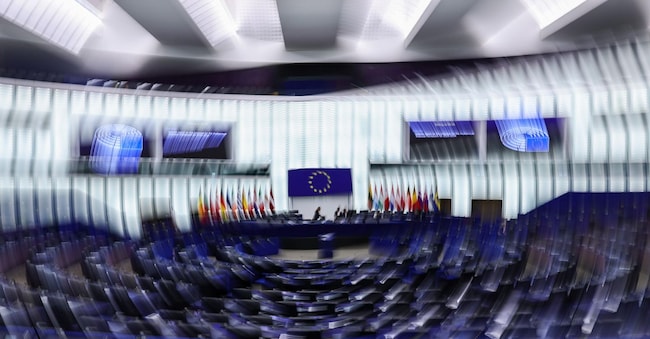
Una veduta dell'emiciclo del Parlamento europeo a Strasburgo, in Francia, il 28 aprile 2026. L'attuale sessione plenaria si svolge dal 27 al 30 aprile 2026.  EPA/RONALD WITTEK

4' min read

Translated by AI
Versione italiana

4' min read

Translated by AI
Versione italiana

BRUSSELS - The European Parliament has approved its position on the next EU budget, the Multiannual Financial Framework (MFF) for 2028-2034. MEPs called for a budget that is about 10 per cent richer than the European Commission's proposal in order to adequately finance historical policies and new priorities. This amounts to just under EUR 200 billion.

The report containing the demands of the MEPs already approved in mid-April by the Committee on Budgets, was confirmed by the Strasbourg plenary with a majority of 370 votes, consisting of the European People's Party (EPP), the Socialists and Democrats (S&D), the Liberals of Renew and the Greens.

Loading...

"With today's vote, the European Parliament has set the level of ambition and the timing (of the negotiations)," said Siegfried Mureşan, a Romanian MEP from the EPP and one of the two rapporteurs of the sensitive and wide-ranging file, together with Portuguese socialist Carla Tavares. "We invite the Council to take a step forward. We are ready for dialogue,' he concluded.

Now the negotiations will take place within the Council of the European Union, which brings together the 27 EU member states, but the positions between the two institutions are very far apart.

According to MEPs, the new EU budget should be worth EUR 2,014 billion, 197 billion more than the Commission proposal presented last July (both values are at current prices) and, above all, unlike the latter, it should not include the repayment of the debt of NextGenerationEU (the instrument that financed the NRPs, the post-pandemic recovery plans through joint debt). These choices would allow historical European expenditure items such as agriculture, cohesion and social investments to be financed in a similar way as in the past, avoiding the latter two areas suffering heavy cuts.

Speaking to the press before the vote, Fratelli d'Italia MEP Nicola Procaccini said that 'support for farmers, rural areas and regions has been strengthened', but pointed out that he could not 'support the report as it stands' due to 'shortcomings' in the area of migration, 'too much emphasis on Green Deal policies', 'the introduction of new own resources' and 'further centralisation'.

The Italian delegations' vote

On the vote, the Italian government majority was divided. Forza Italia voted in favour, the Lega against, while the Fratelli d'Italia group abstained. The opposition also had different positions, with the 5 Star Movement against, some Avs MEPs abstaining and others in favour. The entire delegation of the Partito democratico was also in favour, with Stefano Bonaccini satisfied with the "change of course" that the Europarliament had requested with respect to the Commission's proposal and the requests "of frugal and conservative governments".

The executives of several member states, such as Germany, the Netherlands and some Nordic countries, have already called for an even smaller multi-year budget than the one proposed by the Commission. The MFF, together with international current events, was the focus of the informal European Council in Cyprus last week. The heads of state and government of the 27 discussed for three hours, without reaching a synthesis.

"It is a very difficult negotiation," Council President Giorgia Meloni commented at the time. "Italia's red lines concern cohesion and Common Agricultural Policy (CAP) funds," she added, while also agreeing to finance new priorities such as "defence and competitiveness". The question is where to find the resources for all these objectives.

Since the possibility of issuing common European debt no longer seems to be on the agenda, one of the options at the centre of the debate is to increase the EU's so-called own resources, i.e. those funds that do not pass through the member states but are collected directly by the Union through continental taxes. The Commission has included five funding lines in its proposal and the Parliament has put forward alternatives, emphasising the importance of generating 60 billion euro per year in revenue. However, some states oppose this, both to avoid new taxes and not to give the EU too much autonomy.

At the conclusion of the Cyprus summit, the President of the European Commission, Ursula von der Leyen, insisted that these revenues are 'essential' to repay the debt incurred during the pandemic and that, without them, 'we would either have to increase national contributions or reduce the spending capacity' of the entire European budget.

Europarliament President Metsola also took a very similar line, commenting on the vote on the MFF: "If the states want to reduce their own contributions - and this is a position we hear from many of them - then we must finally make progress on own resources. This is also based on the work done in the Commission and on the debate conducted by our co-rapporteurs, which has attracted a large majority in this Parliament,' he said.

On the other hand, the position of Fratelli d'Italia, also expressed by Procaccini, is quite different. 'We are firmly against new own resources. We do not believe in an additional super budget. We do not want it because we do not want a European superstate,' he concluded.

Copyright reserved ©
Loading...

Brand connect

Loading...

Newsletter

Notizie e approfondimenti sugli avvenimenti politici, economici e finanziari.

Iscriviti