Geopolitics

European politics and business at the crossroads in the face of Trumpian tariffs

The imposition of barriers does not only have economic implications, but also represents the imposition of limits, the rejection of others, the reintroduction of a closure towards what is not indigenous

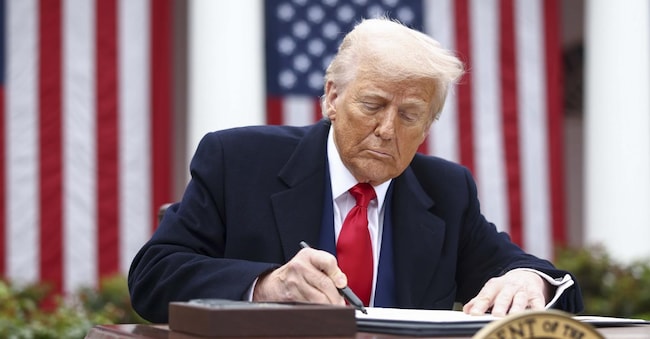
Foto IPP/Jim Loscalzo

3' min read

3' min read

I believe there is little doubt that the economic system followed at a given time connotes the dominant political thought in a country and characterises its distinctive features, just as there is no doubt that, from a macroeconomic point of view, the opposition, in general and beyond the so-called third and fourth ways, between capitalism and socialism still exists, identifying, in these two extremes, two different visions of society.

In this regard, and still remaining in a broadly generalised area, while one can point out, for various reasons, the failure of both systems, it is easy to argue that the bulwark of economic freedom lies in the respect of the principle of free movement of persons, goods and capital, thus promoting and strengthening an environment of ample opportunities and fruitful exchanges at a global level.

Loading...

In this overall picture, the Trumpian tariffs - the entry into force of which has been suspended for the moment - have been inserted a few days ago with tremendous force, which the 47th President's supporters themselves find hard to comment on and which shift the problem to the (not only political, but) political-economic level of the clear opposition between localism and globalism.

Apart from the current (and, in many ways, gruesome) suspension, in fact, the talk of imposing 'duties' has not only economic implications, but also represents the imposition of limits, the rejection of others, the reintroduction of a closure towards what is not indigenous or what is not 'within the borders': it is all this patchwork of negativity and much more.

It is, above all, a world opposite to the idea that has accompanied us all these years: feeling 'friends' of the US and, in some way, even protected by their democratic strength, has been comforting and comfortable.

The issue, however, is today (and to some extent also tomorrow): how to behave not only - or, at least, not only - in the face of this horrendous tariff policy, but also in the face of a (I hope very momentary) closure towards historical alliances and the attempts, which are blatant, to affect the functioning and, above all, the unity of other institutions, starting with the European one.

Wanting to push (force) companies to move production to America and other countries (especially European ones) to buy more from the United States, repudiates the recalled principle of the free movement of goods: it is really strange to note that such impositions (or, rather, attempts to impose them) come from the country that has always represented the bastion of democracy and freedom for westerners.

In the face of this blatant overpowering will (and the suspension is even more indicative of this), thinking of us and Europe, there are two possibilities for re-action, which belong as much to the political level as to the business world and which involve different actors.

On the political level, one can be more or less in line with the thoughts of the so-called 'tycoon', going along with, for example, the imposition of agreements with him, perhaps to be flaunted as great achievements resulting from great personal credibility; or, vice versa, one can be an important and convinced part of the Union to which, on paper, one belongs and which, precisely on the basis of these disreputable American inputs, could find, as many have wished, its own strength to 'be' and not only 'appear' to be a Union.

Then there is the hitherto little considered world of economic realities: and, here too, one can decide to adapt, individually, to the impositions (not only duties) and decide, for example, to transfer one's production (or part of it) to the United States, or decide, as a unit, not to submit to the impositions, strengthening oneself in new markets and creating new opportunities, while waiting for this storm to pass.

Should this second option be considered not only unrealistic but somehow feasible (or, at least, assessable), a role, even as a driver, could and should be taken on by the various European 'Confindustries' which, united and united, could(ro) promote solutions capable of releasing innovative vitality.

Awareness of the strength of European industries, together with the bargaining capacity of their representatives, could be a real driving force for a just and lucid response to the current abuses, which are all the more painful and delicate because they come from the world that, until some time ago, was seen (obviously mistakenly) as the ultimate expression of freedom.

The corporate representation complex can do much to stop the multiple epigones of vassalage, reminding them that the latter, both politically and economically, has never elevated anyone from the rank of subordinate.

Copyright reserved ©
Loading...

Brand connect

Loading...

Newsletter

Notizie e approfondimenti sugli avvenimenti politici, economici e finanziari.

Iscriviti