
European telcos take on Musk: an alliance for satellite services
DT, Orange, Telefónica and Vodafone are in the running in the EU spectrum auction

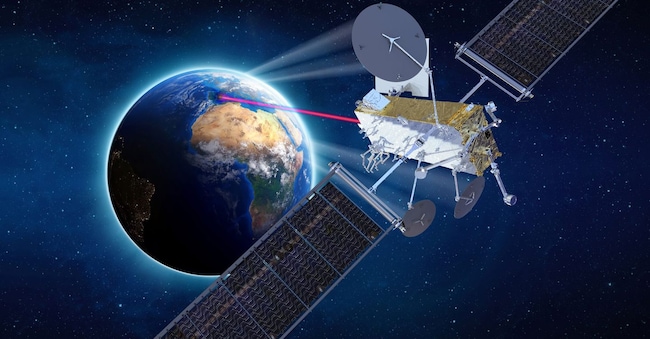
Four major European telecoms firms are taking on Elon Musk’s satellite giant. Deutsche Telekom, Orange, Vodafone and Telefónica are reportedly in talks to form a consortium to take part in the European tender for satellite frequencies and develop their own direct-to-mobile service: connections between satellites and standard smartphones, without the need for dedicated antennas. This is an attempt to establish a European presence in a market where Starlink, the satellite network operated by Elon Musk’s SpaceX, has a head start of several kilometres – and satellites.
The project, as reported by Bloomberg, is still at a preliminary stage and no final decision has been taken, the international news agency clarifies. However, the window of opportunity will open in May 2027, when the current European licences for the 2 GHz band expire. Brussels wants to take advantage of this to change the rules of the game, giving more scope to continental operators and reducing dependence on American platforms. The four telecoms firms aim to bid jointly for a share of those frequencies.
Behind the tender lies a bigger picture. The European Union is building IRIS², the satellite constellation through which Brussels aims to establish its own infrastructure in space. The project involves around 290 satellites. According to the European plan, two-thirds of the spectrum allocated to the system will be set aside for commercial use and divided between EU and non-EU operators. It is the European share that Deutsche Telekom, Orange, Vodafone and Telefónica are keen to get their hands on
The business logic is simple. Spreading investment and risk across four groups makes it possible to achieve greater critical mass and, above all, to build a continental alternative in a sector where economies of scale are crucial. For telecoms operators, satellites can also serve as an extension of mobile networks: covering sparsely populated areas, mountainous regions, rural areas and locations that are currently economically difficult to reach with masts and fibre-optic cables.
However, the comparison with Starlink remains one-sided. Musk already has an operational constellation and a global commercial business. Europe, on the other hand, has yet to transform IRIS² from a strategic project into infrastructure capable of competing in the market. And this is precisely where the alliance between the telecoms companies comes into play: not to build a copy of Starlink from scratch, but to secure the spectrum required to integrate the satellite into their traditional business – mobile telephony.


