Companies

Europe’s largest marine laboratory is in Sicily and is expanding thanks to a further 20 million

Idmar is a prime example of excellence in a sector – the maritime economy – which is worth 17.4 billion on the island, accounting for 6 per cent of the region’s GDP

4' min read

Translated by AI
Versione italiana

4' min read

Translated by AI
Versione italiana

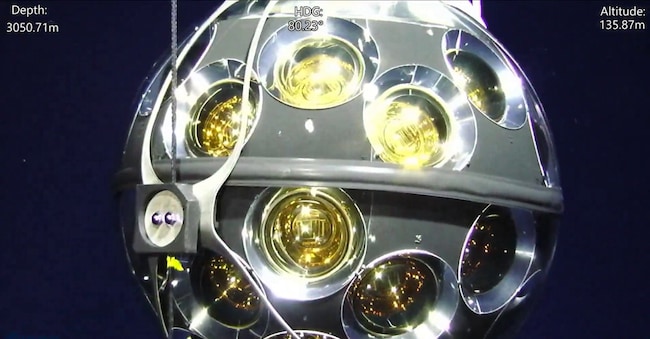
Sicily is home to Europe’s largest marine laboratory, and it is continuing to grow. A further 16 million euros have been allocated by the Sicilian Regional Government and a further 4 million by the National Institute of Nuclear Physics to upgrade the KM3NeT scientific infrastructure, the large underwater observatory in the Mediterranean dedicated to the study of neutrinos and cosmic energy, the first phase of which is already operational at a depth of around 3,500 metres off the coast of Syracuse, opposite Portopalo di Capo Passero.

This is a Sicilian achievement that made headlines around the world in early 2025, because it was thanks to this telescope that an international team of scientists discovered the highest-energy neutrino ever detected.

Loading...

The underwater telescope forms part of Idmar, an integrated, multidisciplinary research facility which also has centres in Catania, Milazzo (Messina), Capo Granitola (Trapani) and Palermo. Essentially, the project has brought together sites that were largely already in existence, each characterised by its own specific scientific and technological expertise.

Its strength lies precisely in the systematic organisation of a unique portfolio of infrastructure and systems for testing, qualification, measurement and the development of technologies and services. However, until a decade ago, these operated in a fragmented manner.

Today, new funding initiatives are seeking to expand this further through the new KM3Ne(X)T project, which strengthens the links between research, universities, scientific centres and the industrial sector even further, thereby attracting investment to the region and creating opportunities for development and skills growth for the benefit of businesses and the areas involved.

Innovation through the integration of the work of research bodies and the business sector is also one of the objectives of the “Regional Innovation Strategy for Smart Specialisation – S3’ of the Sicilian Regional Government’s Department for Productive Activities, which oversees programmes and initiatives supporting businesses and organisations seeking to transform the local community and economy.

According to a report by the BAPR Foundation’s Centre for Economic Studies, the Sicilian maritime economy reached a value of 17.4 billion in 2025, accounting for 6 per cent of regional GDP, compared with a national average of 4 per cent. Almost 30,000 businesses and 102,000 direct employees are involved in the maritime sector. But that is not all: every euro generated creates an additional 1.9 euros in related economic activity. However, the issue of concentration remains, given that 80 per cent of the value comes from tourism and accommodation (43 per cent) and from logistics and transport (38.7 per cent).

According to the 14th National Report on the Maritime Economy 2026, ranks third in Italia in terms of the contribution of maritime economy enterprises to the total regional economy, at 6.8 per cent.

For the sector, technologies such as AI, blockchain, robotics and the Internet of Things help to monitor and manage the effects of the use of marine resources on the ecosystem and human health. The European Commission has calculated that blue biotechnology generated a turnover of €973 million in 2023, up 3 per cent, with a gross value added of €317 million, 2,500 employees with an average annual salary of over 65,000 euros.

“AI is not just another tool – as stated in an article by the World Economic Forum – but is capable of bridging the gap between traditional industrial operations and the thriving sustainable blue economy”. Take, for example, offshore oil or gas platforms that have now become obsolete: “traditional decommissioning is a costly process” but “sophisticated algorithms and digital twins can assess the structural integrity of these platforms with unprecedented precision, modelling their suitability for entirely new purposes”. Transforming them, for example, into bases for offshore wind farms. Advanced technologies can be equally useful when it comes to sustainable ships and ‘smart’ ports (there is also talk of integrated ecosystems in Syracuse).

Loading...

Meanwhile, the island’s innovators are exploring a range of avenues, demonstrating that this field opens the door to a wide variety of applications for new technologies. For example, Catania-based Kosmos is set to launch a modular electric foil bike as early as summer 2027, capable of travelling at up to 40 km/h whilst ‘flying’ over the water as if riding a water go-kart. It is an example of sustainable engineering that combines mobility and fun.

HydroAiMesh, on the other hand, is an advanced IoT system that combines embedded electronics, networks of sensors and distributed actuators, and AI for the sustainable and automated management of water resources, thereby monitoring and optimising water use whilst ensuring efficiency, waste reduction and timely interventions for the maintenance and control of the water system.

Not to mention the experience of Acqua Azzurra, an aquaculture company involved in various research projects, such as the genetic selection programme for sea bream and sea bass, aimed at producing fry that perform better, are more disease-resistant and make more efficient use of feed.

Copyright reserved ©
Loading...

Brand connect

Loading...

Newsletter

Notizie e approfondimenti sugli avvenimenti politici, economici e finanziari.

Iscriviti