
Eurovision, the 70th edition in Vienna
The first semi-final opens the 70th edition of Europe's most pop ritual. Italia is already in the final with Sal Da Vinci, while Vienna welcomes a show suspended between lightness and politics

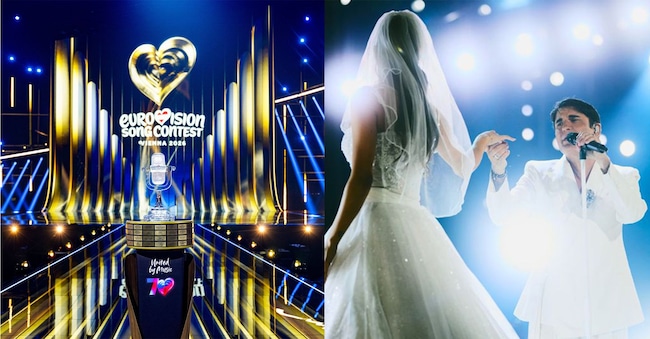
The Eurovision Song Contest is that moment of the year when Europe, and maybe even a piece of the world, tries to tell its story as one big pop party. Three-minute songs, cascades of glitter, outrageous choreography, traditional costumes transformed into augmented national identities, impossible outfits and prime-time raves. But beneath this vaporous, deliberately kitsch surface, the contest almost always ends up tapping into current events, willy-nilly. Even in Vienna, where the first semi-final of the 70th edition was staged last night, the dual 'Dr Jekyll and Mr Hyde' nature of Eurovision was evident from the moment the lights were switched on in the Wiener Stadthalle, the Austrian capital's historic arena: on the one hand, the show's sunny ritual, on the other, what that same show can no longer keep off the stage.
The sunniest face is obviously that of the show. After last night's first semi-final, the competition will continue on Thursday 14 May with the second semi-final, broadcast on Rai 2 and RaiPlay from 9pm, while the final is scheduled for Saturday 16. Italia, as a member of the "Big Five", has already qualified for the final evening with Sal Da Vinci and his Per sempre sì: the Neapolitan singer, winner of Sanremo, performed last night out of competition and was greeted by roaring applause thanks to a wedding performance, with two dancers on stage to evoke a popular wedding and the dancer's skirt that, on the famous "accussì" that closes the song, opened gloriously to show an Italian flag. In the meantime, her odds are also growing among the bookmakers, fuelling the usual national discipline: hope without saying it too loudly. Many had fantasised about a possible victory last year too, betting heavily on the ethereal Lucio Corsi, but this year the chances, in the pop melodrama of Eurovision, seem decidedly more concrete.
The first evening chose the top ten finalists. Greece, Finland, Belgium, Sweden, Moldova, Israel, Serbia, Croatia, Lithuania and Poland passed in an evening that, as always, composed a sentimental and visual atlas of Europe. Satoshi's Moldova opened with Viva, Moldova!, while Lavina's Serbia closed with a dose of Balkan gothic-metal. Among the qualifiers, Akylas' Greece mixed Eighties excess, furry boots from après-ski in Cortina and sprinklings of sirtaki; Felicia's Sweden focused on My System, between rave aesthetics and a glitter mask from a post-pandemic future with disco ambitions; Lion Ceccah's Lithuania brought to the stage a drag and theatrical figure, silvery and alien, as if plunged into a tub of metallic make-up. On the other hand, some of the most curious names of the evening did not make it through: Portugal's Bandidos do Cante, who had chosen a more difficult path by interweaving contemporary pop and Cante Alentejano, the choral tradition recognised by Unesco; Estonia, which counted on the return of Vanilla Ninja, a rock name already known to fans of the kermesse; and San Marino, represented by Senhit, an Italian-Eritrean artist who played the most openly Euro-visual card: the old British glory Boy George in the song Superstar, but did not manage to win the final. Doing the honours on stage was Victoria Swarovski, Austrian singer and presenter, heir to the famous crystal family: in an edition that guarantees glittering performances, even the conduction seems to have been chosen to stay in theme. Together with her, Michael Ostrowski, the face of German-speaking television. The Italia commentary is instead entrusted to Gabriele Corsi and Elettra Lamborghini, making her debut as commentator. And then there is Vienna, of course, already the venue of the festival in 1967 and in 2015, after the victory of the unforgettable Conchita Wurst: the Rathausplatz is the centre of the party, with a Eurovision Village welcoming legions of Euro-fans, while big screens, themed cafés, musical events and a colossal programme of side events are bringing the contest inside the city.
But then there is the other face of Eurovision, the less tame one, impossible to keep on the sidelines. In fact, the Vienna edition opened amidst controversy, boycotts and tensions related to the presence of Israel. Five European public broadcasters withdrew from the competition: Spain, Ireland, the Netherlands, Slovenia and Iceland. The distinction is not only formal: Eurovision is not attended by states, but by broadcasters belonging to the EBU, the European Broadcasting Union. The practical effect, however, is clear: those countries have no artists in the competition. The crux of the matter concerns the participation of the Israeli public broadcaster Kan, confirmed by the EBU despite requests for exclusion received from several broadcasters, also with reference to the precedent of Russia, excluded from the competition since 2022 after the invasion of Ukraine. Israel, represented by Noam Bettan with Michelle, made it through the first semi-final, but its performance was one of the most delicate passages of the evening: some videos circulated on social media showed protests in the hall, which were not audible during the live television broadcast.
The Israel Case
A demonstration is also expected in Vienna on Friday 15 May to mark Nakba Day, which commemorates the more than 700,000 Palestinians forced to flee or expelled from their homes during the 1948 war. Making the Israeli case even more delicate is an investigation by the New York Times, published on the eve of the contest, according to which the Netanyahu government has used Eurovision in recent years as an instrument of soft power, investing in promotional campaigns in support of its artists. The American newspaper, on the basis of documents, voting data and more than fifty interviews, does not point to evidence of bots or clandestine manipulation, but claims that those campaigns could have affected the popular vote in 2025, when the Israeli singer came second, a result that had already raised concerns among broadcasters and observers.

