
First work of art created by a robot exceeds one million
Alan Turing portrait made by humanoid Ai-Da at Sotheby's increases its estimate tenfold to between $120-180,000

4' min read
4' min read
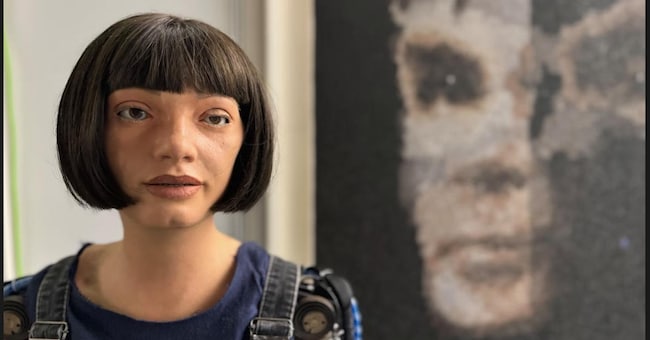
The portrait of British mathematician Alan Turing became the first work of art created by a humanoid robot to be sold at auction, fetching $1.08 million in New York on Thursday 7 November. Entitled "AI God. Portrait of Alan Turing", the 2.2 metre portrait was created by Ai-Da, the world's first ultra-realistic robot artist. In Sotheby's online auction from 31 October to 7 November, it shattered pre-sale expectations by between $120,000 and $180,000 thanks to 27 bids, it was protected by an irrevocable bid and cryptocurrency was also accepted. Ai-Da was created over two years by a team of robotic programmers, art experts and psychologists, completed in 2019 it is being updated as artificial intelligence technology advances. "Ai-Da becomes the first robot to paint like an artist. Today's record sale price for the first artwork by a humanoid robot artist to be auctioned marks a moment in modern and contemporary art history and reflects the growing intersection between artificial intelligence technology and the global art market," Sotheby's explained in a note.
The model genius of AI
.Ai-Da, who uses artificial intelligence to speak, said: 'The fundamental value of my work is its ability to act as a catalyst for dialogue on emerging technologies', adding that a 'portrait of the pioneer Alan Turing invites viewers to reflect on the divine nature of artificial intelligence and computing, while considering the ethical and social implications of these advances'. A thought-provoking statement...
Turing, mathematician and computer pioneer, played a crucial role in the fight against Nazi Germany by working to decipher the famous Enigma Code used by the Germans to transmit information to the armed forces during World War II. Turing's machine, The Bombe, similar in every way to a computer capable of imitating Enigma's rotors and spinning them at high speed by quickly calculating all possible combinations, made it possible to intercept all German messages in real time, foreseeing and anticipating the enemy's moves and 'literally' changing the outcome of the war. But already in the 1950s, the mathematician expressed concerns about the use of artificial intelligence.
The Designer
.Ai-Da is one of the world's most advanced robots, designed to resemble a human woman and named after Ada Lovelace, the world's first computer programmer, conceived by Aidan Meller, a specialist in modern and contemporary art. "The greatest artists in history confronted their period in history, celebrating and questioning changes in society," said Meller, who led the team that created Ai-Da by collaborating with artificial intelligence specialists from the universities of Oxford and Birmingham.
Ai-Da generated ideas through conversations with members of the studio and suggested creating an image of Turing during a discussion on 'AI for good'. The robot was then asked what style, colour, content, tone and texture to use, before using the cameras in its eyes to look at an image of Turing and create the painting.


