
Excessive use of Instagram could erode one’s sense of self, altering our perception of our bodies
A study coordinated by researchers at the Milan campus warns of a digital world in which all faces tend to look alike. The risk is that it will become more difficult to remember what makes us unique

Using Instagram could affect not only the way we see our bodies, but also the way our brains perceive the body we inhabit as ‘ours’, in short, it could erode our sense of self to the point where we no longer recognise ourselves in our own bodies, or no longer feel ‘at home’ within them.
The study
This is the finding of a scientific study published in the international journal *Computers in Human Behaviour* and conducted by a team of researchers led by Professor Giuseppe Riva, director of the Humane Technology Lab at the Università Cattolica del Sacro Cuore, Milan campus. The study, led by Dr Maria Sansoni, puts forward the ‘Digital Erosion of Bodily Identity Hypothesis’: the idea is that years of exposure to selfies, filtered faces and digital representations of the self may gradually blur the perceptual boundaries that allow us to recognise our own face as uniquely our own. In other words, if we live for years in a digital world where all faces tend to look alike, there is a risk that it will become more difficult to remember what makes us unique.
Background
The mental health of adolescents and young adults is one of the main public health challenges today. According to the World Health Organisation, around one in seven adolescents and one in eight adults worldwide live with a mental disorder. Among the factors causing the greatest concern are those related to the body and self-image. In a culture increasingly focused on appearance, physical appearance is playing an ever-greater role in the formation of personal identity and in relationships with others. It is therefore not surprising that body dissatisfaction is now associated with reduced psychological well-being and represents a major risk factor for the development of eating disorders, depression, social anxiety and low self-esteem.
In recent years, the scientific debate has focused primarily on the role of social media. Platforms such as Instagram have transformed the body into one of the main tools of communication and self-representation. In these digital environments, the face and physical appearance are constantly on display, observed, compared, altered through filters and evaluated via ‘likes’, comments and visibility metrics. This constant comparison with idealised images and often unrealistic aesthetic standards can increase the perceived pressure regarding one’s appearance, contributing not only to greater body dissatisfaction but also to a more critical judgement of one’s own body.
But what if the problem runs deeper? What if social media influences not only the way we evaluate our bodies, but also the way we construct our sense of who we are?
The dossier
This is the question that prompted the new study, which explored an aspect that had hitherto been almost completely overlooked: the relationship between Instagram use and the processes that enable the brain to recognise one’s own face as belonging to oneself. The body is, in fact, not merely an image to be looked at. Every day, the brain continuously integrates information from within the body (such as the heartbeat, the position of the limbs and visceral sensations) with information from the external environment – that is, what we see and touch. This integration gives rise to a sensation that seems obvious but is fundamental: the certainty that this body is our own and that we exist as individuals distinct from others.
Neuroscience shows that these processes represent one of the foundations of personal identity. When they function correctly, they contribute to emotional regulation, to our awareness of who we are, and to the immediate sensation that our body belongs to us. When these mechanisms are disrupted, it can become more difficult to feel fully ‘at home’ in one’s own body, to clearly recognise one’s internal states and to maintain a stable distinction between oneself and others. For this reason, disruptions to these mechanisms are considered a vulnerability factor for various clinical conditions, including eating disorders and dissociative disorders.
The team
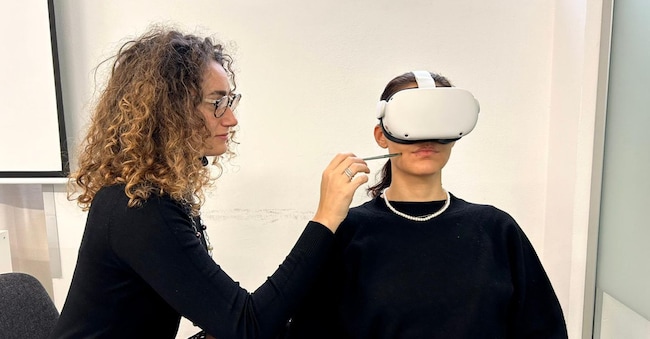
The team recruited 95 young adults, both men and women, with an average age of 26 and a history of using Instagram for almost eight years. The participants were subjected to experiences known as body illusions in a virtual reality setting. By synchronising what a person sees with what they feel on their own body, these procedures can temporarily induce the sensation that another person’s face or body belongs to oneself. Used for years in neuroscience, body illusions enable us to study how solid the boundaries are that separate the self from others and allow us to recognise our body as ‘ours’. The ease with which a person experiences these illusions is therefore an indicator of how malleable and plastic an individual’s bodily identity is.

Brand connect


Newsletter Scuola+
La newsletter premium dedicata al mondo della scuola con approfondimenti normativi, analisi e guide operative
Abbonati