Asia and Oceania

South Korea, progressive Lee Jae-myung elected president, defeated conservative candidate

The near-final projections give the 60-year-old Lee, of the Democratic Party of Korea (Dpk), at 49.3% against the 41.3% of People Power Party (PPP) candidate Kim Moon-soo
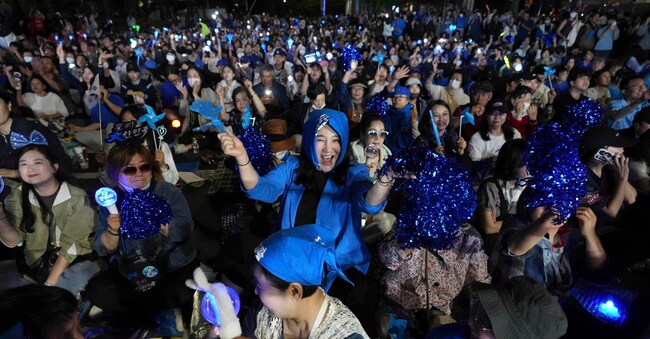
by Marco Masciaga

I sostenitori di Lee Jae-myung durante i festeggiamenti per la sua vittoria davanti all’Assemblea nazionale

3' min read

3' min read

From our correspondent

SEUL - South Korea yesterday closed one of the most difficult chapters in its modern history, electing Lee Jae-myung as president, a progressive candidate who will have to restore authoritative leadership to the country at a time of great uncertainty, after six months in which Asia's fourth largest economy has been effectively without a leader. When it was just after 4 a.m. in Seoul, projections based on 99.2% of ballots already counted gave Lee of the Democratic Party of Korea (Dpk) in the lead with 49.3% of the votes against the 41.3% of the conservative People Power Party (PPP) candidate Kim Moon-soo. The turnout of 79.4% was the highest in 28 years.

Loading...

The result, less wide of the mark than expected, returns the country's leadership to a democratically elected president after the impeachment of Yoon Suk Yeol, the conservative leader who had stunned the world last 3 December, first by instituting martial law and then backing down a few hours later after a roaring night session of the National Assembly. 'Lee's victory,' explains Byong-Chul Lee, a professor at the Institute for Far Eastern Studies at Kyungnam University, 'marks the end of Korea's far-right interlude, a temporary deviation from democratic and liberal values.

According to all observers, Lee's victory represents not only a return to normality after months of continuous changes between interim presidents, but also a strong discontinuity with Yoon. 'Lee,' explains Byong Jin Ahn of the Global Academy for Future Civilizations at Kyung Hee University, 'will be a strong president, not least because he has a solid parliamentary majority on his side.

Haranguing his supporters, the new president promised that there will be no more military coups, that he will immediately start working on the economy, and that he will return to dialogue with North Korea.

In the first quarter of the year, South Korea's GDP contracted by 0.1 per cent year-on-year and by 0.2 per cent compared to the last three months of 2024. Analysts, in addition to the promised investments in high-tech sectors common to all candidates, expect the future president to increase government spending and aid to the lower and middle classes.

According to Professor Lee of the Institute for Far Eastern Studies, there will be 'a rebalancing' in foreign policy after the previous administration's strong proximity to the US. "Lee Jae-myung," he explains, "is convinced that South Korea must hold a position of greater equidistance between the United States and China, because if the former is crucial in terms of deterrence against North Korea, the latter plays a crucial role economically.

The first test of relations with the United States will be the complex trade negotiations that Korea - due to the recent power vacuum, and unlike India and Japan - could not even begin. Then it will be the turn of North Korea, towards which Lee's party has historically had a more conciliatory approach than the conservatives. Although, according to Wooyeal Paik, a professor in the Department of Political Science and International Studies at Yonsei University, the new president's foreign policy advisors are of a less ideological generation than in the past.

The new president himself 'is a very pragmatic leader with little or no interest in values', explains Ahn of Kyung Hee University. "This is partly a product of his background. Lee comes from an extremely poor family and as a young man he never had the luxury of being an activist. The moment he realises he has made an unpopular choice,' he continues, 'he will backtrack. That is why the biggest challenge ahead of him may be to translate the tactical flexibility that served him well in the election campaign into a coherent strategic vision to serve the country.

Copyright reserved ©
Loading...

Brand connect

Loading...

Newsletter

Notizie e approfondimenti sugli avvenimenti politici, economici e finanziari.

Iscriviti