
Exodus from the London Stock Exchange: 800 listed companies lost in ten years
The latest announcement is from Flutter Entertainment, the owner of FanDuel, which is set to delist from the London Stock Exchange in August.

Key points
Flutter Entertainment, the owner of FanDuel, is set to leave the London Stock Exchange in August. This move marks the latest chapter in a trend that has gradually eroded the appeal of the London market in recent years. Between delistings, relistings and failed IPOs, the British stock exchange is witnessing a steady shift of companies towards markets considered more attractive in terms of valuations, liquidity and access to capital.
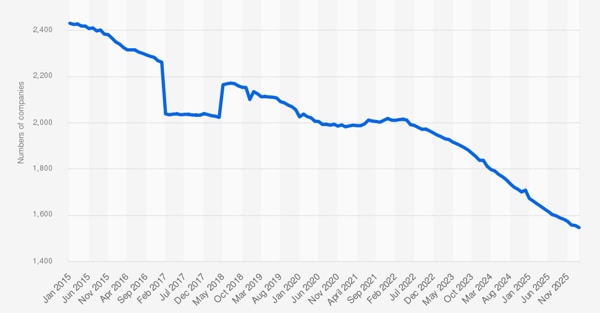
According to data from the London Stock Exchange compiled by Statista, the number of companies listed or traded on the British stock exchange has fallen from around 2,365 in 2015 to just over 1,560 in 2025, a reduction of more than 800 companies, equivalent to around a third of the total. In 2024 alone, according to EY, as many as 88 companies left the main market or transferred their primary listing abroad, compared with just 18 new listings, marking the largest net outflow since the global financial crisis.
Flutter Entertainment bids farewell
Flutter Entertainment, a global leader in online betting and owner of the FanDuel platform, has announced that it will permanently delist from the London Stock Exchange (LSE) in August, retaining the New York Stock Exchange as its sole primary market. With a market capitalisation of around £14.3 billion, Flutter had already transferred its primary listing to New York in 2024. According to management, the definitive delisting from the London Stock Exchange is in the best interests of shareholders, who are increasingly focused on the US market, where the group generates a growing share of its revenue thanks to the boom in online sports betting.
The structural problem with the UK market
Flutter’s decision is part of a wider trend affecting the UK stock market. In recent years, many international investors have reduced their exposure to British shares, helping to keep stock market valuations lower than those seen in the United States.
Several factors are at play: the long-term effects of Brexit, a reduced presence of domestic institutional investors, the growing appeal of Wall Street to technology and high-growth companies, and lower liquidity compared to the major US markets. The result is a gradual migration of companies to New York, which is perceived as the market capable of commanding higher valuations and attracting a broader investor base.


