
Exploring the sounds of the world: meeting with Le Motel
It mixes different languages: notes, fashion and graphics. He uses different techniques and microphones: portable recorders, hydrophones to record underwater or geophones, designed to pick up seismic vibrations.
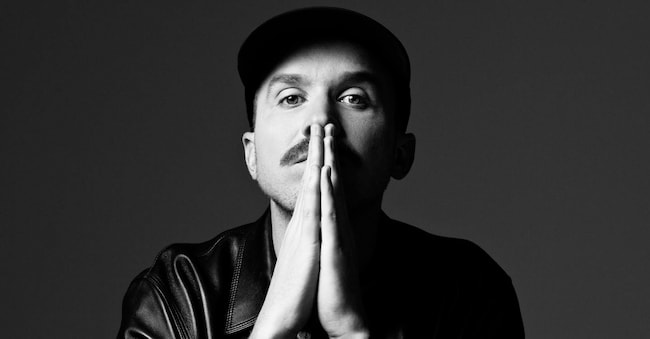
At the crossroads between an electronic music producer, an explorer of world sounds, a trip hop enthusiast of Bristolian lineage and an heir to Brian Eno, we find Le Motel. Many have met him recently, without even knowing it: it was his music for the short film made for Chanel's Métiers d'art 2026 show, directed by Michel Gondry, starring A$AP Rocky and Margaret Qualley, elegant lovers chasing each other through the streets of New York. But the story of Belgian artist, DJ and composer Fabien Leclercq - that's his real name - begins much earlier, far from the maisons and premières. He tells us from his studio in Brussels, the city where he was born 34 years ago: 'Since I was a little boy, I have been fascinated by sounds from all over the world. My father was a big fan, he listened to a lot of music, especially trip hop, but also groups like Boards of Canada (historic Scottish electronic band, ndr). On weekends I would spend hours in the media library, looking for records and recordings from the most diverse places. As a teenager, ever since I had a recorder or any instrument to capture sound in my hands, I never stopped collecting them: in the kitchen, using everyday objects, or while travelling'. Mixing ambient sounds, field recordings and electronic music is the trait that runs through much of Le Motel's production, who in recent years has moved between different genres, always remaining somewhat tied to his initial inclination: "Basically, it's the same approach as a photographer or a videomaker: I try to put my ears at rest and let myself be guided by the sounds. I find it very powerful to record something that at that instant seems interesting, or inspiring, and then let it settle. After a few months, when I listen to it all again in the studio, I am immediately taken back to those places, those emotions, sometimes even more strongly than with a photograph or video. I use different techniques and microphones: portable recorders, but also hydrophones to record underwater or geophones, designed to pick up seismic vibrations'.
Music, however, does not immediately come into his professional life. First there is graphic design, a field in which he trained and worked for several years. It is anything but a minor transition: even today, his musical work retains a strong visual dimension. In 2015, he released his first record, OKA, on a New Zealand label, Cosmic Compositions: "At the time, I was just a bedroom producer, making music in my room and still living it as a hobby. When I was approached to make an album, I gained confidence and trust'. The enlightenment on the right path to follow comes thanks to Les Garages Numériques, a festival and multidisciplinary platform that brings together installations, performances and concerts, and which becomes for him a first laboratory of experimentation. It was there, between 2016 and 2019, that the idea of sound as an "environment to be traversed", rather than as a simple sequence of tracks, took shape ever more clearly: "At that point, I realised that my real passion was the link between images and music. That is why I love working for cinema (he has made several soundtracks, ndr), for installations or for fashion: it is never just music, but a way of telling a story together with others, mixing different languages'.
Le Motel continues on its path, avoiding linear trajectories. Electronic research was soon joined by an immersion in the world of Belgian hip hop: thus Morale (2016) and Morale 2 (2017) were born, made with rapper Roméo Elvis: 'I think I liked the fact that it was hip hop, but mixed with many other influences: jazz, footwork, techno, UK garage. It was a very good experience, because we started from something underground, and then it exploded completely, at least in the French-speaking world'. Success, in other words, came. In the following years, Leclercq alternated between collaborations and more intimate projects. With MAAR (2023), made with guitarist Bruce Wijn, he explores slower atmospheres, while for Baltimore - born during the pandemic but released in 2023 - he works with French rapper Fuzati, reflecting on the theme of travel at a time when moving is almost impossible. Alongside albums and more structured collaborations, he developed over time a series of EPs, conceived as experimental spaces (among the most significant are Transiro and Kernel Panic).
But it is 2025 that marks a new point of synthesis: on the one hand Bitter Better, made with the Nigerian rapper Magugu, in which electronics and pidgin rap meet without hierarchies; on the other Odd Numbers / Sô´Le, built together with Vietnamese poets and musicians. "I arrived in Vietnam to play in a club in Hanoi and, as often happens to me when I travel, I decided to stay as long as possible. I had nothing planned: everything happened step by step, following encounters, suggestions, intuitions. Vietnam was particularly rich in human connections, and at a certain point I felt the desire to put all those voices together, from conversations to the sounds of the markets. I started to document everything through a tape recorder, which I find less intrusive than a big video camera. When I returned to Brussels, I left those recordings aside for months. Listening to them again later was like reactivating those places, but I wanted to avoid an extractive approach, not just take sounds. So I involved all the people I met, exchanging demos and ideas between Brussels and Vietnam, like in a continuous ping pong. Everyone brought their own universe to the project: a collective work was born, in which I also involved Vietnamese musicians living in Europe and used traditional instruments such as the đàn b`âu and the đàn tranh. It is the project that most of all represents what I want to do with my music'.
His relationship with fashion, on the other hand, began thanks to his friend Pierre Debusschere, image and music director at Bottega Veneta in the days of creative director Matthieu Blazy: 'Together we worked on several fashion shows. It was my first step into that world,' he says. So when Blazy moved on to Chanel, he also involved Leclercq in the new adventure, working on sound design, field recording and composing some of the music for the first two fashion shows, as well as the aforementioned short film directed by Michel Gondry, for which he created the soundtrack even before filming: "I'm a big fan of Gondry's work. I felt a real connection, artistic and human. It was a very beautiful journey'.

