Extra-large snow: time for increased skiing
From anti-fatigue equipment to five-star facilities, from safety to guaranteed snow. For those who love the extreme, but choose to be pro-limit: you can challenge the altitude, without taking unnecessary risks.
by Lucia Galli
-U67262416586MLz-1440x752@IlSole24Ore-Web.jpg?r=650x341)
6' min read
6' min read
Qanik is the one that has just fallen from the sky; aput is the certainty of winter; apusiniq already brings with it the breeze of spring. Even without Smilla and her proverbial sense for the many names of the snow, the crystals of a new ski season are being set in the Alps, but at the starting gate of another year of this third millennium, one cannot arrive unprepared. The skiing of today is ski-boosted: it is an oxymoron of nature and technology; it is a dance of centripetal and centrifugal forces enhanced by the clean energy of a future that bursts to the rhythm of curves, carves and serpentines. From equipment, to lifts; from safety, to snow; from the slope, to après-ski; skiing is the luxury that surrounds that desire, the essential one, called freedom.
WALK ON THE PIST Get dressed, let's ski! There is no couturier who has not tried his hand at one of his white lines: haute or prêt, capsule or limited, a pair of skis or a duvet, few are the exceptions. As in a race, the bar for the best performance is constantly being raised. Thus, 2024 puts Louis Vuitton's Monogram Stripe L skis on the track, guaranteeing elegance in every turn; Prada includes in its historic Red Line ski wear even snowboards in colourful textures and eco-friendly materials, while Gucci's goggles sport a touch of ivory in the frame. Armani, sponsor with its EA7 line, of the Azzurri ski team, relaunches Protectum, a line of ski wear with microfibres entirely recycled from plastic bottles.
SHOOTSHOOTS The worst time is always the same: hyperboreal cold, the first descent of the morning (with no gold in the mouth, indeed in the shade) and the boot hooks to close. Even if you don't want to, you have to take off at least one glove and the task is as long as it is annoying. This is where the Boa® technology comes in, which overcomes the effort of lacing up your boots, reducing it to the easy gesture of a twist. Like opening a safe whose combination you know: that's the revolution. Simple, in its comfort, it looks like a wheel that facilitates the progressive closing of the boot plastics: from Fischer to Atomic-Salomon, from K2 to Burton and Scarpa, boot fitters the world over have now elected it as the discovery of the new millennium. Born for snowboards, it has conquered ski mountaineering boots, cross-country ski boots and the summer outdoor world: now, among the brands of the sector, even the wall of the most sceptical is falling.
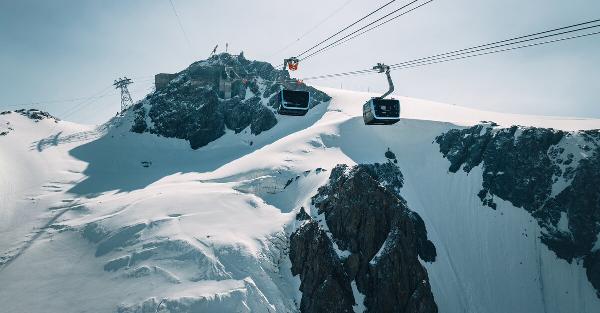
SIGN UP PLANTS Once upon a time there was the ski lift, now there is the Alpine Crossing: hanging from a platter, suspended from a chairlift, ski lifts have always been an icy apostrophe between joy and fun. Necessary to get that lift up, at the starting box of every downhill run. In the last 30 years, to dispense a pinch of comfort, there have come panoramic ovens, padded and heated seats, wind domes, the automatic coupling that avoids jolting and suspense at every pylon. Then last July saw the arrival of the gondola designed by Pininfarina for the South Tyrolean group Hti-Leitner, which connects Cervinia to Zermatt, finally bridging a gap in the ski area after years. The leader of a new generation of lifts, this installation allows even non-skiers to breathe in the thrill of 4,000 metres, making each ascent an experience rather than a necessity. The 12 cabins resemble a crystal shuttle, total look glass for a 360 degree panorama that, in four minutes, delivers snow lovers of all ages from the Italian Plateau Rosà to the Little Matterhorn on Swiss soil. The border can be crossed by flying and you don't need a passport. All you need is an (ad hoc) ski pass.
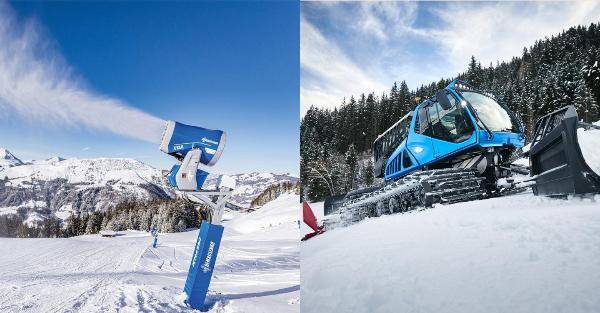
NEVE MADE IN ITALY Among all the excellences and primacies of our savoir-faire, there is also that of inventors of artificial snow, which today is defined as technical or, better still, programmed. The two leading multinationals in this sector are Demaclenko and TechnoAlpin, with the two cold centres between Bolzano and Sterzing. It all started in a garage in Val Gardena in the 1980s (you don't need to be in Cupertino to have good ideas!). A rudimentary technology had already arrived from the United States to produce icy water filters with compressed air, but with the drier climate of the Alps and Europe, it didn't work. Two families had an epiphany almost at the same time: the Demetzs in the shadow of the Sassolungo, the Lenkos in Sweden. They joined forces and, in 2011, Demaclenko was born. TechnoAlpin, on the other hand, founded by the Eisaths, another Val Gardena native, has been finding ways to transform white gold from a liquid to a gaseous state since 1990. Today, snow making is a science, as well as a necessity: lances and cannons need 50 hours and temperatures slightly below zero to whitewash a meadow, but thanks to snow groomers, again Italian, such as Prinoth, and also powered by hydrogen, with gps, it is 'spread' only where it is needed. Goodbye waste and heaps, abandoned at the edge of the track. Goodbye additives invented in Colorado: today's technical snow is undoubtedly heavier than natural snow, but it is green, summer alpine-proof and melts. Of course water and electricity are needed to produce it, a cubic metre costs 3-5 euro, with investments reaching breakeven in 20 winters, but with the consequences of climate change the mountain economy would be at risk and so would the safety of the trails.
-U31682726662DMd-600x313@IlSole24Ore-Web.jpg)