
Eyes Fixed on the Abyss by Otto Muehl
The aesthetics of destruction and nihilism in an artist at the centre of a profound, unsettling and tragic existential quest

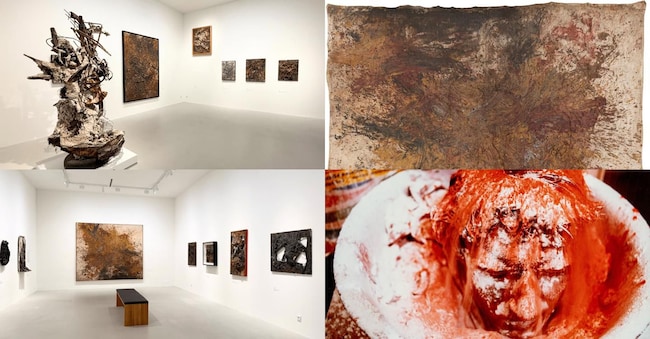
To transform life, in its entirety, into a work of art. This is the dream of twentieth-century avant-garde art. This is the tragic aspiration that led the Austrian artist Otto Muehl (1925–2013), one of the leading figures of Viennese Actionism, to radically reject all forms of aesthetic ‘discrimination’. His deepest and most extreme aspiration, ‘proclaimed’ with the power of his images, was in fact this: that everything should become art! And so every boundary between reality and creative imagination, between what is permissible and what is forbidden, was dissolved in his artistic gesture, to the point of touching the abyss of the human soul and conceiving a communal system in which the quest for utopia culminated in crime.
A bold exhibition entitled “OTTO MUEHL: Kunst am Abgrund” (OTTO MUEHL: Art on the Brink of the Abyss) was recently dedicated to the artist in Vienna. Held at the Wiener Aktionismus Museum (WAM), which is dedicated to research and outreach on the controversial artistic movement of the 1960s – a movement that, from the heart of Central Europe, anticipated international trends such as Body Art and Fluxus – the exhibition takes a meticulously critical look at the developments in Muehl’s multifaceted art.
The 1960s
A great deal of space is devoted to his works from the 1960s – probably the aesthetic pinnacle of his revolutionary drive. On the one hand, there is his exploration of the ‘topographies of destruction’: the new symbolic formations that emerged in the devastated landscape of the twentieth century, which Muehl had also experienced as a soldier during the Second World War. This gave rise to composite installations made of concrete, paper and rubbish, alongside hyper-material monochrome canvases: art which, in the artist’s own words, is “a warning of the abyss looming over us all”. On the other hand, the exhibition provides a photographic record of the Actionist performances, in which the themes of corporeality, sexuality and criticism of the bourgeois order are intensified to the point of foreshadowing a transcendence of human subjectivity itself: the individual is annihilated, becoming artistic matter; their body rises to become a pictorial surface; their face disappears. After the ‘death of God’ (Nietzsche) comes, inevitably, the ‘death of man’ (Foucault). It is, in fact, impossible to understand Muehl’s aesthetics outside the context of the advent of nihilism. Initially perceived as tragic, nihilism is subsequently experienced in an active sense: as a tool for deconstructing Western modernity and asserting a new worldview, centred on the ‘re-enchantment’ of matter, which in many works is effectively ‘mythologised’. Thus emerges the iconography of the myth of Leda and the swan in the Actionist cycle or, many years later, that of the god Bacchus, the orgiastic patron of a paganism of the flesh and instincts, as well as the artist’s alter ego.
The artistic revolution envisaged by Muehl unfolds through the other phases documented in the exhibition – from his Pop Art-style caricatures of powerful figures to his return to a colourful and wild style of painting in the 1980s – and reaches a decisive turning point in the Commune project, established in 1970 in Vienna (on Praterstraße) and later relocated to Friedrichshof. Conceived as a therapeutic and educational project aimed at liberating the individual from moral prejudices and bourgeois social constraints – the nuclear family foremost among them – based on a reinterpretation of the theories of Sigmund Freud and Wilhelm Reich, the AAO (Organisation for Analytical Action) represents Muehl’s final attempt to remain faithful to the ideal of Art/Life.
The film Meine keine Familie (2012)
He himself sets out – as shown in the film Meine keine Familie (2012) – his aesthetic manifesto: the members of the Commune live within a work of art that they themselves create; it “differs entirely from every previous artistic form because it is a truly revolutionary art, because it is art that is truly alive. It is the first example, in the whole world, of a living art. Here, the definition of art history expands into a global dimension, in terms of both time and space; it expands to its fullest extent. (…) The whole world is the material to be creatively shaped’.

