
F1: Norris wins at Interlagos, with two Red Bulls behind him. Toto Wolff is like Frank Williams
With the Drivers’ Championship already clinched a week ago by Kimi Antonelli in a Brazilian race that was, as ever, unpredictable, Toto’s performance from the pit wall stands out more than Lando’s swan song on the track

Key points
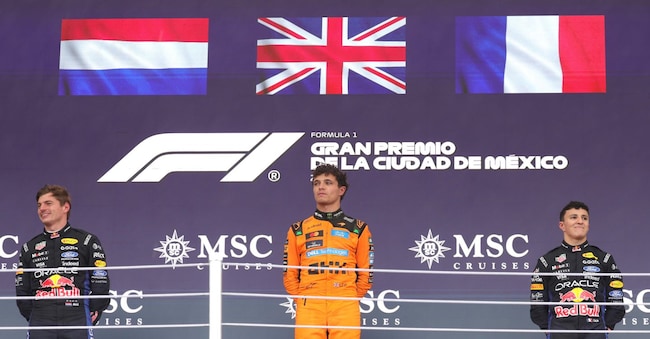
A convincing yet ultimately meaningless victory for Lando Norris in the run-up to both world titles, as he claimed his third win of 2026 in São Paulo, starting from pole position just as he did in 2025. An unexpected burst of form, if anything, in a year in which the reigning champion lies sixth with 246 points, 144 points behind Antonelli: he is behind both Mercedes, both Ferraris and, of course, Verstappen. His result was the least predictable. The Dutchman started twenty-first after receiving a thirty-place grid penalty for power unit components and finished second; Isack Hadjar, fifth on the grid, completed the Red Bull podium. Norris, however, is on a run of pole positions at this circuit, a feat previously achieved only by the ‘local hero’, the unforgettable Felipe Massa in a Ferrari.
At the start, with everyone on intermediate tyres, Antonelli overtook him at the first corner and Lawson at the second; Norris regained second place on lap six and switched to slicks on lap sixteen, one lap before Antonelli and Verstappen. On lap 20, the Italian’s spin at Turn 1 handed him the lead, which he only lost for a few laps during the final pit stops: at the finish line, he had a commanding lead of 14.602 seconds over Verstappen.
On Sunday, however, the media spotlight was firmly on Red Bull. Verstappen, who started twenty-first on the grid following a thirty-place grid penalty, made up nineteen places and even finished second; Hadjar, who started fifth, came third, albeit almost twenty-five seconds behind. He was the first to overtake Antonelli, on the lap following the spin. On lap 38, the pit wall asked him to let his four-time world champion team-mate through, who was just a second behind him, and Hadjar asked whether his position would be restored should Verstappen fail to overtake Norris. He didn’t overtake him: the gap remained between seven and thirteen seconds, and the request came to nothing. No scandal, no controversy: the Dutch veteran’s pace was in a league of its own. However, after the twenty-fourth lap, the race at the front was decided more by the pit wall than on the track, until the rain returned – light with about twenty laps to go and heavy in the final ten. Mercedes had been banking on more rain or a safety car, but it didn’t go as they’d hoped: no switch to full wet tyres was necessary, nor were there any serious incidents, so Antonelli stayed on dry tyres until the fifty-fourth lap, losing over a second per lap.
The newly crowned Italian champion had reported from the 18th lap that his car was pulling to one side; the pit wall attributed this to tyre temperature. After spinning, he made another mistake on the 24th lap and dropped to fourth. Russell, who had spectacularly spun out upon exiting the pits on lap 16 and crashed into the wall, had slipped to eighth but finished fourth: in the closing stages, Mercedes let him through, whilst Antonelli was under investigation for a pit release in front of Colapinto’s Alpine, which was deemed ‘unsafe’. Russell also reported unusual balance, and the team said that both drivers described the car in similar terms. Amidst all the mix-ups, involving both the pit wall and the drivers, Antonelli still managed to set the fastest lap, 1’12”689 on lap 55. The 22 points, compared to Ferrari’s 8, take Mercedes’ tally to 652 against 512: all they needed was to beat Ferrari by three points, and with a 140-point lead and 129 points still up for grabs in the three remaining races, the title is as good as theirs. It is their ninth Constructors’ title, the first since 2021.
Toto Wolff as Frank Williams
Having secured the Constructors’ Championship in Brazil, Toto Wolff has drawn level with Sir Frank Williams on nine titles, placing him third in the all-time rankings behind Ferrari and McLaren. Eight consecutive titles from 2014 to 2021, followed by four seasons without success, and a return to the top with a completely different driver line-up. But the most interesting comparison concerns the drivers: Wolff has won eight drivers’ titles with three champions – six with Hamilton, one with Rosberg and now one with Antonelli. Frank Williams had won seven with seven different drivers: Alan Jones, Keke Rosberg, Nelson Piquet, Nigel Mansell, Alain Prost, Damon Hill and Jacques Villeneuve. Rosberg senior even won in 1982 without the constructors’ title; at Mercedes, the opposite happened in 2021: they were simply top of the constructors’ standings, whilst Verstappen was crowned champion. Wolff’s ninth world title carries particular significance for this very reason: after dominating an entire era with Hamilton, he managed to rebuild a winning team by backing a 20-year-old, whilst his former champion ended up at a Ferrari that is still struggling to get the best out of him.


