Formula 1

Antonelli makes history at Monza: he wins from nineteenth on the grid, the first Italian to do so in 60 years

A dream come true. Sixty years after Ludovico Scarfiotti, Kimi Antonelli has put an Italian driver back on the top step of the podium at the Italian Grand Prix

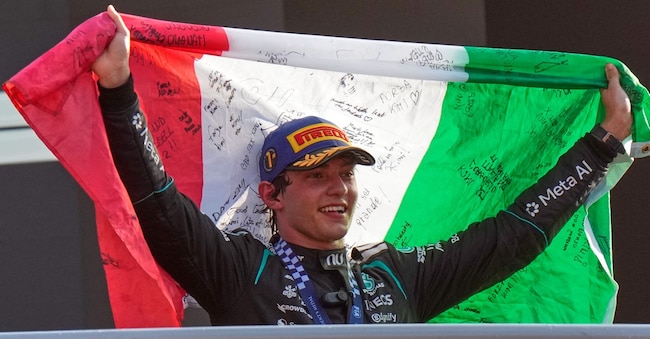
Andrea Kimi Antonelli festeggia dal podio la sua vittoria a Monza, primo italiano dopo 60 anni. (AP Photo/Luca Bruno)      Associate Press/ LaPresse Only Italy and Spain APS

8' min read

Translated by AI
Versione italiana

8' min read

Translated by AI
Versione italiana

The best-known Kimi of this decade starts the race as the World Championship leader, but above all from nineteenth on the grid, where he had been demoted following the replacement of his power unit. On the eve of the race, the comeback seemed primarily aimed at limiting the damage: Russell started second and had the chance to chip away at his team-mate’s points lead. The opposite happened.

It is a result that also rewrites the records at Monza: prior to today, no one had ever won the Italian Grand Prix starting from further back than Peter Gethin’s eleventh place in 1971. It is also the best comeback of this century, from the back of the grid to first place: to find a better one, you have to go back to John Watson in 1983 at Long Beach (from twenty-second) or Bill Vukovich’s nineteenth place in the Indianapolis 500, which at the time counted towards the F1 title.

Loading...

The nineteenth pizza: it seemed like an almost inevitable fate

On a circuit where overtaking comes at a high price and gaps widen, nineteenth place was almost a foregone conclusion. Antonelli turned it around with a car that was superior to the rest, granted, but also thanks to a race that was anything but straightforward, decided by a red flag, a Virtual Safety Car and a mistake that could have ended his race.

To understand how he managed it, however, it’s worth starting from the grid – and from a pole position that Alpine didn’t secure by chance. At Monza, where drivers are at full throttle for around 80 per cent of the lap, the team found an aerodynamic configuration that was particularly efficient on the straights, with very little drag. And on a track like this, even the Mercedes engine needs to be pushed to the very last horsepower and, with the 2026 power units, to the very last available joule: pure speed, but also careful management of the electric power deployment. This didn’t work quite as well for Verstappen: whilst the criticism was tempered by a very lucrative contract renewal with Red Bull a few weeks ago, it hasn’t entirely silenced the complaints directed at his own team. But certainly, managing the recovered energy on such long straights was no easy task for any team.

The departure

The start was seemingly uneventful, with no real incidents, but there was too much friction between the two Ferrari drivers. Hamilton tries to take the position, Leclerc defends fiercely and, in the close battle, Lewis is forced off the track, ends up in the gravel and drops several places. An incident that would have warranted at least a serious discussion at the pit wall, all the more so at Ferrari, where problems with governance and internal management are certainly nothing new.

Out of pride, Charles understandably wanted to hold onto that position. A few minutes later, however, fate dealt him a much harsher blow. On the third lap, whilst Piastri was attacking him at the Parabolica, the Ferrari suddenly lost rear grip. Leclerc tried to regain control, but the car spun out and veered off to the outside, eventually crashing violently into the barriers. No contact with the McLaren has, as yet, been confirmed: it was the Ferrari that lost control whilst the two were battling.

Leclerc walks off the track under his own steam, and this is, of course, the top story. But it’s a heavy blow to take. Morale, first and foremost: in his home Grand Prix, after just five minutes, whilst Ferrari still had everything to play for. And the impact is also striking – very abrupt, with a significant lateral component and little energy potentially dissipated by the barriers.

Kimi Antonelli vince il Gp di Monza di Formula 1

Photogallery7 foto

Third time lucky

At the restart the race takes a different turn. First, the grid has to be realigned: Tsunoda stops in the wrong grid position and the procedure is aborted. After six laps were cancelled, at the restart Russell was already in the lead, having overtaken Gasly before the red flag, and set off in front of the pack. Most of the drivers opted for the hard tyres; Antonelli, who had already used that compound in the first phase, went for the mediums. Gasly soon discovers the opposite limit of his Alpine: the pace that had secured pole position is not enough to defend his position at race pace, and after just a few laps he has to start managing his tyres. Hamilton fights his way back up to third place.

At the front, Verstappen made the most of the medium tyres and overtook Russell on lap 12, but his Red Bull began to show rear-end problems. Within a few laps, the situation is turned on its head: Russell catches up with Max on lap 15, Antonelli overtakes him on lap 16 and even takes the lead on lap 18. From that moment on, the Grand Prix becomes, above all, an in-house battle within Mercedes. Russell and Antonelli swapped the lead several times, making the most of slipstreaming and overtaking manoeuvres, to the point where the pit wall asked the pair to stop playing cat and mouse and build a gap over Verstappen: they were damaging each other like a couple of schoolboys! Antonelli, however, being faster and on better tyres, did not like the idea of being stuck behind, and the radio communications revealed real tension: Russell was given the go-ahead to try and pull away, with the prospect of swapping positions if he failed. But the Englishman is selfish and defensive. When the time came to overtake him for real, Kimi braked too hard at the first chicane and ended up in the gravel: a costly mistake of youth, but not a career-ending one. It was not an unprecedented or isolated incident.

The turning point

The strategic turning point came two laps later, with the Virtual Safety Car deployed following the retirement of Stroll. Antonelli pitted and fitted new medium tyres, dropping back to sixth place; Russell stayed out on his already heavily worn hard tyres. It was this decision that definitively separated the two races. Kimi sets off again at a significantly faster pace, overtakes Hamilton on lap 35, Piastri on lap 36, and sets off in pursuit of his team-mate. From then on, it was simply a matter of closing the gap and the battle between his fresh medium tyres and Russell’s worn hards: with three laps to go, Antonelli completed his comeback, overtook his team-mate – not without drama (indeed, with a gross and dangerous error) – and claimed victory.

Loading...

Behind them, Verstappen still managed to secure a place on the podium despite problems with his rear suspension, whilst for much of the race Hamilton and the McLarens battled for the positions immediately behind the Mercedes. And it is precisely Lewis’s race that leaves Ferrari with one of its biggest regrets: after being pushed back in the close battle with Leclerc at the start, he fought his way back up to podium position, but on lap 28 he was not called into the pits during the ‘Virtual’ period. With his tyres deteriorating, he became easy prey for Antonelli and lost touch with the leading group.

For Ferrari, the outcome at Monza is therefore much harsher than Friday’s proceedings would have suggested. The SF-26 had kicked off the weekend with Leclerc and Hamilton finishing first and second in FP1; the new engine had fuelled expectations and Hamilton had turned up in the paddock with his newly acquired F40, with that exposed number 44 stamped on the engine, which had presented an almost perfect image on the eve of the race. Then the track took almost everything away: Leclerc was out after three laps, Hamilton was penalised in terms of position by the in-pack battle at the start and, later on, was left on the track just as the VSC offered the chance to change tyres at reduced cost.

The point is not that Ferrari lacked pace: it had enough to stay with the leading group, as the free practice sessions had shown. The problem is that it failed to turn that into a consistent result. It is this, rather than the story of the F40 found abandoned by Lewis with the number 44 on the engine or the Friday party in Milan, that is difficult to justify. And it is not the first weekend in which Ferrari has left more on the table than the car’s potential would suggest. It is a painful realisation, given Friday’s fast laps, the perfect weather, and the Tifosi – always those unique Italian fans, but also many foreign ones, with a capital ‘T’, who are always present and growing in number.

From Monza to Milan, Formula 1 is establishing a second Italian venue

Monza brought to a close a weekend in which Formula 1 confirmed that it is now much more than just a Grand Prix. The paddock was visited by Jannik Sinner, Matteo Berrettini, Alberto Tomba, Valentino Rossi and Giorgio Chiellini; Lightning McQueen, the safety car inspired by Cars to mark the 20th anniversary of the Disney-Pixar film, also took to the track. Behind this initiative lies a meaning that is less obvious than it seems: drivers such as Liam Lawson were children when the first “Cars” film was released and grew up immersed in that world: Antonelli must have loved it too, considering that the second instalment was released before he had even started primary school.

A similar connection between memory and new audiences ran through the tribute to Michael Schumacher, told in two parallel ways. In Milan, at the Arco della Pace, LEGO transformed the Ferrari F2004 into a collective mosaic made up of around 85,000 bricks. At the racetrack, Sebastian Vettel took the actual F2002 back onto the track, thirty years after Schumacher’s arrival at Ferrari; the day before, it had been Rubens Barrichello’s turn to complete the demonstration laps in the same car. Two contrasting approaches – a pop culture reference and a sporting gesture – for the same anniversary, aimed at audiences who were often not yet born when Schumacher dominated the World Championship.

Milan was the other star of the show over the past few days. Over 26,000 people turned out to welcome Leclerc and Hamilton to Piazzetta Reale, and just recently Formula 1 officially announced that from 18 to 20 February 2027 the city will host F1 Live Milan: three days of Fan Festival events open to the public and, on the evening of the 18th, a show featuring drivers and team principals from all eleven teams. Following the 2025 edition in London, the launch of the next season will therefore take place in Italia.

Part of this same shift is the presence of Laura Pausini on the starting grid, the 100-metre-long ‘Tavolata’ laid out by Barilla on Thursday along the straight with Massimo Bottura, the TAG Heuer initiatives and other events taking place across Milan and Monza. It is no longer merely the sponsor’s private party that characterised earlier eras of Formula 1: it is a constellation of music, gastronomy, fashion and entertainment that reaches audiences beyond just racing enthusiasts.

Monza remains the hub around which all this revolves. And this is perhaps the most significant news of recent days: Milan is growing as an international stage for Formula 1 without detracting from the Autodromo’s identity. Indeed, it is the strength of the Italia Grand Prix that has made it possible to establish, just a few kilometres further on, a second global event.

Copyright reserved ©
Loading...

Brand connect

Loading...

Newsletter

Notizie e approfondimenti sugli avvenimenti politici, economici e finanziari.

Iscriviti

Tutto mercato WEB