F1, Italian lights switch on at Marina Bay for the Singapore Grand Prix

The Singapore Grand Prix since 2008 has been the forerunner of night racing in Formula 1, an example followed by other circuits. This story of innovation was made possible thanks to an Italian company, DZ Engineering, which was able to successfully fit into a global and high-tech context

by Massimo Ruberti and Glenda Mecaj

6' min read

Translated by AI
Versione italiana

6' min read

Translated by AI
Versione italiana

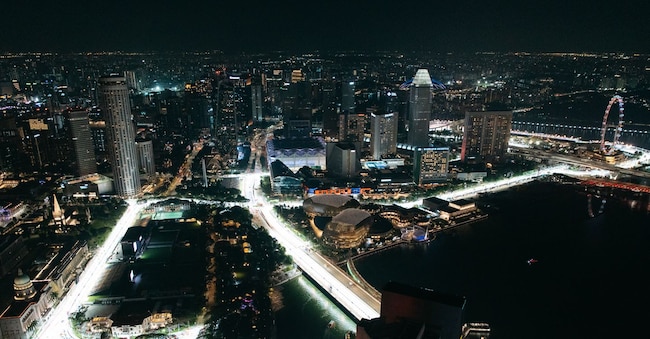
Formula 1 returns to Singapore, one of the most eagerly awaited stages since its introduction in the world championship in 2008. The Marina Bay circuit, perfectly integrated into the streets of the Asian city-state, was the forerunner of night races. The decision to race 'in the dark' stemmed from the need to align GP times with the European time zone, and also to allow drivers to race in lower temperatures, in a city with an equatorial climate. In addition, the sight of Singapore at night, with its thousands of lights and the desire to make it stand out in the eyes of the world, prompted the organisers (basically the Singapore government itself) to give the city a touch of glamour.

Since 2008, with Singapore leading the way, Formula One has seen the addition of more night races: the Abu Dhabi Grand Prix (2009), the Bahrain Grand Prix (2014), the Saudi Arabian Grand Prix (2022), the Las Vegas Grand Prix (2023) and, since last season, the Qatar Grand Prix. Just as the trend for city circuits is on the rise, so is the trend for night races, also considering the likely evening choice for the future Madrid Grand Prix.

Loading...

The Italian touch at the Singapore GP with DZ Engineering

.

Organising a Formula 1 race in the middle of the night in an urban setting is by no means easy, especially when you consider that the single-seaters are speeding at over 300 km/h: no flaw is acceptable. It is essential to ensure perfect visibility when cornering, with gradients, trees and reflective facades. But also to avoid annoying glare for the drivers, to guarantee the reliability of the system against rain, humidity and equatorial heat. To do this, an efficient lighting system is essential, and this is precisely what DZ Engineering, part of the Dino Zoli Holding group, is concerned with.

The Italian company, based in Forlì and specialising in the design and implementation of integrated solutions in the lighting and telecommunications sectors, picked up the baton from Valerio Maioli. The latter is the originator of the idea and many technological solutions in Formula 1, with an active presence since the 1980s. DZ Engineering, following in his footsteps, designed and built systems that were not only TV-worthy, but also controllable and modular, and that met strict safety criteria: precise light beams, zero shadow zones, immediate backup.

DZ's modular system in Singapore

.

The lighting system of the Singapore Grand Prix is an example of technological excellence and operational flexibility. The system is not owned by the Italian company, but 60% belongs to local institutions and 40% to private individuals. DZE Asia Pte Ltd acts as the operational manager during the event, taking care of the assembly of the system in the four months preceding the race and the subsequent dismantling, which takes about two months, with storage and maintenance of the material for subsequent editions.

As DZE Director in Singapore Marco Scaioli points out, 'the main competitive advantage of our system is its modularity. This modular approach is especially crucial in the case of changes to the track layout: the system can be disassembled, repositioned and reassembled quickly and efficiently, whereas a fixed system would make this operation almost impossible.

Environmental impact, efficiency and responsibility

In 2023, a significant change was the transition from discharge lamps to LEDs. This 'relamping' was achieved with a 1:1 replacement ratio, thus maintaining the same luminaire arrangement and ensuring the same apparent wattage but with a marked improvement in efficiency. Where in the past 2000 watts were required, today around 1300 are sufficient, with an average energy saving of 30%. In total, DZE Asia installed 1584 three-module and 34 two-module LED luminaires.

Switching to LED is certainly not a fad, but a responsibility to reduce consumption and indirect emissions. Also in future terms, the investment has an additional positive economic return due to lower maintenance costs, as LEDs last longer.

Communications and race systems: not just lights

DZ Engineering is not limited to lighting: the other half of the scene is communication on the track. From the control rooms, which are also coordinated in Italy for the Monza and Imola GPs, DZE has developed a technological ecosystem that supports every phase of the race: from emergency management to live feeds for television, from recovery interventions to the synchronisation of FIA decisions.

In addition, 'Race Control Systems' allow real-time monitoring of the status of lighting equipment. With this data, the company provides preventive maintenance and reduces the risk of blackouts or critical failures. Other technologies include monitor walls, CCTV camera management and joysticks to move them. Finally, DZE has developed Digiflags, the digital signalling system on the track. Instead of traditional flags, there are multi-coloured electronic panels that provide clear signals for drivers and teams. Today it is an FIA standard, used in all Grand Prix and has spread to other motor sports.

The situation in the championships ahead of the Singapore GP

.

With seven races to go, the drivers' championship still has no master: the mistakes of the McLaren drivers and the boundless talent of Max Verstappen have thrown anxiety and uncertainty on the Papaya fans. Piastri's advantage over the Dutch driver is still very wide (69 points) but, with a Red Bull on the rise (also demonstrated by Yuki Tsunoda's improvement), nothing seems predictable anymore. The Singapore Grand Prix, with its unpredictable weather conditions and a track that does not forgive mistakes, could be the last wildcard for Max, before a series of more traditional tracks.

The question is, in fact, whether Red Bull's progress is linked to the Milton Keynes car's ability to perform in extreme conditions, such as the very fast Monza and Baku, and whether McLaren's difficulties (apart from driver errors) can be attributed to the surprisingly cool temperatures in Baku. In the meantime, the bookmakers, who until two Grands Prix ago were quoting Verstappen's victory 100 times the stakes, have now dropped to much more moderate values, around 8, i.e. a probability of success of around 12%.

The other 'winner' in Baku was Carlos Sainz. The Williams driver brought the British team back to the podium after six years and, with his third place, collected practically the same points as he had earned so far. The Spaniard had been going through a lean season, consistently losing out in races to teammate Alexander Albon. However, the negative results were often conditioned by an ability to be in the wrong place at the wrong time, something that did not happen in Baku: excellent second place in qualifying and a GP lived with free air in front and little stress behind, given the counter-performances of the drivers of the top teams.

It is paradoxical that Sainz celebrated a race podium before his replacement at Ferrari, Lewis Hamilton. After 17 races, it can objectively be said that the SF-25 is a bad design as well as disappointing. In a race in which even Charles Leclerc did not do well, the Maranello team sees the overtaking in the constructors' standings by Mercedes complete, as well as the approach of Red Bull. It is possible to hypothesise a final finish even in fourth place, despite the opponents' negative performance of their second driver. On the other hand, of the four top teams, it is the only one not to have won any races, and the best driver (Leclerc) is fifth in the standings, well off the podium.

LE CLASSIFICHE

Loading...

The Singapore appointment

.

Looking back at the history of the Singapore Grand Prix, it can be said that, like Monaco, the Marina Bay circuit always makes history in relation to the rest of the season. The warm temperatures and the ability to exploit the mechanics have always seen Ferrari perform well, and here it boasts an absolute record of seven poles in sixteen editions, as well as four victories (like Mercedes and Red Bull). Not bad for an era in which Ferrari has collected little.

Indeed, Singapore is a very special GP: the only track among those fixed in the calendar that has not yet heard the Dutch anthem played for Max Verstappen. Last year, with not a few thrills, Lando Norris brought home victory and pole position.

The Singapore weekend starts on Friday with the first free practice session at 11:30 am Italian time (5:30 pm local time). Saturday's qualifying at 15:00 (21:00 in Singapore) and finally the race on Sunday not to be missed at 14:00 (20:00 local time).

Copyright reserved ©
Loading...

Brand connect

Loading...

Newsletter

Notizie e approfondimenti sugli avvenimenti politici, economici e finanziari.

Iscriviti

Tutto mercato WEB