Motorsport

F1, new industry structures and the challenge of the advanced hybrid

Two weeks after the conclusion of pre-season testing, teams and drivers are ready to get back on track at the Melbourne circuit to kick off a season that looks like a real white page in Formula 1. With a new technical regulation and a balance still to be defined, a championship that sees the entry of industrial giants such as Audi, General Motors and Ford will be inaugurated

by Massimo Ruberti and Glenda Mecaj

 EPA

7' min read

Translated by AI
Versione italiana

7' min read

Translated by AI
Versione italiana

The first Grand Prix in 2026 not only marks the start of competition on the track, but also certifies a radical transformation for the entire Formula 1 ecosystem. On the industrial front, the most important novelty is the reorganisation of the car manufacturers involved. In addition to the already known manufacturers, there is the entry of historical brands that have taken over racing teams or entered into new partnerships. Specifically, Audi definitively takes over Sauber, Renault discontinues its engine production after more than 30 years, Honda returns after a short break, and Cadillac, an expression of the General Motors group, makes its entrance.

Cadillac, however, is not the only news from overseas: strengthening the US presence in the Circus is a major agreement involving Max Verstappen's Red Bull. The Dutch driver will drive a car equipped with an engine built in-house (Red Bull Powertrains) in collaboration with Ford. The Detroit giant is entering Formula 1 on tiptoe after a 22-year absence, but taking an important strategic step highlighted by Bill Ford's statement: 'Let's be clear: the high-voltage systems and battery software we are perfecting for 2026 are the blueprints for the trucks and cars our customers will drive every day. When you choose a Ranger Raptor or an F-150, you are buying the data and grit gained during racing. We are not in F1 just to collect trophies, but to design better and better vehicles."

Loading...

24 Grand Prix and a new circuit: the 2026 calendar

The industrial and economic reorganisation of the teams goes hand in hand with the geographical and logistical reorganisation of the championship. The calendar has been structured according to a regional logic, with the aim of optimising logistics and making the organisation of Grand Prix more efficient and sustainable from an environmental and economic point of view. Thus, after the start in Melbourne, F1 will continue between Asia and the Middle East and, barring any disruptions linked to the recent conflict, one will have to wait until 7 June for the first European appointment (Monaco).

The European series will consist of nine races in a row, the last of which will take place on 13 September with the debut of the Madrid Grand Prix. The latter represents the main discontinuity of 2026 and marks the end of the double round in Italy, following the non-renewal of the Imola Grand Prix. The championship will end on 6 December in Abu Dhabi, the season's customary final theatre.

The mechanical revolution and sustainable fuels

The 2026 Formula 1 season opens with a profound regulatory change, which makes the championship very uncertain both from a sporting point of view and in terms of the strategic choices involved. The single-seaters have undergone a visible revolution (with new aerodynamic effects on the bodywork and wings) and an invisible one, under the bonnet, with a radical change in the power unit.

The engine remains a hybrid type, but the electric component has greater weight, providing around 50 per cent of the power. A significant change concerns the petrol: no longer of fossil origin, but 100% from renewable sources. This is not yet marketable on a large scale, but essential to set the direction and compete on the market with the advance of electric vehicles. In order to maintain dominance in fuels and energy production, petrochemical companies thus confirm the use of Formula 1 as a technological platform for advanced development.

A technological centrality also in the sporting sphere quantified sharply by Mattia Binotto, who heads the Audi F1 project, at the microphones of the Terruzzi Racconta podcast: "Fuel has a direct impact on engine performance, the difference between a good quality fuel and a bad one can be worth 10 to 15 kilowatts, or about 15 horsepower. In terms of lap time, this can mean four tenths, even half a second,' which is precisely why the choice of suppliers of these new fuels becomes crucial for the racing teams.

From Active Aerodynamics to Overtake Mode

With the increase of the power component, the FIA had to adapt the aerodynamics, favouring solutions that would allow the cars to have less drag. Unlike the old DRS (the movable rear wing activated for overtaking), which is now being retired, the new active aerodynamic system has an overall efficiency purpose. To facilitate overtaking, the real heir to DRS is the so-called 'Overtake Mode' (or Manual Override), which does not act on aerodynamics but provides a strategic boost of extra electrical power to the pursuing driver.

The architecture of the aerodynamic system is based on two main configurations: Cornering mode (or Z-Mode), which guarantees the high load essential for grip when cornering and braking, and Straight-line mode (or X-Mode), which can be activated on straights to move the flaps and reduce drag. The use of the latter by all cars is vital for energy management: without a drastic reduction in aerodynamic drag, in fact, the hybrid component would quickly run out of charge on every lap.

In order to balance the efficiency of electrical consumption with the strict safety requirements in the rain, where a low integral aerodynamic load would be dangerous, the Federation then introduced a third engineering option: Partial Active Aero. This configuration, specific for a wet track, foresees the exclusive opening of the front wing to preserve energy, while keeping the rear wing closed to ensure the necessary stability for the single-seater.

Winter tests and Aston Martin disappointment

The pre-season tests were longer than usual precisely because of this radical change, with one week of testing at Montmeló (Barcelona) and two weeks of sessions in Bahrain. Given the need for highly innovative technological development, the racing teams adopted heterogeneous construction philosophies, often favouring reliability and correlation of on-track data with simulations over pure performance. It is therefore very complex to delineate the real values in the field.

However, the tests highlighted Aston Martin's difficulties, held back by numerous technical problems despite being credited as one of the possible championship contenders, strengthened also by the full-time entry of Adrian Newey. The real challenge for the British team remains the transition from a proven engine like Mercedes to the new Honda supply, with all the unknowns of adaptation that entails.

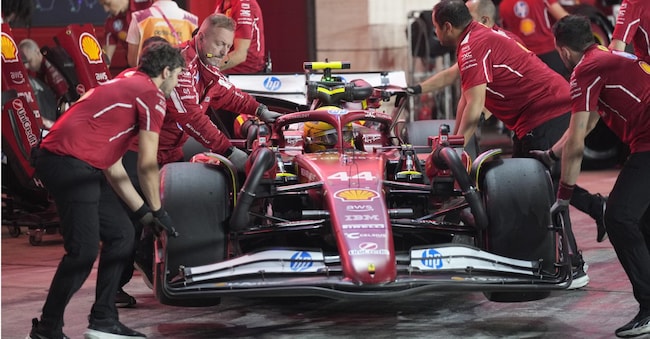
As always, special attention is paid to Ferrari. The signs emerging from the tests are encouraging, with Charles Leclerc setting the best overall time, confirming the good feeling around the Maranello team. Mercedes and Red Bull also look promising. According to what the Monegasque told Sky Sport F1, both teams seem to have hidden a lot of potential during the tests: "Red Bull seems to be in good shape, but Mercedes is also doing well. They are still hiding a lot. McLaren is the big question mark and the most difficult to assess."

Mercedes and the compression ratio knot: technical innovation at the limits of the regulations

One of the main themes that emerged during the pre-season tests concerned the Mercedes case, which ended up under investigation by the FIA for an alleged irregularity related to the compression ratio of the power unit. This parameter, which expresses the ratio between the total volume of the cylinder and the volume of the combustion chamber, was allegedly higher than the limit imposed by the technical regulations, resulting in greater thermodynamic efficiency and, consequently, an increase in performance in terms of power on track.

Toto Wolff comments: 'Our power unit is legal, it is in line with what is written in the regulations, with the controls and measures. The other teams get a move on'. Meanwhile, prompted by the rival teams, primarily Ferrari, the FIA has announced an adjustment to the regulations as of 1 June. In short, it promises to be a hard-fought world championship even off the track.

The Pilots 2026

Faced with an engineering upheaval on such a scale, most teams preferred to protect themselves by ensuring stability on the human capital front. Unlike last season, 2026 does not present any substantial revolutions in the driver line-up. The most important change concerns the expansion of the grid: there will be 22 drivers at the start, compared to 20 last year, thanks to the entry of Cadillac. The new team has focused on experience and solidity, relying on two veterans like Sergio Pérez and Valtteri Bottas. Another novelty at Red Bull, the team decided to promote Isack Hadjar alongside Max Verstappen, and consequently Racing Bulls chose to bet on rookie Arvid Lindblad.

Bookmakers' analyses of world championship victory: four teams in the running?

The unprecedented technical framework and the new grid layouts present a profoundly different scenario from 2025, the year in which McLaren almost doubled its rivals in the constructors' standings. Today, the quota market acts as a real benchmark for estimating technological values on the track. Suspicions about the power unit lead bookmakers to price Mercedes as the clear favourite for the constructors' title (40%), an advantage that is reflected in the drivers' championship, where George Russell leads the odds at 30%.

Behind the house of Stuttgart, the numbers certify the uncertainty linked to technological innovations: the odds for the constructors' title see McLaren and Scuderia Ferrari paired at 25%. Particularly telling is the market's assessment of Red Bull: the team is suffering from the unknown linked to Hadjar's performance, stopping at 10% among the constructors. However, the "human capital" represented by four-time champion Max Verstappen keeps the Dutchman at 20% for the drivers' title, ahead of Charles Leclerc (15%) and reigning champion Lando Norris (10%).

In the second line, the odds take a snapshot of a generational shift: expectations on Antonelli's talent (10%) equal the chances of a possible redemption for Lewis Hamilton (10%), while the victory of the host of the opening race Oscar Piastri is currently considered unlikely (5%). The other seven teams currently have no realistic chance of competing for the world championship. These are, in any case, estimates that are bound to change enormously after the first qualifying, when the track will provide the first real feedback.

Copyright reserved ©
Loading...

Brand connect

Loading...

Newsletter

Notizie e approfondimenti sugli avvenimenti politici, economici e finanziari.

Iscriviti

Tutto mercato WEB