Canadian GP

F1, the new regulatory change is a golden opportunity for young drivers

The 2026 Formula 1 season is marked by a momentous change: the new 60/40 hybrid engine and ongoing regulatory changes are levelling the field, favouring young drivers

by Massimo Ruberti and Glenda Mecaj

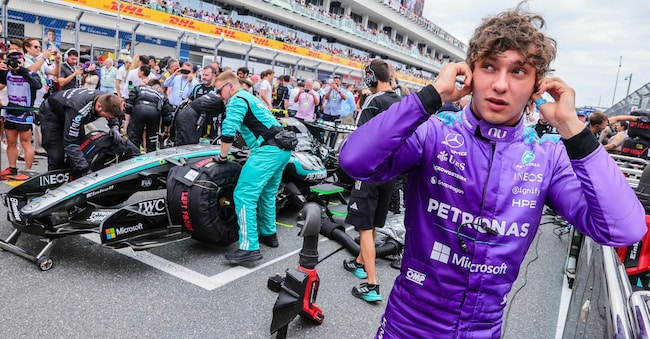
Il pilota italiano della Mercedes Andrea Kimi Antonelli scende dalla sua vettura sulla griglia di partenza prima del Gran Premio di Formula 1 di Miami, all'Autodromo Internazionale di Miami a Miami Gardens, in Florida (USA), il 3 maggio 2026.  EPA/CRISTOBAL HERRERA-ULASHKEVICH EPA

6' min read

Translated by AI
Versione italiana

6' min read

Translated by AI
Versione italiana

The start of this Formula 1 season is characterised by profound uncertainty, linked not only to the performance of the cars, but also to the evolution of the regulatory framework. The technical challenge introduced by the 50/50 hybrid engine has redefined the very essence of racing, profoundly altering some crucial moments of the race weekend, especially qualifying. As a result, almost every Grand Prix the FIA - the body in charge of drafting the technical and sporting regulations - initiates major changes, either with immediate impact or valid for the following season. The latest directive in chronological order, but perhaps the most impactful, envisages a more moderate 60/40 ratio between endothermic and electric power from 2027.

The great regulatory revolution of 2026 and the ongoing corrections are causing an unexpected phenomenon to emerge: younger drivers are overturning the hierarchies to the detriment of their more experienced colleagues. The need to adapt to completely new technologies and the consequent wiping out of the competitive advantage linked to the experience of veterans have accelerated a generational change that would physiologically take years. It is therefore no coincidence that, today, the current leader of the World Championship is only 19 years old.

Loading...

Andrea Kimi Antonelli: youngest Formula 1 World Championship leader

Toto Wolff's decision to give Andrea Kimi Antonelli the seat left empty by Lewis Hamilton has overturned the historical paradigm on which top team recruitment is based. Traditionally, in fact, young talents are made to mature in satellite teams in order to assimilate the mechanisms of F1 with less pressure: the paths of Charles Leclerc, with his apprenticeship year in Sauber in 2018, and of George Russell, with his three-year period in Williams from 2019 to 2021, are clear examples of this. The enfant prodige Max Verstappen himself played more than one season in Toro Rosso before the big jump to Red Bull. A practice also currently confirmed by Ferrari, which has placed Oliver Bearman at Haas while waiting for the right moment for a possible promotion to Maranello.

The physiological difficulties in rising to the top and the specific weight of experience mean that the average age of Formula 1 world champions is historically around 32, with the record for absolute precocity standing at 23 (Sebastian Vettel). Having a 19-year-old at the top of the championship standings is therefore a statistical anomaly, undoubtedly the result of the driver's crystalline talent and the farsightedness of the manager who bet on him, but triggered precisely by a regulatory reset that has forced the entire grid to start from scratch. Fundamental in this sense was the abnegation in the preparatory phase, as underlined by Antonelli himself: "The pre-season preparation was much more intense than last year. I spent several days in England on the simulator, trying to decipher the regulations. It's not easy: even though you try virtually, replicating the same dynamics on the track remains complex. Sometimes you are forced to go against your own instincts. What has made the difference so far has been excellent preparation and the effort to make manoeuvres that were initially unnatural look natural, so that you can automate them without expending too much energy.

The Circus now heads to Montreal with Antonelli in the lead. The 19-year-old arrives at the Canadian appointment as the youngest rainbow leader in the history of F1, twenty points ahead of his team mate George Russell and pushed by the long wave of a perfect weekend like the one in Miami. In Florida, his pole-win double was embellished with records that give the real dimension of the feat: by taking his third consecutive pole position, he equalled the winning start of such motor racing legends as Ayrton Senna and Michael Schumacher.

IL CAMPIONATO MONDIALE DI FORMULA 1

Loading...

The numbers of hierarchical overturning

To objectively measure the impact of the new regulations on performance, it is useful to analyse the internal comparison of the eight teams (out of eleven in total) that have confirmed the same driver line-up as in 2025. The two teams in the Red Bull orbit (due to Lindblad's entry and Hadjar's displacement) and the new entry Cadillac are therefore excluded from the scope of the investigation.

Within these eight pairs, isolating the 'young' from the 'experienced' profile, a marked age gap immediately emerges: on average, the former is 25 years old, the latter 34. The widest age range touches 17 (as in the duels Stroll against Alonso in Aston Martin and Bortoleto against Hülkenberg in Sauber), while Williams and McLaren present the most homogeneous line-ups. In the latter cases, there is barely a two-year gap in terms of age, but a much more marked asymmetry in terms of seniority within the team.

LE OTTO COPPIE DI PILOTI CONFERMATE NEL 2026

Loading...

Looking at the cumulative performance over the entire 2025 season, the veterans clearly dominated the internal duel. The most experienced driver scored a total of 1,129 points (a good 161 more than his younger partner), corresponding to 53.8% of the spoils collected by the eight teams analysed. An even sharper gap presented itself on the dry lap: in 60.6% of the cases the head-to-head in qualifying was won by the more mature driver (103 to 67). These numbers are hardly surprising and entirely in line with the historical expectations of the sector.

The start of this season, however, is telling a radically different story. The gap in qualifying has been completely closed, with the newcomers even taking a 16 to 15 lead in direct comparisons. This reversal is also clearly reflected in the standings: in terms of points won, the youngsters currently win the comparison 229 to 203, having taken exactly 53% of the points so far. A genuine handover.

IL CONFRONTO

Loading...

LA PERCENTUALE DI PUNTI REALIZZATI DAL PILOTA PIÙ GIOVANE

Loading...

The 'depreciation' of experience: with the new regulation we start from scratch

With the radical regulatory change that came into force in 2026, Formula 1 has started from a metaphorical blank sheet of paper. In this completely unprecedented technical scenario, the immense capital of experience accumulated over the years by veterans of the calibre of Fernando Alonso and Lewis Hamilton is in danger of suffering a sudden depreciation. The new generation single-seaters, equipped with power units with revised architectures, impose profoundly different driving styles compared to the past and require an extraordinary propensity to 'unlearn' the old automatisms.

It is no coincidence that the most vocal criticism of the new cockpit complexity has come from the most experienced drivers. At the microphones of Sky Sport, Fernando Alonso did not hide his perplexity: 'The 2026 rules seem complicated. Too many buttons, too ambitious and they might not even be enough to achieve the weight targets. Honestly I would like more creativity, not complexity. Is that what we want in the future?".

The 'digital natives' of motorsport and the push of gamification

While veterans struggle, younger drivers benefit from an undeniable competitive advantage rooted in their generational background. Having grown up in a constantly evolving technological ecosystem, they show a natural inclination to quickly assimilate the operation of complex interfaces. This sociological dynamic is also well known in business and economics: faced with disruptive innovations such as Artificial Intelligence, younger generations exhibit shorter learning times and significantly higher adoption rates than the cohorts that preceded them.

It is precisely on this assumption that former team principal Günther Steiner justified the current performance gap. Speaking on the Drive to Wynn podcast, the manager framed the situation as follows: "Young drivers have adapted better than the more experienced ones. They have fewer habits to change and, growing up in a world with more technology, they are more adept at managing it. These youngsters are the new generation of drivers who know how to use technology better than anyone else, precisely because they have grown up in it'.

A generation gap that even reshapes competitive training methodologies. If historically the obligatory rigmarole for every aspiring champion was to grind kilometres on karts, today the gamification phenomenon has shifted the centre of gravity to software: reflexes are trained by spending thousands of hours on simulators. A transition theorised and advocated even by the multiple champion Max Verstappen who, in a now famous interview, launched an opinion destined to set the standard: "A piece of advice I can give to aspiring drivers? Invest in a simulator rather than continue with karting'.

The value of experience for the newborn Cadillac

The entry of the eleventh team into Formula 1 did not bring anything new in terms of drivers, but rather brought back two veterans whose careers were thought to be over: Sergio Perez and Valtteri Bottas.

In a context of a total technical 'tabula rasa', where numbers show that young people adapt much faster, the decision of the fledgling US team to entrust its steering wheels to drivers at the end of their careers might seem counterintuitive. In reality, the choice obeys strict risk management logic.

While today's newcomers provide greater flexibility in adaptation and potential performance peaks, they statistically have a much higher incidence of driving errors. For a rookie team, having to juggle high start-up costs and the strict budget cap, damage to the single-seaters is a cost to be avoided. Relying on the experience of Perez and Bottas therefore means bartering performance and growth with the guarantee of a more conservative management, protected from excessive costs and damage in the delicate debut year.

The Montreal GP

The Canadian weekend will once again feature the Sprint format, with evening times for Italia dictated by the time zone. Friday's Sprint qualifying is scheduled for 10.30pm and will determine the starting order for Saturday's short race, scheduled for 6pm. This will be followed (at 22.00) by traditional qualifying for the Sunday race, with the traffic lights switching off at 22.00.

Copyright reserved ©
Loading...

Brand connect

Loading...

Newsletter

Notizie e approfondimenti sugli avvenimenti politici, economici e finanziari.

Iscriviti

Tutto mercato WEB