Engines

F1, the perfect money machine: from social boom to sustainable revolution

From projected revenues of over $3.5 billion to the sustainable revolution of 2026: the Circus reaps the benefits of American management. Female audiences and Gen Z drive engagement, while the stables' accounts steadily return to profit

by Massimo Ruberti and Glenda Mecaj

6' min read

Translated by AI
Versione italiana

6' min read

Translated by AI
Versione italiana

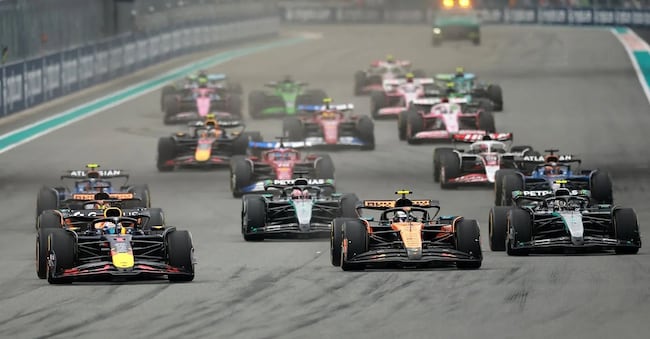
The year 2025 closes for Formula 1 with positive results on all fronts. On the sporting side, the final three-way battle between Max Verstappen, Lando Norris and Oscar Piastri kept fans in suspense until the last lap of the Abu Dhabi Grand Prix. On the media and popular side, the growth of spectators at GPs is a continuous sell-out and on social media the community is young and active. Finally, from a financial point of view, both the teams and Liberty Media are fully capitalising on this golden age.

The paradigm shift: from Ecclestone's vision to the conquest of Gen Z

Liberty Media's process of 'modernising' Formula One has been courageous, but it has borne fruit. Spectacle-making operations such as the Netflix series Drive to Survive, or the Drivers' Parade before races, appear clumsy in the eyes of long-term fans, but they have had the ability to bring in a more diverse audience.

Loading...

The confirmation of the success of this era of Formula 1 lies in the numbers, starting with the core business, i.e. ticket sales on race weekends. An analysis of the 20 GPs in 2025 for which we have access to data to calculate attendance shows that for the first time in history the average attendance exceeded 300,000. The peak was recorded at Silverstone with even half a million people, despite the fact that it was not a sprint weekend. The overall average figure is significantly up on 2024 (+4.2%) and is only limited by the number of places on the circuit, which require continuous investment to meet the growing demand.

Outside the racetracks, the data is even more surprising: in a recent questionnaire that Formula 1 published in collaboration with Motorsport Network, it emerged that 27% of respondents belong to Gen Z, with a perfect gender balance among fans. The consequence of this growth among young people and women is a meteoric rise in social media relevance. At the time of the acquisition by Liberty Media (2016), Formula 1 was not the most popular motor sport, ranking well behind MotoGP. Before long (in 2019), four-wheelers had caught up with motorbikes at 8.8 million followers on Instagram. Today the overtaking is clear, with the @F1 account at 40.5 million, while @motogp has more than doubled to 18 million.

The survey also shows that 27% of respondents have been following Formula 1 for less than five years and 61% interact with the category's social content on a daily basis. A figure that shows the Circus' ability to create active content and generate engagement, i.e. the ability to stimulate concrete interaction from the audience (such as comments, shares and 'likes'), an indication of a solid and ongoing relationship between user and brand.

FOLLOWER E TIFOSI

Milioni di follower e rispondenti al sondaggio in %

Loading...

Formula 1's media footprint is the result of a clear choice in the minds of Liberty Media, which already stated in its 2017 annual report: 'Formula 1's objective is to further expand the global reach and attractiveness of the World Championship in order to improve the overall value of Formula 1 as a sport and its financial performance. Key drivers of this strategy include: seizing the opportunities generated by the evolution of media, including the growth of social media and the development of Formula One's digital assets; enhancing the entertainment experience for fans; and engaging new fans globally in order to further increase race attendance and television viewership." Said and done.

A vision that is precisely 'young' and radically opposed to the perception of former patron Bernie Ecclestone, who declared to Campaign Asia Magazine in 2014: 'I'm not interested in Twitter, Facebook and all this nonsense; I've tried to understand it, but I'm too old-fashioned to see the value in it. I don't know what today's new generation really wants. If you have a brand to show to hundreds of millions of people, I can easily do it on television. You don't need to attract young people to expose them to a brand: kids who see Rolex are certainly not going to go out and buy one, they can't afford it'. Ipse Dixit.

Liberty Media's recipe

The growing global interest in the Formula 1 championship, combined with the expansion of the racing calendar, is generating tangible positive effects for Liberty Media. An analysis of the Formula 1 Group's economic data shows a gradual increase in overall revenue: from around $1.83 billion recorded in 2018 to $3.41 billion in 2024, an increase of around 86%. While waiting for the year-end financial report, it is possible to make a projection of 2025 revenues based on the latest quarterly report; a (conservative) estimate allows us to indicate a value of more than $3.5 billion.

L’EVOLUZIONE DEI RICAVI DI F1 GROUP

Ricavi totali. In milioni di dollari

Loading...

The financial reports published by the US group highlight three main revenue categories: circuit fees (or Race Promotion), media rights and sponsorship. Based on the data collected, media rights represent the largest share on average, accounting for 39% of total revenue. This is followed by the fees paid by the circuits (28%), while sponsorships contribute about 17%, still maintaining a strategic role in the growth of the group's revenue.

The cost structure also increased gradually, from $1.27 billion in 2018 to $2.33 billion in 2024. The most significant cost item is payments to the racing teams, which increased from $913 million in 2018 to over $1.2 billion in 2024, to about 54% of total costs. From 2026 there will be eleven slices of the cake for the teams, but with the new Concord Pact and Liberty Media's recipe, the banquet still promises to be rich for everyone.

STRUTTURA DEI RICAVI E DINAMICA DEI COSTI

In percentuale e miliardi di dollari

Loading...

The economic success of the stables

The evolution of payments to the teams means that the economic results of the Formula One racing teams under Liberty Media management are gradually improving. The following graph shows the average profitability of the teams based in England; Sauber (Switzerland) and the two Italian teams (Ferrari and Racing Bulls) are therefore excluded.

From 2019 (pre-pandemic year) to 2024 (last available year) the average revenue growth was 94%, reaching £344 million. The top performer in 2024 was Mercedes with 638 million. Costs also increased, but less than proportionally: already by 2021 the racing teams reached the coveted break-even point, with an average EBITDA of £24 million.

SCUDERIE IN ATTIVO

La dinamica entrate/uscite. In milioni di sterline

Loading...

Future perspectives: what can we expect from 2026?

In an increasingly commercial platform for sponsors and companies, the sporting value of the competition must remain at the centre, in order to guarantee the Circus long-term financial sustainability and crystallise continued growth. The Formula 1 championship of 2026 promises to be one of the most revolutionary of recent decades, thanks to a profound transformation on both the technical and sporting levels, and as a result, economically.

The new technical regulations will introduce substantial changes especially on the power unit front, with more emphasis on sustainability, electrification and the use of totally sustainable fuels, probably redefining the balance between the racing teams. The aerodynamics of the car will also be revised: the ground effect will be reduced and goodbye to the traditional DRS. The cars will have wings that can be activated on command on both the rear and the front of the car. A small revolution in the name of sustainability, which hopefully will also increase the spectacle on the track.

Making the 2026 season even more interesting is the start of a championship in which the manufacturers' title will no longer be contested by 10 teams, but by 11 with the entry of Cadillac. In addition to the American manufacturer, we will see the entry of Audi in place of Sauber and the tiptoeing arrival of Toyota alongside Haas.

There will also be changes in the driver line-up: in addition to the return of Perez and Bottas to the championship driving Cadillacs, Red Bull is promoting Isack Hadjar alongside Max Verstappen, leaving Yuki Tsunoda without a grid place; making his debut in Racing Bulls Arvid Lindblad, the only 2026 rookie.

A further curiosity undoubtedly concerns the complementarity of Formula 1 and MotoGP, acquired definitively by Liberty Media on 3 July. As we have seen from previous figures, MotoGP was at the top of motorsport preferences until a few years ago, before this phase of relative decline. Will the US company be able to replicate the recipe and bring MotoGP back at least in the wake of Formula 1?

Copyright reserved ©
Loading...

Brand connect

Loading...

Newsletter

Notizie e approfondimenti sugli avvenimenti politici, economici e finanziari.

Iscriviti

Tutto mercato WEB