Bahrain GP

F1, around the world in 24 weekends and the global logistics operation

If on Sunday all eyes are on the drivers, single-seaters and the competition on the track, it is during the week that another crucial race takes place: that of logistics. Liberty Media's management is aiming for a more global Formula 1 that is attentive to sustainability issues, two aspects that are difficult to reconcile when you consider that logistics operations are responsible for around half of the Circus' carbon emissions

by Massimo Ruberti and Glenda Mecaj

(Alex Plavevski/Pool Photo via AP)

8' min read

8' min read

The first three very different races have painted a very clear picture of the technical hierarchies of the 2025 projects. McLaren is confirmed as the most driveable and high-performance car with both drivers fighting for the championship. The Red Bull, a much more nervous and difficult car to tame, has in its driver Max Verstappen a true phenomenon of driving on the limit. The Dutchman, just one point from the top of the world championship, has scored 100 per cent of his team's points.

Ferrari has already accumulated a delay of 76 points from the top of the world championship. Beyond the double disqualification of the Shanghai Grand Prix, the gap with the rivals is disarming. Frédéric Vasseur has tried in front of the media to lower the bar of Ferrari's ambitions, perhaps to protect the Scuderia. However, there is no point in hiding behind a finger: the more than positive end to the 2024 season and the arrival of Lewis Hamilton have rightly created high expectations for the championship, confirmed by the latter at the presentation of the SF25 in Milan: "I believe we can fight for the championship".

Loading...

Ferrari's great hope is car updates. It sounds a bit rhetorical by now, but Formula 1 lives on technical updates and, on balance, in a championship with very close lap gaps, the marginal effect of technical improvements can drastically change the current scenarios. See for example 2024, when after the first six races McLaren was 115 points behind Red Bull, only to win the constructors' championship thanks to technical development.

On the Mercedes side, one sees a consistency of performance with the two drivers always close to the positions that count, but without peaks of performance. If George Russell is confirming himself as an excellent driver, especially in qualifying, the one who is really stealing the eye is Andrea Kimi Antonelli. The 18-year-old from Bologna, author of an excellent performance at Suzuka, confirms the great managerial skills of Toto Wolff. The seat abandoned by Lewis has been worthily replaced by a boy who has time to make mistakes, but also to make people dream.

From the Far East of the first three races, we return to the Middle East, to Bahrain, now a reference point for Formula 1 and the venue for pre-season testing. The internationalisation of Formula 1 has led to an increase in Grand Prix and the challenges associated with travelling and organising the championship. Driven also by environmental concerns, these intercontinental journeys have, as far as possible, been optimised recently. Let us see how.

CAMPIONATO 2025 POST GP GIAPPONE

Loading...

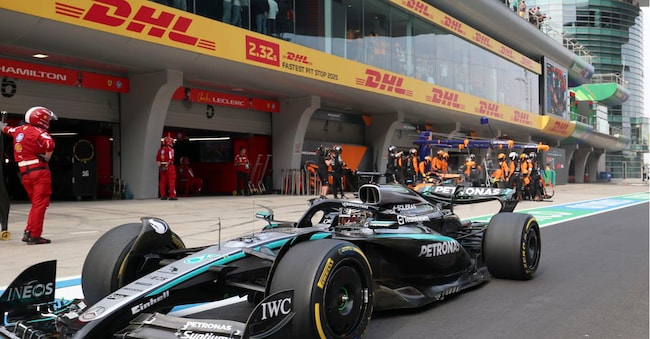
The Formula 1 championship is one of the most complex sporting events to organise and the success of each Grand Prix depends on the efficiency with which cars, equipment and teams are transported around the world. To ensure the success of these global operations, Formula 1 relies on DHL, an official partner for more than 20 years. The leading global freight forwarding company handles the transport of around 1,400 tonnes of essential materials for each race, including single-seaters, tyres, spare parts, fuel, communication equipment, marketing and hospitality materials.

The partnership has had to adapt to major changes, such as the increase in the number of races in the championship over the years and the increased focus on an increasingly sustainable Formula 1. In particular with the Net Zero Carbon goal for the total reduction of carbon emissions, which requires the commitment not only of the Formula 1 Group and the teams but also of sponsors, commercial partners and especially logistical partners. In fact, according to the sustainability report published by Formula 1 in 2023, 49% of the total carbon emissions (223,031 tonnes of CO2 in 2022) came from logistics and 29% from moving the workforce (an average of 50 people per team).

For more urgent deliveries, DHL uses air transport with fuel-efficient Boeing 777 freighters and sustainable aviation fuel. Instead, it relies on sea transport for less urgent cargo between different continents. By contrast, especially for European tenders, land transport is predominant, given the shorter distances. In the land fleet in Europe, there are 37 DHL trucks powered by HVO100 biofuel (hydrotreated vegetable oil), which have reduced emissions by an average of 83% per truck compared to trucks with conventional fuels.

Grand Prix calendar on a regional basis for greater logistical efficiency: comparison between 2018 and 2025

Since the Net Zero Carbon target was published in 2018, all stakeholders and in particular Formula 1 itself have been activating strategies that aim to achieve it by 2030. A first step towards approaching the target was to revisit the Grand Prix calendar on a regional basis. This allows, despite the increase in the number of championship stages, to cross all continents except Africa in a more logistically efficient manner. One must consider that in the planning of the championship stages and their distribution over the course of the year, climatic conditions play a decisive role. One example is the European races, which are rarely scheduled in autumn or winter, but are generally concentrated during the spring and summer seasons due to the favourable weather conditions.

The evolution of Liberty Media's strategies to make Formula One an increasingly globally watched sport has led to an expansion of the championship to markets outside Europe. In the United States, where previously there was only one round in Austin, the calendar now includes three stages with the addition of the Miami and Las Vegas Grand Prix. At the same time, expansion in Arab countries has seen the entry of the Qatar Grand Prix and Jeddah, which join the already consolidated events in Bahrain and Abu Dhabi. As a result, of the 24 races in the 2025 season, only nine are European (37.5%). In 2000, there were 17, of which 11 were European (64.7%).

Without going too far back in time, let us make a comparison between 2018 (the year the Net Zero target was published) and the current season.

The expansion of the championship has made it necessary to redefine the calendar, eliminating Grand Prix scheduled for 2018 such as Russia, France and Germany to make way for new events, such as the Netherlands, Imola and the four new stages outside the European continent, adding three races compared to the 21 in 2018. While in 2018 many of the transfers took place within Europe, with short distances between certain circuits, such as Le Castellet-Silverstone for 825 km and Silverstone-Hockenheim for 742 km, today, on the other hand, a more globalised calendar is planned, with long transfers required, such as the one from Singapore to Austin of almost 16,000 km. The increase from around 104 thousand kilometres covered in 2018 to more than 114 thousand kilometres to be covered this season is therefore not surprising, registering an increase of 9.6 per cent. However, if we look at the average distance travelled there has been a reduction of 250 km per trip, which is far from obvious given the greater geographical dispersion of the new stages.

Another difference related to the expansion of the championship is the frequency of Grand Prix in consecutive weeks. The logistical operations are more intense and the work of the drivers, teams and backstage staff is more tiring. This is especially true for the three 'triplets': in April (Japan, Bahrain and Saudi Arabia), in May (Imola, Monaco and Barcelona) and the three end-of-season races between November and early December (Las Vegas, Qatar, Abu Dhabi).

This is a challenge for everyone involved, also for the logistics partner DHL: "As the official logistics partner of Formula 1, DHL will take care of a total of 24 races in 2025. Transporting everything from the media centre to the safety cars, the DHL team will take on 3 times 3 races in succession and 5 times 2 races in succession without a weekend break, in a revised F1 calendar on a regional basis."

CALENDARIO FORMULA 1

Loading...

More Grand Prix and more sustainability, is it possible?

Formula 1 on the one hand pursues global growth, expanding into new markets and increasing the number of races; on the other hand, it has set itself the ambitious goal of achieving carbon neutrality by 2030. So how does Formula 1 strike the right balance between internationalisation and increased sustainability?

Firstly, with the reorganisation of the calendar stages on a regional basis to reduce the total kilometres travelled. For example, the Japanese Grand Prix has been brought forward to spring to align with Australia and China and reduce intercontinental flights. In addition, starting in 2026, the Canadian Grand Prix will be moved to May, placing it close to the American races and contributing to a further reduction in distances travelled.

FIA President Mohammed Ben Sulayem on the calendar action said: "The 2025 FIA Formula One World Championship calendar, approved by the World Motorsport Council, is a further demonstration of our collective mission to achieve sustainability goals through regionalisation of events. While our primary objective is the overall stability of Formula 1, we also have a shared responsibility to the environment and the health and well-being of the travelling public."

Despite the progress towards an increasingly regionalised calendar, some critical issues remain. The three races in the United States are sub-optimally distributed, with Miami scheduled for round six, Austin for round nineteen and Las Vegas for round twenty-two. Even in Europe the sequence of races could be improved, with the Canadian Grand Prix positioned between Barcelona and Austria breaking the continuity of the European stages.

Also with a view to a more sustainable Formula 1, some teams such as Mercedes and Ferrari have implemented remote garages, i.e. set-ups at the team's headquarters with advanced telemetry technology and real-time data connections that allow engineers to monitor and analyse the performance of the cars, develop strategies and support the team on the track as effectively as a physical presence in the pits.

This not only makes league management more sustainable from an environmental point of view, with a reduction in carbon emissions due to staff travel, but also from the point of view of the well-being of the workforce, as they are not subjected to the stress that moving from one part of the world to another can generate.

The growing number of stages outside Europe confirms Formula One's plans to expand into strategic markets such as the United States, the Middle East and Asia, but the risks are many, including increased logistical costs, environmental impact and an increasingly stressful season for teams.

The Bahrain stage

Whether indeed globalisation of the championship and greater sustainability can go hand in hand, we will only find out with the evolution of Formula 1. Meanwhile, with not a little inconsistency, after three very distant stages we return to where the teams did their pre-season testing just over a month ago. The characteristics of the Manama circuit offer little hope to the outsiders, given the improbability of adverse environmental conditions and above all the huge amount of data accumulated by the teams on this track.

However, compared to the Suzuka race, there will be more room for strategy. In fact, the race in Japan with only one stop and a circuit that is not conducive to overtaking, was an uninspiring race, with the drivers arriving with their starting order (with a few exceptions). In Bahrain, there will be room for comebacks and overtaking, with a strategy that is usually two stops. Qualifying on Saturday will take place from 6pm, while the race will be on Sunday at 5pm.

Copyright reserved ©
Loading...

Brand connect

Loading...

Newsletter

Notizie e approfondimenti sugli avvenimenti politici, economici e finanziari.

Iscriviti

Tutto mercato WEB