Suzuka Grand Prix

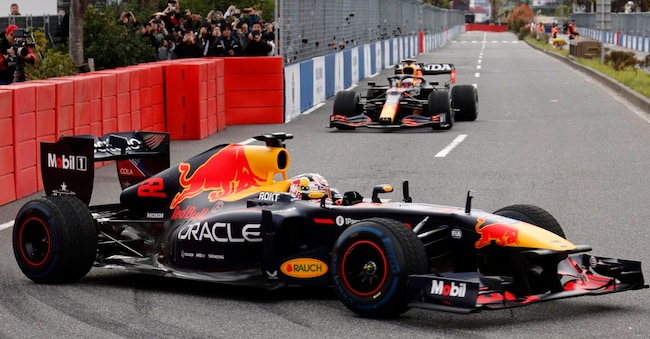
F1 stops in Japan: expectation for Yuki Tsunoda's Red Bull debut

Ferrari awaits an important test on a demanding track. Meanwhile McLaren is already showing a technical dominance that fans of the other teams hope will be overcome with the next updates

by Massimo Ruberti and Glenda Mecaj

6' min read

6' min read

The sprint weekend in Shanghai had started well for the Maranello stable with Hamilton's victory. Lewis deluded all the Red Team fans with a performance of pure domination in tyre management, but already in qualifying a few hours later the music changed. In fact, the two red drivers did not prove competitive and shared the third row. Sunday ends much worse, with the cars disqualified for two different irregularities: Leclerc's 16 due to being underweight by 1 kg and Hamilton's 44 due to excessive consumption of the skid pad placed to protect the bottom.

Regardless of the tragic adventures of the Maranello stable, Formula 1 arrives in Japan with a lot to say. The news of Yuki Tsunoda at the helm of Red Bull is heart-stopping for the Japanese people, among the most passionate about motorsport. The decision to replace Lawson after only two races can be attributed to an effort by Honda (Red Bull's motoring partner), which has always been Yuki's main sponsor, but it is not surprising, given the many race farewells that have taken place in the Milton Keynes stable. The change apparently did not find favour with Max Verstappen.

Loading...

Japanese adventures in Formula 1

.

While in two-wheel racing Japanese manufacturers have long dominated with 657 victories in the premier class of motorbike racing (more than twice as many as Italian manufacturers), in Formula 1 Japanese manufacturers have had less luck. Honda, supplier of engines for over 500 races in F1, participated as constructor from '64 to '68 and then again from 2006 to 2008, achieving at most three victories in 88 Grand Prix, but never the podium in the constructor's classification.

Other Japanese parent company adventures are limited to Toyota's 140 races between 2002 and 2009 (zero victories). Toyota, perhaps the world's most famous manufacturer of hybrid cars, left racing just at the dawn of the hybrid evolution in Formula 1, missing an opportunity to position the Japanese brand in a higher segment. Indeed, Toyota's technical ability in motorsport is unquestionable, just look at its recent dominance in the WEC championship.

Other teams that tasted Formula 1 without making their mark were Maki with 8 races between 1974 and 1976, Kojima with 2 races in 1976-1977 and more recently Super Aguri: 39 races in the three-year period 2006-2008. The latter team, supported by Honda, even ended the 2008 season after only four races, literally leaving Takuma Sato, so far the greatest Japanese driver in Formula 1 history, with an eighth place finish in the 2004 season. Honda, Sato's sponsor at the time, certainly believes in Tsunoda as heir and new superhero of the Rising Sun.

Brief economic overview of the Rising Sun

.

Japan has certain economic and demographic characteristics that make it very similar to Italy. Like our country, Japan had an important break with the past in the Second World War that led it to relaunch itself economically, experiencing a real boom. A growth even greater than the 'Italian miracle', which led it in a few years to become the second economic power behind only the United States.

Although Japan has experienced temporary crises since the 1970s, it is since the 1990s that the country has entered a period of economic crisis, so complex and with no apparent way out that it has given rise to the concept of Ushinawareta Jūnen, lost decade. The decades, which have now become three (Ushinawareta Sanjūnen), have been characterised by a stagnant GDP and the loss of economic dominance over East Asia, subordinated to China, Japan's main export market.

Among the challenges facing the Japanese economy are the high public debt (around 250% of GDP) and an ageing population (28.7% over 65) accompanied by a low birth rate (1.38 children per woman). Problems with which we are familiar in Italy. The post-Covid era is also causing Japan to experience inflation not seen since before the 'lost decades', prompting the Bank of Japan to slowly raise interest rates that were literally below zero. This is not helping the purchasing power of the Japanese, with a currency, the Yen, that has lost a lot of ground against major international currencies since 2020.

Within a lacklustre macroeconomic picture, however, Japan remains among the world leaders in the automotive market, contributing 2.9 per cent of national GDP and 13.9 per cent of manufacturing GDP, and retaining the fourth place globally in terms of revenue thanks to many internationally known car manufacturers, such as Toyota, Honda, Nissan, Mazda, Suzuki, Subaru, Daihatsu and Mitsubishi.

Japan is the world's largest producer of low to mid-range vehicles

.

Since the 1960s, Japan has been one of the world's largest car producers. Although the production trend is declining, the number of cars produced was over 8 million units in 2024. But what were the steps that led the Land of the Rising Sun to consolidate itself as a major car manufacturer? Let us look at it briefly.

In the 1910s, some industries followed the 'watch and learn' strategy, building their first cars following the European example, such as the Mitsubishi Model A, which was based on the Fiat Type 3; others sought licences to produce and sell cars of European brands, and still others decided to focus on truck production. Within 20 years, the Japanese automotive industry saw a strong expansion, especially with the three US giants opening their subsidiaries in the country: Ford, General Motors and Chrysler, producing between the 1920s and 1930s more than 208,000 vehicles compared to only 12,000 from domestic manufacturers, including Toyota, which presented its first model, the Toyota AA, in 1936. This era ended in the early 1940s when the Japanese government enacted a law forcing foreign manufacturers to leave the country.

In the first decade after World War II, production focused mainly on trucks, but later passenger cars became predominant in the market thanks to Japanese designs that continued to be inspired by European and American models, with Subaru, Suzuki, Daihatsu and Honda launching their first cars in the mid-1950s.

The Japanese automotive industry began to shine in the 1960s with the launch of kei cars, very small cars that made buying cars accessible to the population and exponentially increased sales and market development that continued in the following decades, leading Japan to become one of the global leaders in the production and export of mid- to low-end cars.

AUTO PRODOTTE IN GIAPPONE DAL ’93 AD OGGI

Loading...

The F1 Project: Flagship One

.

It was easy for Japan to penetrate the lower-medium car market, but it took the Flagship One (F1) project, initiated by Toyota, which involved 1,400 engineers, 2,300 technicians and 60 designers and required an investment of around USD 1 billion to bring the Lexus brand to life with the LS 400 model in the late 1980s.

Advertised in 1989 at the North American International Auto Show in Detroit, the model was praised for its quietness and value for money, selling more than 63,000 units within a year of its official launch. By the end of 1991, Lexus became the best-selling premium import car brand in the United States, with sales of more than 70,000 units. That same year, the LS 400 was ranked number one by J.D. Power and Associates due to its quality, customer satisfaction and sales. The brand's success led to the increase in the price of its models in the US market, while still remaining competitive with European prices of premium models, and the gradual expansion of its product range, including the first LX 450 SUV in 1994, the IS sports sedan in '99 and the first SC 430 convertible in 2001, until it was able to expand globally.

The success of the Lexus car brand is evident, with a large growth in percentage terms of the total Japanese car sector, but in absolute terms it is the mid-range brands such as Nissan and Toyota that still dominate the number of new sales.

PERCENTUALE AUTO LEXUS SU TOTALE AUTO GIAPPONESI

Loading...

On average, since '93 to date, 40.78% of the annual production volume is destined for export: in 2024, for example, out of more than 8 million cars produced, some 3.8 million were exported. If Japan finds a living target in the USA to export its cars (around 20% of total exports), the same cannot be said for Europe, which is the destination for only around 10% of total exports. If we look at the ten best-selling car models in the world in 2024 (Statista data), we find four Japanese car models: compact sedans or SUVs. A confirmation of how small cars, once the soul of Japanese (but also Italian!) production, are still struggling, despite the potential advantages of lower production costs.

AUTO PIÙ VENDUTE NEL 2024

Loading...

Drivers' and Constructors' Championship post-China

The predominant colour in this championship for the time being continues to be orange, with McLaren triumphing in Shanghai with the one-two that could have been won as early as Melbourne if it had not been for Piastri's long run, but the Australian driver was able to bounce back by earning his first career pole and his third win in China. If the constant of this early year is the strength of the McLaren team, the hierarchy between the two drivers is less clear. Piastri in China beat Norris in both qualifying and the races, confirming that he was very competitive.

It was also a positive weekend for Mercedes with Russell on the podium and Antonelli P6, and for Haas who got their first points of the season with Ocon P5 and rookie Bearman in P8. Flavio Briatore will not be happy, who sees Alpine still on zero points after the second race with Gasly's disqualification and a still uncompetitive Doohan. Once again an early morning wake-up call for fans, with qualifying at 8am and the race at 7am.

IL CAMPIONATO 2025 POST GP DI CINA

Loading...
Copyright reserved ©
Loading...

Brand connect

Loading...

Newsletter

Notizie e approfondimenti sugli avvenimenti politici, economici e finanziari.

Iscriviti

Tutto mercato WEB