Dutch Grand Prix

F1, teammate comparison and Elo scores: who is really the strongest?

Formula 1 resumes from Zandvoort with the last half of the season and a drivers' championship contested between Norris and Piastri. If the comparison between teammates remains the most immediate method, the Elo system - borrowed from chess - could offer an alternative assessment of the real value of the protagonists on the track

by Massimo Ruberti and Glenda Mecaj
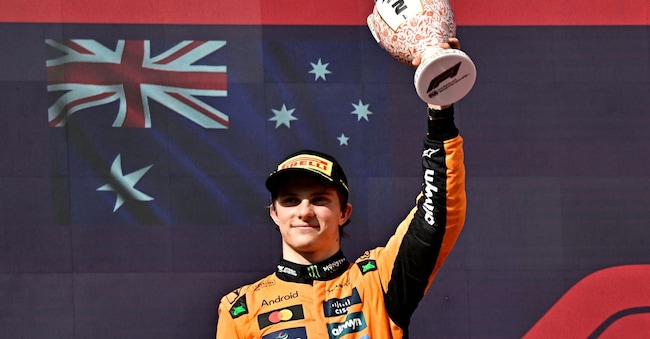
3 agosto 2025 Oscar Piastri della McLaren festeggia sul podio con un trofeo dopo il secondo posto nel Gran Premio d'Ungheria REUTERS/Marton Monus/

7' min read

7' min read

Formula 1 resumes from Zandvoort with the last half of the season and a disputed drivers' championship between Norris and Piastri. In a sport where driver rivalry is the mainstay, comparing performances is never easy, because they depend to a large extent on the potential of the single-seater. If the comparison between teammates remains the most immediate method, the Elo system - borrowed from chess - could offer an alternative assessment of the real value of the protagonists on the track.

Formula 1 resumes in Holland

After the Hungarian Grand Prix and a three-week summer break the drivers take to the track at Zandvoort to begin the final part of the 2025 season, a championship in which McLaren's orange is the predominant colour. The constructors' victory is virtually in McLaren's pocket, with a 299-point gap to Ferrari in second place. The drivers' title is also contested internally between Piastri and Norris, separated by just nine points.

Loading...

Ferrari, a week away from its home Grand Prix in Monza, must start again from Zandvoort, forgetting Hungary, where a disastrous and obscure problem thwarted Charles Leclerc's excellent pole position. These last ten races of the season must boost morale at Maranello, especially for Hamilton, who has reached the lowest point of his glorious career. Perhaps it is the extraordinary level reached by Charles Leclerc that puts Lewis Hamilton in the most difficulty: it is well known that the first opponent is the team-mate and, as we shall see, never before has there been such a big difference between the pairs of drivers as this year. With the great exception of the balance between Piastri and Norris.

CLASSIFICA CAMPIONATO

Loading...

A confrontation between stable mates: unbalanced head-to-head between drivers

.

Formula 1 is one of the most competitive sports that exists and in which the rivalry between drivers is at the heart of the championship. Every driver gets into a single-seater with one goal, that of winning and becoming world champion, but this dream is only realised for a few. The skill of a driver, however great, does not alone determine championship victory, as the key factor is the performance of the single-seater on the track. Just look at how four-time reigning world champion Max Verstappen is floundering this season: his skill certainly hasn't diminished but the performance of his single-seater relative to that of the dominant McLaren absolutely has.

If making a comparison between drivers who are not part of the same team is difficult, it is a different matter between teammates with the same car. In the following table we see in detail the data that allows an objective comparison to be made between drivers from the same team. The three factors analysed are the number of races in which a driver finished in a better position than his teammate, the number of qualifying races in which a driver finished ahead of his teammate, and the championship score of each driver. From the analysis carried out, a disparity between teammates is found in all the racing teams, in some there is a huge gap between one driver and the other, in others it is smaller. As mentioned above, the only exception is the balance at McLaren.

The teams where the disparity between drivers is most obvious are Red Bull, where Verstappen with 187 points has always prevailed both in qualifying and in the race over his partner Tsunoda with only 7 points. In Mercedes, Antonelli has never placed ahead of Russell in a race and has only prevailed over Russell in one qualifying. In Aston Martin, although the two drivers are on equal points, in qualifying Alonso has always finished ahead of Stroll (14-0) and also in the race the Asturian has clearly outdone the Canadian (8-2). Even in Alpine the situation is no better, with Gasly dominating both in qualifying and in the race over team-mate Colapinto, still with zero points in the championship. In Williams, Albon with 54 points prevailed over Sainz (16 points): a dull season for Sainz, who only finished ahead of his teammate twice in the race despite prevailing over Albon for six qualifying runs. At home in Ferrari, Hamilton's level is lower than expected. Leclerc has so far clearly outperformed his team-mate in the race (11-2) and in qualifying (10-4), although the difference is less clear-cut in the classification (151 vs 109). More balanced instead are the results in Racing Bulls, Sauber and Haas.

TESTA A TESTA TRA COMPAGNI DI SCUDERIA

Loading...

Applying the chess Elo system in Formula 1 to make comparisons between drivers from different teams: is it possible?

Comparing the skill of drivers from two different teams is complex, but not impossible. For example, it is also possible to apply the Elo system, borrowed from chess, to Formula 1. Introduced in the 1970s, the Elo system makes it possible to measure the strength of players by relating them to each other: based on the results of each match played in a career, points are gained or lost depending on whether one wins or loses. The number of points varies depending on the relative strength of the opponents.

To give a practical example: if player A has a higher Elo score than player B, and is therefore considered stronger, it is expected that A will win over B. If A actually wins, he will get few points and B will lose relatively few (because he lost to a stronger opponent). Conversely, if B were able to win against A, he would gain many points, having beaten a player statistically stronger than him. At the same time, player A would lose more points, having been defeated by an opponent of lower rank. Thus, this method assigns a statistical score that varies according to the results: the higher the score, the greater the player's strength, and each victory or defeat changes the value according to the difficulty of the opponent faced.

The Elo system applied to Formula 1 is based on head-to-head competition between team mates and follows a specific logic. Each year the Elo score is equal to the last figure of the previous season, if the driver is a rookie then the Elo base is 1500 points. In this way at each Grand Prix the team mates are compared to each other based on their performance in qualifying and their performance in the race: the score is only calculated if both drivers from the same team cross the finish line. In the long run, this system makes it possible to compare the performances of drivers from different racing teams, as the following tables show.

The first table shows the ten strongest drivers in Formula 1 history, sorted according to the maximum Elo achieved after one race. It is not surprising to find among the first names not only drivers currently on the grid, such as Max Verstappen, in first place with a maximum Elo of 2045 points after the Belgian Grand Prix, but also great drivers from the past. These include Jenson Button with 1906 points recorded after the 2016 Australian Grand Prix and Ayrton Senna with 1861 points in 1990 after the Portuguese Grand Prix against teammate Berger. It is worth noting, somewhat surprisingly, the tenth position of Alexander Albon, a driver held back by the performance of the Williams and who has not yet been able to show all his talent in a title car, but who has often prevailed over his team-mate, as he is doing with Carlos Sainz in 2025.

TOP 10 ELO CARRIERA

Loading...

The second table focuses instead on the highest Elo looking only at the qualifications. In this case, the ranking shows a different dynamic: in first place we find Senna, with 2287 points achieved after qualifying for the Italian Grand Prix in 1991, followed by Michael Schumacher (2187) after qualifying for the Belgian Grand Prix in 2001, and in third place Lewis Hamilton (2080) after qualifying for the Russian Grand Prix in 2021. In fact, these are also the three drivers to have won the most pole positions in their careers..

TOP 10 ELO QUALIFICHE

Loading...

These data show how the application of the Chess Elo system to Formula 1, over an extended period of time, allows objective comparisons to be made between drivers from different teams and eras, offering a quantitative measure of their relative performance on the track.

ELO ATTUALE DEI PILOTI IN CAMPIONATO

Loading...

Based on the above, it is possible to create an objective comparison of the current pilot line-up. It is important to keep in mind that the Elo score is variable, it can increase or decrease depending on the strength of the opponent. Furthermore, every Formula 1 driver starts with an Elo base equal to the last score of the previous year, except for rookies who started with a base score of 1,500 points.

From reading the data, a well-defined top three emerges: at the top is Max Verstappen, absolute leader with 2045 Elo in the race and 1963 in qualifying, followed by George Russell, who records 1877 in the race and 1957 in qualifying, and Alexander Albon, with 1843 in the race and 1783 in qualifying. It is interesting to note that Russell, unlike the other two, has a higher Elo in qualifying than in the race, an indication that his dry lap performance is, on average, more impactful than his race pace.

Scrolling down the rankings, among the Ferrari drivers we find Charles Leclerc in fourth position, with an Elo of 1773 in the race and 1738 in qualifying, values that place him ahead of his team-mate Lewis Hamilton, eighth with 1594 in the race and 1657 in qualifying showing - like Russell - more solidity in qualifying than in the race.

The current leader of the drivers' championship (Oscar Piastri) only occupies ninth place in this ranking, with an Elo of 1567 in competition and an Elo of 1709 in qualifying. It should be pointed out, however, that this system is more accurate due to variations in team pairs, and Oscar Piastri has so far only been able to compare himself with Lando Norris

The expectations for the Dutch Grand Prix

.

The Dutch Grand Prix will take place in standard format, with qualifying on Saturday at 3pm and the race on Sunday at the same time. The compulsory favourites are the two McLaren drivers, with Lando Norris already dominating in 2024 when he took pole position, victory and fastest lap. Headlights are also on the host, Max Verstappen. The Dutch phenomenon has achieved just one podium in the last seven races, showing flashes of light in the pole at Silverstone and the sprint race at Spa-Francorchamps. However, Red Bull is going through a complicated technical period, during which Yuki Tsunoda is also sinking.

Copyright reserved ©
Loading...

Brand connect

Loading...

Newsletter

Notizie e approfondimenti sugli avvenimenti politici, economici e finanziari.

Iscriviti

Tutto mercato WEB