
F1: the race among energy giants towards new sustainable fuels
With the introduction of 100% sustainable fuels, the World Championship is also being decided in the laboratories, with a multi-billion-dollar battle between five energy giants. It is a contest in which innovation is not just about shaving tenths of a second off the clock, but about securing technological leadership for the mobility of tomorrow

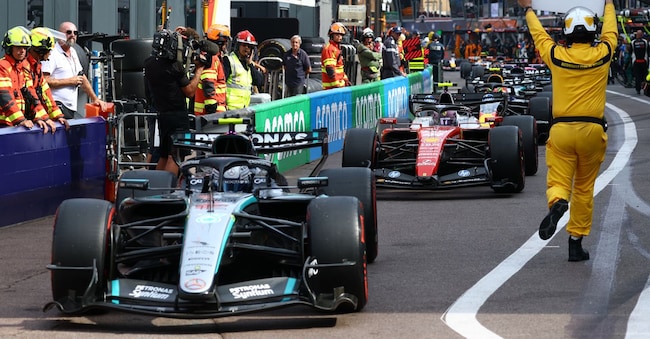
Andrea Kimi Antonelli’s start to the 2026 season can be summed up in figures: nineteen years old, five consecutive wins, and a 68-point lead over his team-mate, George Russell, after six races. Or through the latter’s excuses: in Miami, ‘it’s clearly a circuit where I struggle and Antonelli excels’; in Canada, ‘luck isn’t on my side at the moment’; in Monaco, ‘this car doesn’t suit my driving style’. Numbers and words that help us understand the strength of a champion long awaited in Italia.
Antonelli’s triumph was set against the backdrop of a difficult weekend for Ferrari. The Maranello-based team, which arrived in Monaco as favourites, put in a mixed performance. On the one hand, Lewis Hamilton, finally smiling, secured his third podium of the season and second place in the standings; on the other, Charles Leclerc, frustrated by mistakes in qualifying and the race, was forced to finish behind his team-mate for the third race in a row. The weekend of 12–14 June at Montmeló will reveal whether the changes to the braking system, validated by Lewis three races ago, will succeed in restoring the Monegasque talent’s lost feel for the car.
To further shake things up – and the perceived hierarchies within the paddock – an unexpected factor has emerged, revealed almost by chance by Hamilton himself to the British press: the outcome of the ADUO. The mechanism established by the FIA to assess and, where necessary, level the performance of internal combustion engines (ICE) has in fact delivered a verdict that overturns the teams’ hopes of catching up with Mercedes. Contrary to estimates that suggested the Mercedes power unit produced in Brixworth was the absolute technical benchmark, the FIA’s analysis has crowned the Red Bull engine as the best. The German manufacturer is said to be 2% behind, whilst Ferrari slips to third place with an estimated gap of 4%.
A scenario that radically overturns medium- and long-term expectations: Mercedes, despite being the undisputed dominant force on the track thanks to Antonelli’s performance, finds itself, paradoxically, in a position to further develop and update its engine. If Toto Wolff’s team is monopolising the championship with a power unit that, on paper, still has room for efficiency improvements, the right to take advantage of these regulatory concessions risks becoming a definitive liability in the World Championship, widening the competitive gap with its rivals to an unbridgeable extent.
What if it weren't just about the engine?
If the Brixworth internal combustion engine does not represent the peak efficiency certified by the Federation, the secret behind the clear superiority of Antonelli’s Mercedes must be sought elsewhere. The answer seems to lie in the intricacies of a technical regulation that has revolutionised the architecture of the power units. On the one hand, the real competitive advantage of Toto Wolff’s team could lie in an approach to managing the electric component that is as extreme as it is effective: maximising hybrid energy, which on the track translates into an unbeatable pace, albeit at a very high cost in terms of reliability, as demonstrated by the numerous battery packs already ‘burned out’ and replaced in these first six races. Precisely to sustain this extreme use of the hybrid system and balance its critical issues, it becomes vital to extract the maximum possible performance from the combustion engine by relying on thermodynamically perfect mixtures. On the other hand, a parallel development front is opening up, strictly shrouded in industrial secrecy, capable of shifting the focus of the competition from pure mechanics to chemistry. It is the dawn of a new technological competition: that of 100% sustainable advanced fuels.


