
False stars: space pollution will be the next ecological emergency
By 2035, 60,000 to 100,000 satellites are expected in the lower atmosphere. A solution? Start considering Earth orbits as a common good, to be protected like the oceans.

4' min read
4' min read
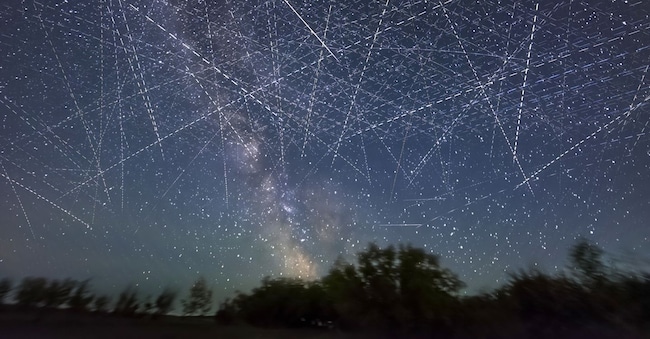
If we look up and see a trail of light that looks like a shooting star, it is likely that we are actually observing a satellite as it re-enters the earth's atmosphere. At that stage, the satellite vaporises, decomposing its structural elements, mainly aluminium, copper and lithium. This small scene is one of the most underestimated forms of pollution currently taking place: in 2024, there were about a thousand satellite re-entries on their way to retirement, practically three a day. With the growth of companies and services such as those offered by Elon Musk's Space X, within a decade we could see up to 50 satellites a day re-entering, according to estimates for Bloomberg by Jonathan McDowell, a Harvard professor and one of the world's leading astrophysicists.
Every economic sector produces impact and pollution at its peak, and the space sector is no exception. The expansion curve of the space economy is this: in 2019 we launched 500 satellites into low Earth orbits, in 2024 there were 2,800. They are now the neuralgic fabric of our economy: the sector is now worth 15 billion dollars a year, according to Goldman Sachs it will reach 108 billion by the middle of the next decade, with an estimated 60,000 to 100,000 satellites saturating the orbits (with an ever-increasing risk of collisions). One of the most enlightening reads on the subject is Space Ecology (Hoepli Editore) by Patrizia Caraveo, astrophysicist and president of the Italian Astronomical Society. The book's invitation is clear: start including what happens outside the Earth's atmosphere among the topics of environmentalism. The environmental movements in their contemporary form, the author recalls, were also born thanks to the emotion generated by a photo taken from space, the Blue Marble portrait of the Earth taken by the crew of the Apollo 17 in 1972. The first time we saw our home from the outside was also when we really started working to protect it. The problem is that we neglected what was outside, around the house, because in 1971 the orbits were empty, a frontier, now they are as crowded as an urban ring road at rush hour. "I started to deal with this issue starting from the light pollution caused by the so-called trains of satellites of Elon Musk's Starlink service, which have become a big problem for us astronomers". Starlink is the satellite connection that has also become a strategic geopolitical asset in recent years. "They are little trains because they are launched in groups of 60, they call them mini-satellites, but they are like big ultra-reflective kitchen tables. They are beacons turned on in space, which have the side effect of making it more difficult to observe the stars'. The Starlink satellites are three metres long, one and a half metres wide, they are very small, like spotlights, in fact. The problem is that there are so many of them: there are about 7,000 in orbit at the moment. When the service is up and running, there will be 42,000, with a life expectancy of five years and a rate of 23 launches per day, according to Musk's business plan.
When Caraveo started working on the ecology of space as an astrophysicist, she was worried about the light making the work of her telescopes difficult. Then she realised that there were more serious problems, such as the paraffin used for launches or the chemicals dispersed in the higher, thinner layers of the atmosphere, which are threatening the ozone layer that protects it. The hole in the ozone layer is one of the few ecological problems that humanity can claim to have solved, thanks to the success of the 1987 Montreal Treaty to ban chlorofluorocarbons. "Here, we are now returning to the levels that made that treaty necessary: more than the ozone layer, it now looks like a gruyère full of holes," he explains. Technological progress cannot be stopped, but according to Caraveo it must necessarily be governed, and the only possible instrument is a new UN space treaty, updating the 1967 one. "The context in which it was signed was completely different, in the midst of the Cold War between the US and the USSR, the main concern then was the demilitarisation of space, the ban on carrying nuclear warheads. Now the real issue is to understand that our earth orbits must be treated as a common good of mankind, just like the oceans'. Difficult, when there is only one company (Space X) that does more launches than all other countries or subjects put together. "But I'm not against Musk," Caraveo points out, "I admire his mission and the contribution he has made to the exploration of the cosmos, we just have to find an honourable compromise between progress, the importance of the services offered by satellites, the use of orbits, which at the moment concerns more than ninety countries in the world, and the good health of our atmosphere.
LA SALUTE DEI CIELI 'Space Ecology' by Patrizia Caraveo, Hoepli Editore, 17.90 €. SOCIETÀ ASTRONOMICA ITALIANA, sait.it.

