
Farewell to Daniel Kahneman, Nobel laureate in economics and father of behavioural finance
He was 90 years old. As a psychologist he was awarded the Nobel Prize for Economics in 2002

3' min read
3' min read
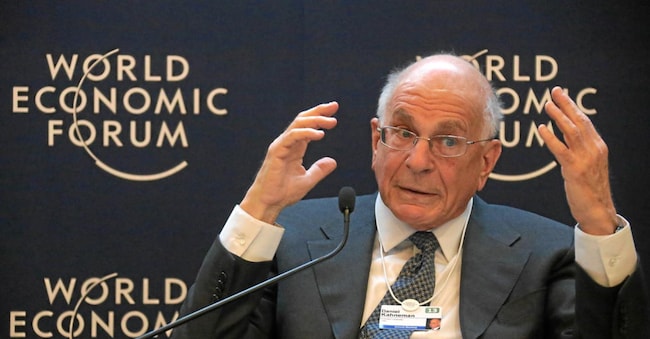
He was regarded as the father of behavioural finance and the progenitor of a discipline that over the years has increasingly broadened its scope. Daniel Kahneman passed away at the age of 90. In 2002 he had won the Nobel Prize in Economics, the first psychologist to achieve this accolade. His work, together with his other psychologist and friend Amos Tversky, had called into question the very concept of rationality underlying decision-making processes, overturning the assumptions that had dominated economics for decades, such as Schumpeter's definition of homo oeconomicus. Kahneman was "the world's most influential living psychologist", Harvard University professor Steven Pinker told the Guardian in 2014. "His work is truly monumental in the history of thought."
Working together with Tversky, Kahneman isolated biases that distort decision-making, particularly loss aversion and the impact of the way an answer is formulated on the response. "People are designed to tell the best story they can," he had said in a 2012 interview with the American Psychological Association. "We don't spend a lot of time saying, 'Well, there's a lot we don't know.' We settle for what we know."
With the so-called 'prospect theory', Kahneman and Tversky triggered a revolution in psychology and then in economics, which until the 1970s had rarely been considered an experimental science. Subsequently, behavioural economics took its cue from the publications of the two Israeli-born psychologists, when a group of young economists used their insights to challenge classical notions of radionics in decision-making.
In 2011, Kahneman expanded his popularity with the bestseller Thinking, Fast and Slow, in which he presented a comprehensive view of the mind as containing two systems, one fast and intuitive, the other slow and more rational. In the book, he also added to the analysis of decision-making mechanisms a series of tips for making better decisions, starting with: "Recognise the signs that you are a cognitive minefield". In this sense, his work was decisive in paving the way for Richard Thaler, also a psychologist and winner of the 2017 Nobel Prize in Economics for his work culminating in the book Nudge, co-written with Cass Sunstein, in which he identifies the ways in which distortions in decision-making processes can be corrected by 'positive' context-induced conditioning.
Daniel Kahneman was born on 5 March 1934 in Tel Aviv, where his mother was visiting relatives. The family lived in France, where they had emigrated from Lithuania. His father, a Jewish chemist, was arrested because of his religion during the Second World War, then released. After the war, the family moved to Palestine. After graduating in psychology from the Hebrew University of Jerusalem in 1954, he joined the army soon afterwards where he was assigned to the psychology branch and in charge of assessing recruits and pilots' performance in air missions. He later earned a PhD from the University of California at Berkeley in 1961 and returned to the Hebrew University to teach in the psychology department.


