Art

Arnaldo Pomodoro, farewell to the sculptor with the unmistakable cuneiform slashes

The artist passed away last night at the age of 99 in his Milan home. This was announced by the Foundation named after him

by S.Bio.
4' min read

4' min read

His unmistakable cuneiform engravings, rich in echoes and highly metaphorical, and his sign-piercing solids marked the history of sculpture and he was certainly among the greats of Art of the last century: he is now rightly mourned.

"Arnaldo Pomodoro passed away last night, Sunday 22 June, in Milan at the age of 99 in his home". This was announced in a long and heartfelt note by the Foundation named after him.

Loading...

"With the passing of Arnaldo Pomodoro, the art world loses one of its most authoritative, lucid and visionary voices. The Maestro leaves an immense legacy, not only for the strength of his work, recognised at an international level, but also for the coherence and intensity of his thought, capable of looking to the future with indefatigable creative energy," write the Foundation.

''The Maestro leaves an immense legacy, not only for the strength of his work, recognised internationally, but also for the coherence and intensity of his thinking, capable of looking to the future with untiring creative energy,'' says Carlotta Montebello, recalling a sentence by Pomodoro.

"I have never believed in foundations that celebrate a single artist as a unicum. The artist is part of a fabric of culture, his or her active contribution can never fail, and this is why I conceived my Foundation as an active and living place of cultural elaboration, as well as a centre for the documentation of my work, capable of making original proposals and not just passively preserving. But the best is yet to come: this was only a beginning and in my intentions the project - aimed at the young and the future - must take root, make continuity an inescapable element... ', wrote the artist.
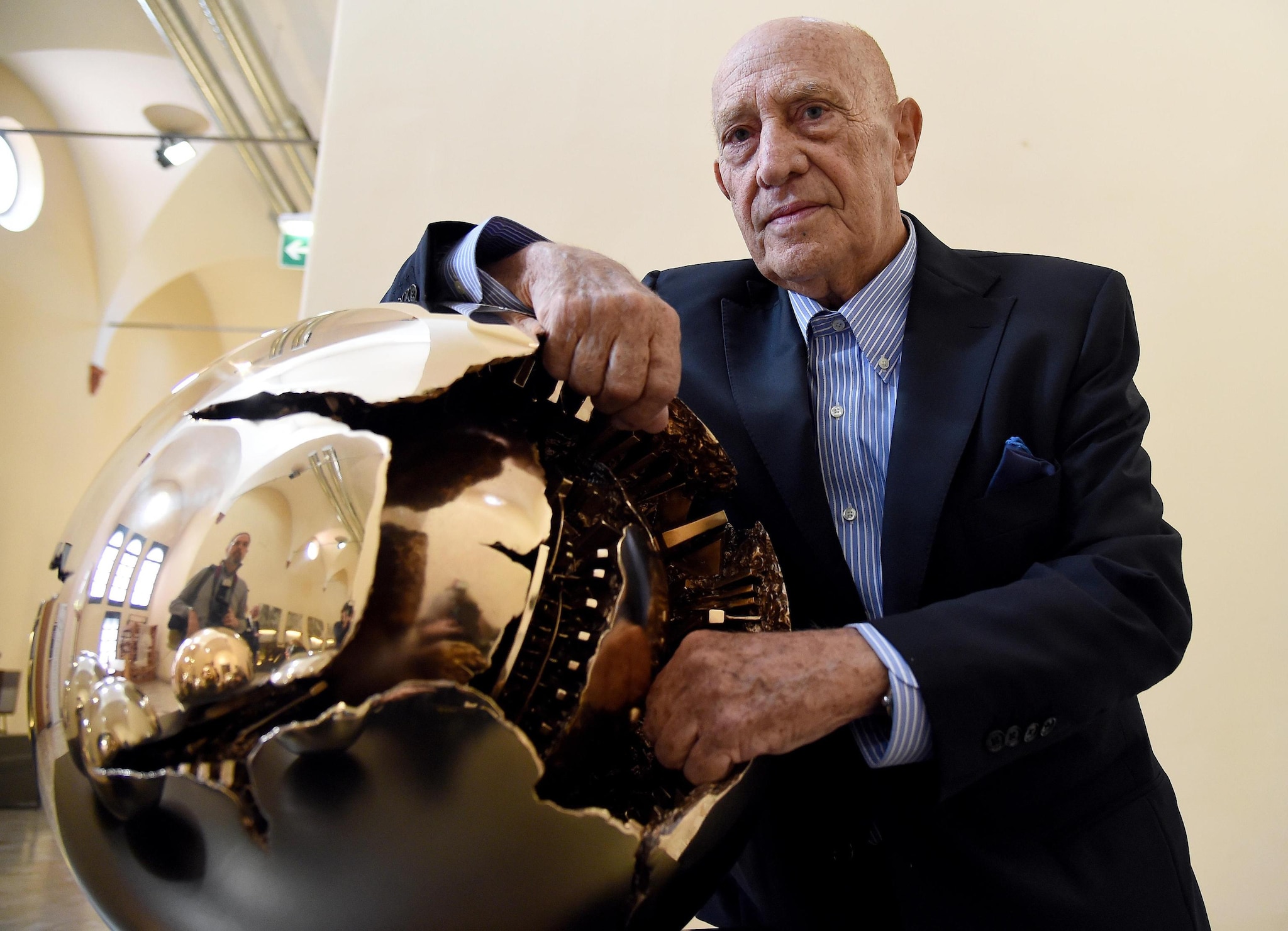
Arnaldo Pomodoro. (ANSA/ DANIEL DAL ZENNARO)

The Foundation

''The Foundation, born from this vision and strong in the direction traced out by Arnaldo Pomodoro over thirty years, will continue to operate according to the will of its founder, guaranteeing the conservation and valorisation of his work, committing itself to disseminating its material and immaterial heritage through the realisation of exhibitions events and initiatives in an inventive, almost experimental space of study and discussion on the themes of art and sculpture, aiming at a profound and global involvement with people and society We will all miss you Arnaldo and treasure your teachings,' Montebello then adds.

Arnaldo Pomodoro, le sue opere

Photogallery13 foto

The two brothers

.

Arnaldo Pomodoro, Giorgio 'Gio' Pomodoro's older brother, also a sculptor, first studied as a surveyor to soon discover his passion for metal and sculpture. A goldsmith at first, it was in the 1950s that he began to make his first large forms after moving to Milan in 1954 when he began to weave his signatures in relief, creating visual situations on the borderline between two- and three-dimensionality. "For me," the already over-90-year-old artist recounted, "it was a dense period of intellectual exchange.

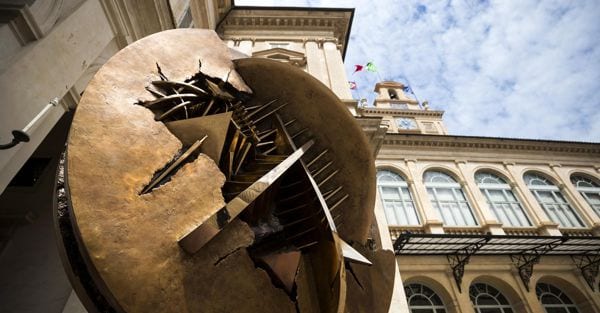
La scultura di Arnaldo Pomodoro "Disco in forma di rosa del deserto" esposta durante l'anteprima della mostra "Quirinale Contemporaneo. (ANSA/ANGELO CARCONI)

Lucio Fontana

With Lucio Fontana and others he founded the Continuity Group. Today, his works are exhibited all over the world. The last major exhibition in 2023 in collaboration with Fendi, at the Palazzo della Civiltà Italiana, a fashion house that had also chosen one of his most significant environmental works, Ingresso nel labirinto (Entrance into the Labyrinth), for its headquarters in Via Solari in Milan.

(ANSA / UFFICIO STAMPA)

His poetics

.

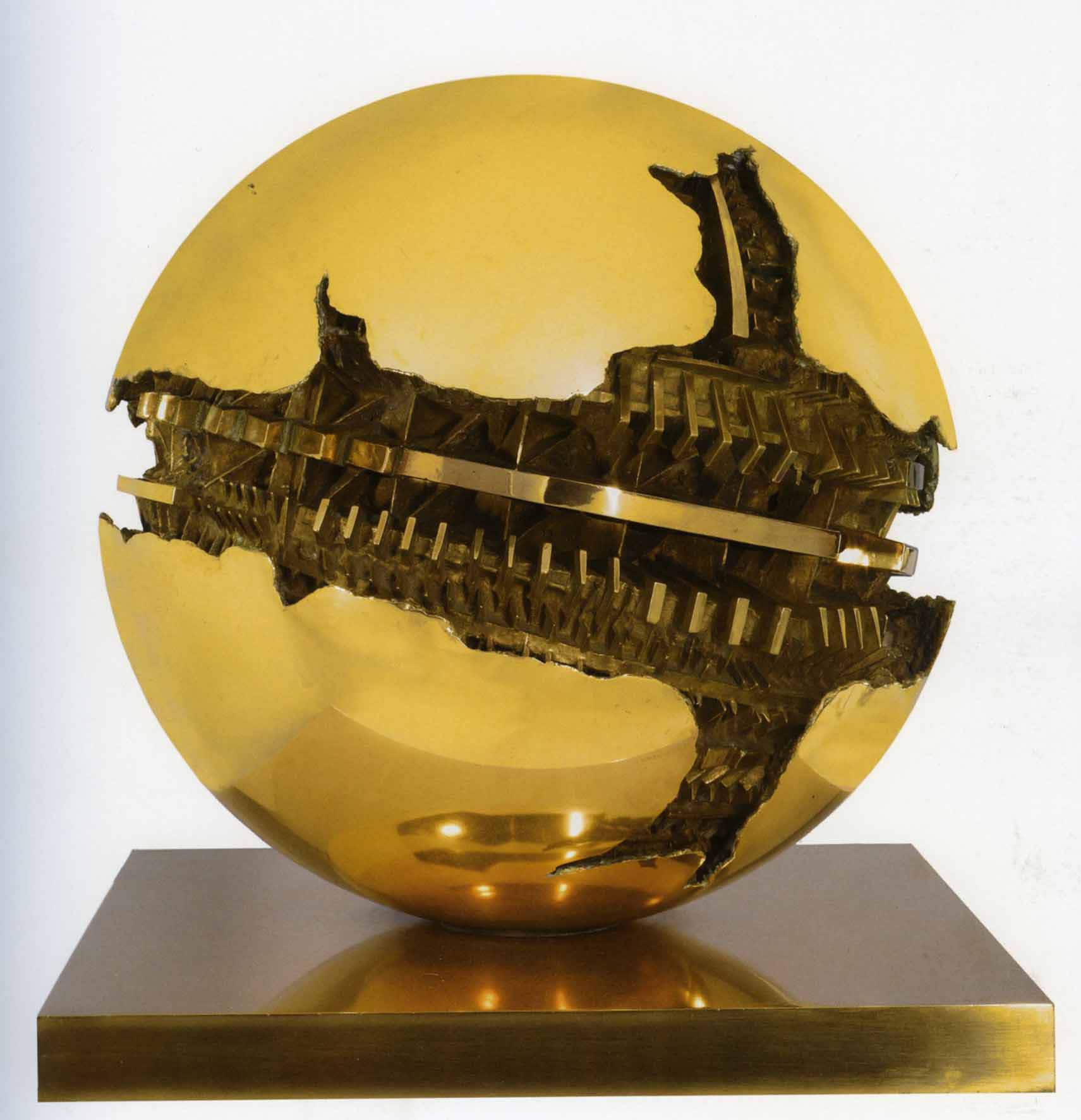
Pomodoro's first sculptural language is made up of high reliefs, crossed by a cuneiform, archaic, symbolic writing. A 'writing of time', as he called it. From the 1960s onwards, he began to work on solid geometric forms using bronze, lead, tin and concrete: the materials chosen by Pomodoro are always instruments of a philosophical quest - spheres, cubes, cylinders, discs, cones - built in shiny bronze, then broken, opened, slashed.

The exterior is perfect and polished, the interior is messy, technical, organic: a plastic metaphor for the contrast between appearance and substance. This dialectic will become Pomodoro's stylistic signature.

Each of his works is a space to be explored, a mental architecture, a living organism. Pomodoro himself spoke of his sculptures as 'mythological machines'.

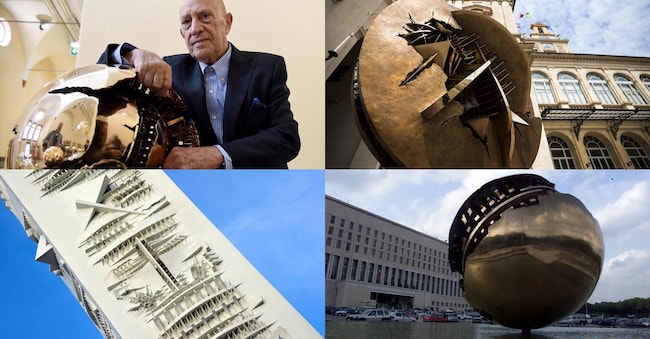
Pomodoro never accepted that sculpture was only an object. His art is spatial, environmental, total. From the 1960s onwards, with works such as 'The Traveller's Column' (1962), 'Great Radar' (1963), 'Sphere with Sphere' (1966), 'Constructed Cylinder' (1968-70) and 'Circular Mole' (1968-70) the artist explored the interaction between sculpture and environment.

It is not just a question of monumental dimensions: Pomodoro wants his works to be traversed, experienced, investigated. He wants the viewer to lose himself in them, as in a labyrinth of being.

The culmination of this aspiration is perhaps the work 'Entrance into the Labyrinth', dedicated to the epic of Gilgamesh, an environmental installation that transcends the boundaries of sculpture to become a mythical experience, an existential threshold.

Elsewhere, with works such as 'Carapace' (2010) - the sculpture-cellar for the Lunelli family in Bevagna - Pomodoro has fused art and architecture in a unique gesture: to create a place to be inhabited aesthetically, spiritually, culturally. Pomodoro's artistic production is immense and scattered all over the world.

His public works can be found, for example, in Rome, Milan, Copenhagen, Brisbane, Dublin, New York, Paris, Los Angeles and Darmstadt. Among his most iconic works: 'Traveller's Column' (1962), a pioneering work in volumetric sculpture, created for 'Sculptures in the City' in Spoleto; 'Solar Disk' (1991), donated to Russia and placed in Moscow during the post-Soviet thaw; 'Papyrus' (1992) in Darmstadt, Germany; 'Lance of Light' (1995), a steel and copper obelisk in Terni; the bronze portal of the Cathedral of Cefalù (1998); the sacred furnishings in the church of Padre Pio in San Giovanni Rotondo, in collaboration with the archistar Renzo Piano.

His environmental works are numerous: from the project for the Urbino cemetery in 1973 excavated inside the Urbino hill, later not realised due to local contrasts and problems, to 'Moto terreno solare', the long concrete mural for the Minoa Symposium in Marsala, from the Sala d'Armi for the Poldi Pezzoli Museum in Milan, to the environment 'Ingresso nel labirinto' (Entrance into the Labyrinth), dedicated to the epic of Gilgamesh.

Pomodoro has also designed impressive theatre sets for Greek tragedies, contemporary dramas and operas, receiving the Ubu Prize for his stage creations.

Copyright reserved ©
Loading...

Brand connect

Loading...

Newsletter

Notizie e approfondimenti sugli avvenimenti politici, economici e finanziari.

Iscriviti