
Farewell to Carlo Borlenghi, the master who revolutionised sailing photography
Carlo Borlenghi was not just a regatta photographer, but a true innovator who was able to capture the invisible essence of the sea and the boats.

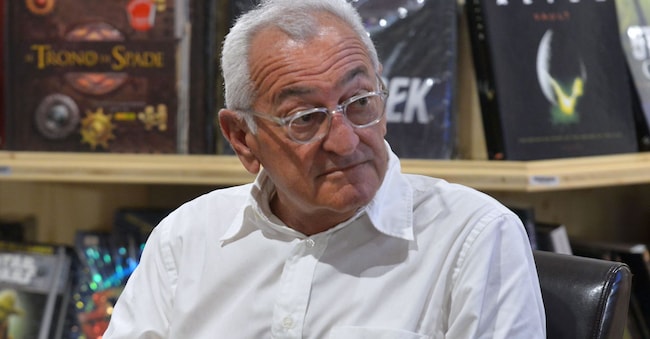
The passing of Carlo Borlenghi deprives Italian sports photography of one of its most recognisable international figures. To call him a ‘sailing photographer’ (or a photographer of boats in general) is accurate, but insufficient. Borlenghi did not merely document a regatta: he sought out its invisible structure, the relationship between the hull, the sailors, the wind, the light and the landscape. In a niche and technically demanding field, his surname had become a benchmark, the standard against which any image of the sea was measured.
Born in Bellano in 1956, he began his career by photographing regattas on Lake Como whilst studying in Milan. The turning point came in the late 1970s, with his collaboration with *Uomo Mare Vogue* and a photograph destined to become an icon of sailing: *Brava*, Pasquale Landolfi’s boat, heeling over off the coast of Alassio, almost capsized, with the owner half-submerged. It was 1979. That shot already revealed what would characterise his entire career: not the boat posed in front of the lens, but the moment when the sea reveals its power, its limits and its character.
Margherita Bottini, a journalist and nautical photographer, also played a key role at that stage; she welcomed him on board on the very day that established him as a promising newcomer, recognising his talent and helping to fast-track his career. Borlenghi would later give back much of what he had received, mentoring others and building a professional network around him. Among the many who passed through his school, Guido Cantini (another great photographer of boats and winter sports) cited him as his mentor; Stefano Gattini, Simon Palfrader and Alessandro Trovati worked with him within the Studio Borlenghi circle. Not a workshop in the traditional sense, but a method passed on through practical experience, tight deadlines, thorough preparation and the obligation to produce an unconventional image: ‘news’ photos for the press, ‘art’ photos for exhibitions and books, and an endless, innovative and unique creative exploration.
Since 1983, he has covered every edition of the America’s Cup, starting with Azzurra in Newport. He has been the official photographer for campaigns such as Italia, Il Moro di Venezia, Luna Rossa and Alinghi, as well as the 2007 event in Valencia. He has documented the Olympic Games, the Whitbread Round the World Race and the Volvo Ocean Race, ‘The Race’ with Club Med, Giovanni Soldini’s ocean voyages and, for decades, the most important Rolex sailing events. Years ago, he also captured all the top motorboat racing competitions, featuring every type of hull and engine, from Casiraghi’s offshore racing to the electric foiling boats of the E1 series on his lake. In 1989, he founded Sea&See, an agency specialising in water sports. The list of teams, shipyards, sponsors and organisations that have placed their trust in him is extensive, but the key factor is another: he was called upon at the very highest levels because he guaranteed a combination of documentary precision, industrial reliability and an artist’s signature.
Seascape photographer and tireless researcher
The helicopter had become one of his most distinctive vantage points. From up there, he would direct the pilot, wait for the bow to cut through the waves, and look for the spray, the criss-crossing paths, and the geometry of the fleet. But to reduce it to aerial photography would be a mistake. From a rubber dinghy, from the deck of a yacht, from the shore, with a remote-controlled boat beneath a buoy, or leaning out from whatever vessel was to hand, he could capture a masterpiece. Position was a tool; true talent lay in seeing first. It is no coincidence that his ‘at-the-water’s-edge’ photos are the most famous, because he was the first to invest in, intuit and innovate within a sector that could not afford to be prone to repetition: the sea, more so than many other environments and competitive settings, naturally offered far greater creative possibilities, but not everyone knew how to seize them as he did.


