
Farewell to the lawyer always at the side of the Agnelli family
There was no corporate operation of the group or personal problem of the exterminated family that did not see his involvement
by Paolo Bricco
3' min read
3' min read
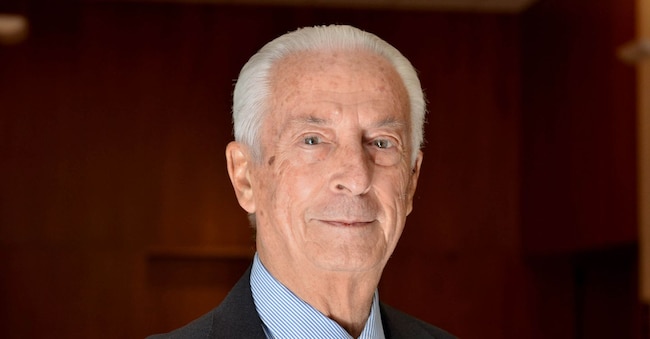
With Franzo Grande Stevens, who passed away at the age of 96, goes a piece of 20th century Italy: the secular, resurgent, industrial Italy, rooted in the past but projected into modernity, serious but obsessed with not being bored. No, he was not simply - as so many remember him by a nickname that connoisseurs of Turin's minimal history trace back to Gianni Agnelli himself - 'the lawyer's lawyer', the custodian of the civil law component of the secret life of Italy's first family and of the corporate mechanisms of a group that no longer exists today, but which was - from Fiat to Stampa, from Corriere della Sera to Sanpaolo - a state within a state. Franzo Grande Stevens, simply 'Franzo' for the many who appreciated his friendliness and education as Neapolitan and Anglo-Saxon as his origins and that of so much of the most enlightened and cosmopolitan Neapolitan bourgeoisie, was a direct pupil of Alessandro Galante Garrone. From a cultural point of view - in his ability to transform the legal and political-philosophical culture of books into professional wisdom - he participated in the great Italian season that built a piece of our identity: straight from Mazzini's Risorgimento, passing through the anti-fascist education of the Gianbattista Vico high school (he told the writer about the history and philosophy teacher who every morning, opening the windows, would declaim ironically 'dear boys, even today the fine weather is guaranteed to us by the Duce, to him we owe all this'), arriving at a smiling and non-moralistic anti-fascism ('where did you resist?' he would ask, in the not infrequent conversations with the leaders of a PCI and a trade union that in Turin were the other side of the Agnelli family's harsh and ferocious coin). After the Second World War, after graduating in law at the Federico II University in Naples, in Turin he forged a true relationship with the mild-mannered Jacobin Galante Garrone and then threw himself into the battle of life as a lawyer specialising in business matters. First a passage in the State Holdings of Ilte, that of the telephone directories of the then Sip, where in Turin, very young and super charming, he made all the secretaries fall in love with him, then the entry into real power, solid and aware, hierarchical but ready (also) to the recognition of individual qualities such as that generated, coagulated and sedimented by the Agnelli family of the two brothers Gianni and Umberto. With Gianluigi Gabetti he formed a central couple in the known and unknown history of capitalism and finance in our country and Europe. If Gabetti - a former pupil of Raffaele Mattioli and Adriano Olivetti - took care for the Turin-based family above all of relations with the great American finance and with exponents of the European Jewish network, Grande Stevens was responsible for the widest possible spectrum, which he cultivated thanks also to his knowledge of French, English, Spanish, Russian and Portuguese. There was no corporate operation of the group or personal problem of the exterminated Agnelli family that did not call for the involvement of Gabetti and precisely Grande Stevens. The two dimensions - the morphology of Italy's largest industrial reality and the interests of its shareholders - merged in the construction of the corporate boxes, conceived and studied, also, by Grande Stevens. For this reason, his firm was most recently involved - without ever being investigated - in the bleeding diatribe between Gianni Agnelli's heirs - in particular his daughter Margherita and grandson John Elkann - over the lawyer's estate, of which he was technically executor. Not least for this essential function in the world of the Agnellis, years ago he was charged - together with Gabetti - for the equity-swap of Ifil-Exor, the borderline and fulminating operation that, in 2005, allowed the Agnellis to retain control of Fiat. He was a soldier of the king, standing up when Gianni Agnelli entered the room. But he always did so with dignity and awareness, irony and quality.


