
Farmers' despair: flooded fields for the fourth time
Since the great flood of May 2023, entrepreneurs have only been compensated for a fraction of the damage suffered. And some are already throwing in the towel in the fields
3' min read
3' min read
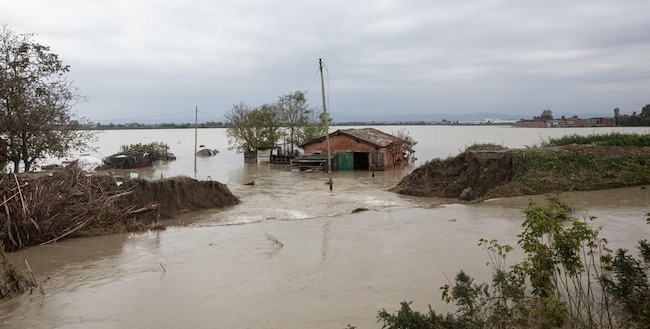
"This flood is worse than the one in 2023: back then it was May, we were heading towards summer and the soils dried out. Now, on the other hand, everything will stay wet until December. And how can you sow?". Giordano Alpi, 60 years old and 30 hectares of land near Imola, has been under water four times in a year and a half. The first was with the great flood in Romagna last year, the last one last Sunday. In between, there is anger and resignation. And more rain is forecast between tomorrow and Friday.
Of its 30 hectares planted with peaches, apricots, pears and grapes, 15 are located near the Sillaro torrent: "At least three and a half hectares ended up under two metres of water on Sunday, you can't even see the tips of the vines," Alpi says. "So far I had made 20 per cent of the harvest, I'm afraid that out of 3,000 quintals of Trebbiano grapes I'll lose between 20 and 30 per cent. In Imola, farmers have been reporting on river maintenance for twenty years: "At my place, after 2023, they even cleaned up well," says Alpi, "but in order to make the land safe, we needed emergency works with emergency laws: ordinary projects, like ordinary contracts, take years.
Coldiretti calculates that with this latest wave of bad weather tens of thousands of hectares have been invaded by water and mud, with damage to the production of fruit, vegetables, maize, sugar beet, cereals, orchards and vineyards. "And then there is anxiety," says Alpi, "so much anxiety about what may happen again. In Traversara and Cotignola some farmers have already started to throw in the towel, and here too some are thinking about it, especially in the hills where there are landslides". But what about compensation? "Out of 120 thousand euro in damages," he says, "I have so far recovered only 8 per cent.
Even Isacco Minarelli, 200 hectares in Vedrana di Budrio near Bologna, has had little in the way of compensation: 'Compared to 350 thousand euro of damage, all of which has been assessed, I received 60 thousand'. Forty-three years old, a member of the Patfrut cooperative, Minarelli has been hit by the fury of the Idice torrent four times already: the first time the banks broke was in 2019, then there was the great flood of May 2023, then again a month ago and finally on Sunday: 'This time it went better,' he says, 'the water from the fields went away in a day. But last month all the sugar beets rotted away'. The portion of the Idice embankment, on the other hand, is still there, still to be repaired. He's not thinking about leaving, though: 'I've invested a lot in this land, between rents and the mortgage still to be paid,' he says, 'I'm going to plant wheat, which is the least expensive. I can't afford to invest another 11,000 euros per hectare, as I have done so far'.
Farmers are tired, they demand structural, serious action. And quickly. They would gladly take care of it with their own hands, to clean up the river beds, if only the law would still allow them to do so as it once did. But today it is forbidden. And among those who cultivate the fields every day anguish mounts over what may happen the next day. "Farmers can no longer move forward in this way, let alone plan for the future,' says the president of Confagricoltura Emilia Romagna, Marcello Bonvicini. 'Many of the companies affected by the new wave of bad weather have not even finished paying for the damage caused by previous catastrophic events such as frost, tornadoes, flooding and landslides.


