Fashion and the heat: change is essential – strategies involving fashion shows, fabrics and climate managers
Rising temperatures make a paradigm shift urgent – from the timing and format of fashion weeks to research into ‘cooling’ textiles, new ways of dressing and innovative professions

In a study published in Nature on a cold day in January 1980, a group of researchers sought to answer the question: “Why do Bedouins wear black in hot deserts?”. They argued that several factors underpinned this distinctive tradition: the thick black garments prevented the scorching heat of the sun from reaching the skin, which was thus able to maintain a temperature that was, all things considered, acceptable, and their loose fit allowed for a circulation of hot and cooler air, creating a sort of continuous breeze. In the same year, but in April, the famous CBS journalist Walter Cronkite hosted a programme in which the ‘greenhouse effect’ and global warming were discussed for the first time: first and foremost, the phenomenon was acknowledged, linking it to the rise in carbon dioxide in the atmosphere, and it was suggested that one day, due to the melting of the polar ice caps, cities such as Miami, Boston and New Orleans would disappear beneath the sea.
Almost 50 years on, climate change and global warming are now well-established realities, and even though Miami is not yet under water and the Bedouins continue to wear dark, thick garments (though, in truth, they alternate these with lighter, paler ones), human activities must come to terms with yet another shift in their context. First and foremost, fashion – understood as the way we dress, the way we produce clothes, and also the way we communicate them.
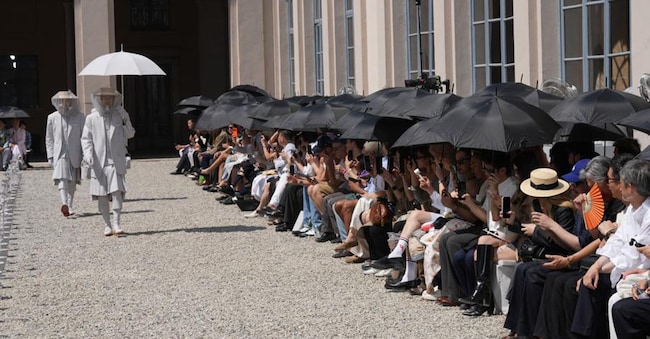
Let’s start with this very point: during the most severe heatwave France has seen since temperature records began in 1873, Paris Fashion Week is putting the thousands of people involved through a gruelling ordeal, as they are forced to walk the catwalk, organise and watch the shows – often outdoors – with very little protection other than umbrellas, mist sprayers and fans. This scenario had, incidentally, been repeated in Milan in the preceding days. Recently, the Fédération de la Haute Couture et de la Mode in Paris and the National Chamber of Italian Fashion in Milan, which organise the industry’s two most important fashion weeks, have renewed their Memorandum of Understanding concerning, amongst other things, support for emerging designers and the joint promotion of sustainability programmes: at this stage, they could easily envisage a review of the June fashion show calendar, perhaps bringing it forward or postponing it, in line with other fashion weeks and the production and distribution schedules for the collections, and at the same time draw up a summer protocol covering venues, timetables, the use of resources – and energy in particular.
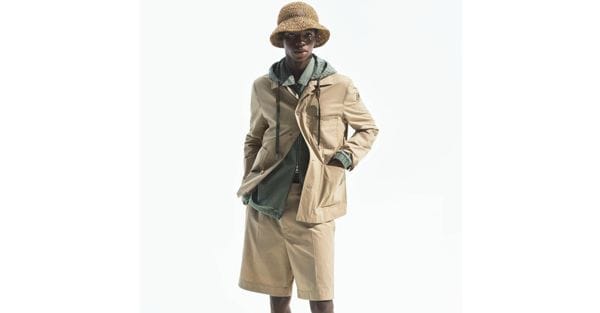
This new paradigm is also underpinned by a gradual shift in seasonal trends, which sees lighter garments featured in winter collections and makes layering – that is, wearing garments in layers – more widespread in summer. This year, moreover, has been marked by a very significant development in this regard: Moncler, the historic brand renowned for its down jackets and winter collections, has launched Puffy Summer, its first ‘summer’ collection comprising jackets, shorts, T-shirts and described as ‘layered’, designed to be worn in multiple layers.
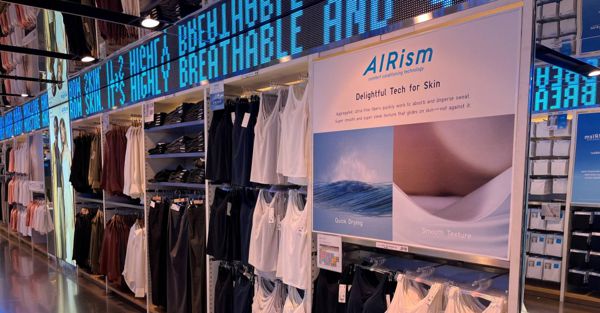
As well as style, technology is also supporting the fashion industry’s climate transition: last May Geox added the new “Ventilated Cushioning System” to its numerous patents for regulating the climate of the foot inside the shoe, which allows ventilation to be activated under the sole whilst walking. And since as far back as 2012, the Japanese brand Uniqlo has been bringing Airism technology to the market: developed in collaboration with the chemical group Toray, it produces fabrics made from very fine polyester fibres – with a diameter one-twelfth that of a human hair – which improve absorption and breathability. It has proved a success: whilst initially limited to lingerie, the Airism range has now expanded to cover the entire wardrobe.