
Fashion excess burns to ashes in the Atacama Desert
In Alto Hospicio, northern Chile, Desierto Vestido activists denounce the huge and growing illegal dumping of used or never sold clothes and accessories: 'We need to increase quality, limit synthetic fibres, buy consciously'.

3' min read
3' min read
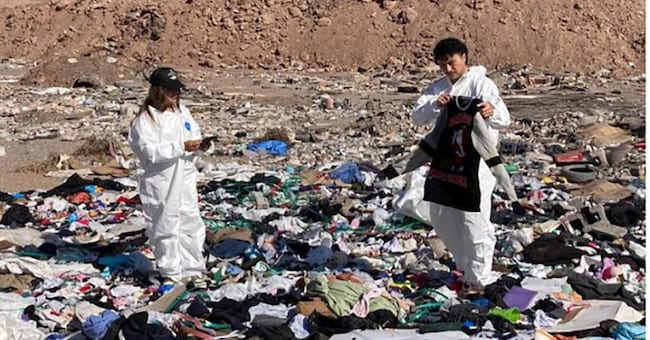
From the top of Cerro Dragon, a spectacular 200-metre-high dune embracing the city of Iquique in northern Chile, on one side one sees cargo ships arriving at the large port with their cargoes of second-hand clothes from Europe, Asia and the United States, and on the other, much of the same merchandise burning in the hills of nearby Alto Hospicio, colouring the Atacama Desert grey.
According to the Observatory of Economic Complexity, in 2022 Chile was the world's third largest importer of second-hand clothing after Pakistan and the United Arab Emirates. It is estimated that every year at least 60,000 tonnes of used or unsold clothes, shoes and accessories arrive enclosed in bales in the Iquique free zone, where two thousand specialised companies are ready to sort them: the best merchandise is resold as 'vintage' in other countries, the worst has to be disposed of. The latter category includes as much as 70% of the total. And since there is no adequate national legislation for disposal and it costs too much to do so, the huge quantities of goods destined for the dump are entrusted to people who transport them to the sands of Atacama and burn them there, over an area of around 300 hectares, the ashes of which can also be seen in the photos taken by satellites.
In that ash, which clothes one of the poorest areas of the country, as well as one of the most environmentally fragile, ends the overproduction of the global fashion industry. It is no coincidence that the boom in imported used fashion in Chile occurred in the same years as the explosion of fast fashion. The fires in the Alto Hospicio area are not controlled: in June 2022 one burned for three days, fuelled by some 100,000 tonnes of waste, asphyxiating residents who often live in miserable conditions. The waste is mostly composed of synthetic fabrics and releases microplastics that accumulate dangerously in the planet's rainiest environment. A human and environmental tragedy that a group of activists in the area is rebelling against, denouncing the situation mainly via social media.
"In the desert, we mainly find clothes, jeans, jackets, but also shoes and accessories,' explains Karla Avilés, co-founder of the NGO Desierto Vestido from Alto Hospicio, which for two years has been trying to raise awareness among institutions and consumers about the risks and consequences of the fashion industry's overproduction. These are mainly poor quality products. The most recurring brands are H&M, Old Navy, Zara, Guess, Adidas, Gap, last time we saw the first rejects with Shein labels. But sometimes we also come across luxury brands: we have found things from Gucci, Chanel, Dior, Calvin Klein, just to name a few. They are generally broken products, cut, a very common practice to prevent them from being reused'. New products, still in their wrappers, are increasing.
In the desert that continues to burn, together with Fashion Revolution Brazil and Artplan, a Brazilian communication agency, Desierto Vestido organised "Atacama Fashion Week", a provocation rather than a real event, showing looks created with clothes and accessories found in the dumps: "We are also very happy with the controversy it has aroused," continues Avilés, "because for us it is very important that the problem is a recurring topic of discussion in public opinion. The industry must understand that we are not its garbage dump'.


