
Fashion, 200 euro increase per month and 600 euro welfare for 400,000 workers
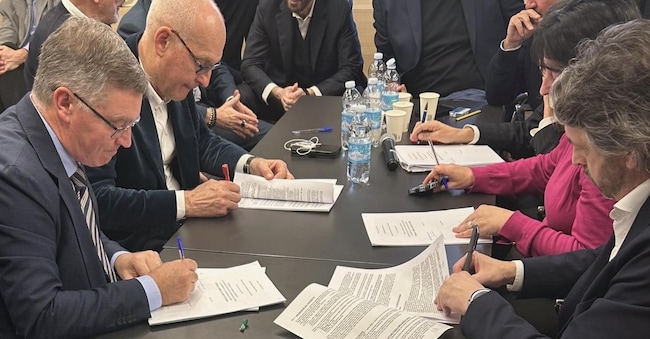
Smi and the trade unions (Filctem, Femca and Uiltec) signed the hypothesis of agreement for the renewal of the national labour contract that strengthens contractual welfare and training
5' min read
Key points
5' min read
For the 400,000 textile-clothing workers comes an increase of EUR 200, when fully implemented, over three years, and an amount to be spent on welfare goods and services, worth a total of EUR 600 over the three-year period. In addition to significant improvements in contractual welfare - from supplementary health care to long term care - and training. These are some of the qualifying points of the agreement hypothesis for the renewal of the national collective contract for the textile-clothing industry, signed by Sistema moda italia (Smi) and Filctem, Femca and Uiltec, which concerns about 400 thousand workers and 40 thousand companies. But let's look in detail at the points of the agreement, which was signed a few months after the expiry of the previous contract, despite the economic phase that the fashion textile industry is experiencing. The president of Smi, Sergio Tamborini, explains that 'despite a particularly difficult time for the entire textile-clothing supply chain, we have signed a national contract that marks the beginning of a positive and constructive change in the relationship between companies and workers. Alongside economic solutions, it was important to balance the demands of professionalism and efficiency of the companies on the one hand, and safety, fairness and work-life balance of our employees on the other. In this context, the renewed focus on welfare, i.e. the overall well-being of employees, also becomes an important turning point for a fruitful relationship between companies and workers'. For the trade unions, it is "an innovative contract, which focuses on Industrial Relations for the re-launch of the sector, giving certain answers to female and male workers, not only in economic terms, but also in terms of regulations, with specific attention to the reconciliation of work and life times," say Sonia Tosoni, Raffaele Salvatoni, and Livia Raffaglio, national secretaries of Filctem Cgil, Femca Cisl, and Uiltec Uil, respectively. According to their calculation, the total economic treatment, considering the increase and improvement of welfare institutions rises to 232 euros on average. But let us see.
The economic part
.In order to recover the loss of purchasing power of wages, taking into account the inflationary forecasts from now until 2027, Smi and the trade unions agreed on an average increase of the contractual minimum, the so-called Tem, of 200 euros gross in total at the 4th level of the classification. It will be paid in 3 tranches, EUR 95 immediately, from this December, EUR 57 from January 2026 and EUR 48 from January 2027. The total amount will be EUR 4,001 and the increase corresponding to the percentage on the minimums of 11.20 per cent, as calculated by the unions. It should be noted that those classified at level 1 will have an increase over the three-year period of 271 euros: this will allow the hourly wage to be exceeded by 9 euros.
In order to maximise the net income for the benefit of workers, an amount worth EUR 600 has also been defined, which can be spent on welfare goods and services, i.e. services with a social purpose, education and education, family assistance, and then also goods and services in kind, which, with recent regulatory interventions, enjoy significant tax and contribution exemptions. Immediately in December the first EUR 200 will arrive, then by 31 December 2025 a further EUR 200 and finally by 31 December 2026 the last EUR 200. The pay guarantee element, which is present in companies where there is no second-level bargaining and no individual pay in addition to that of the contract, with effect from 2025, has been raised from EUR 300 to EUR 350.
Equal Employment Relationship Rules
Among the new features of this contract is the elimination of the differences between blue-collar, middle-collar and white-collar workers in the regulation of the employment relationship. Smi and the trade unions decided to overcome these distinctions, which are now largely obsolete, and to do a synthesis and integration job. Thus, the new national contract defined a general contractual regulation on how to hire young graduates or diploma holders, on the regulation of sick pay, especially for short illnesses, and on the contractual notice period.
In addition, an intervention on flexibility was defined with the definition of contractual grounds that allow the extension of the duration of fixed-term contracts from 12 to 24 months.

