
Fashion that breaks down barriers: diverse bodies and adaptive clothing
Its design stems from a focus on movement. The aim of Francesco Saverio Matera, winner of the CNMI Fashion Trust Grant 2026, is to create products that expand people’s possibilities.


Not an ideal body, but a real one: one that walks, bends, overcomes obstacles and changes over time. Francesco Saverio Matera’s work stems from an almost anthropological observation of movement. He is one of the three winners – alongside Act N°1 and Institution – of the CNMI Fashion Trust Grant 2026: a body of work straddling design, sportswear, materials research and adaptive technologies.
Born in 1996 and originally from Basilicata, Matera has forged his career within some of the most cutting-edge organisations in the Italian fashion industry, from Moncler Footwear to Stone Island. These experiences have enabled him to engage with seemingly diverse fields — footwear, technical apparel, accessories and prototyping — yet all united by the same question: how can a product enhance the interaction between the body — any kind of body — and its surroundings?
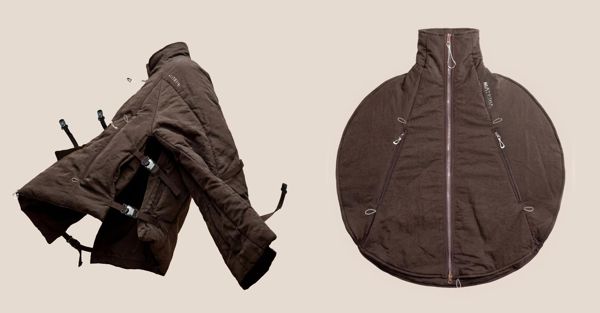
Driven by a desire to offer a personal response to this question, Materia Adapt was launched in 2023 as his independent project, which now serves as the laboratory through which he conducts his research. More than just a brand, it is a platform where advanced manufacturing, 3D printing, design and ergonomic experimentation come together. Matera constantly explores how emerging technologies can meet real needs without compromising the emotional and cultural value of objects. Whether it be adaptive clothing, modular systems or 3D-printed footwear, the aim remains the same: to break down barriers and create products that expand people’s possibilities rather than limiting them.

Matera’s aesthetic has its roots in the landscape of southern Italia. Geological stratifications, rock erosion, and surfaces shaped by wind and water serve as methodological rather than formal references. In his designs, nature is not imitated, but studied as a system capable of adapting and transforming over time. This gives rise to products that defy traditional categorisation. 3D-printed footwear, modular systems and components inspired by the world of orthopaedics and prosthetics are reinterpreted not as devices to be concealed, but as design elements to be showcased. Function ceases to be an aesthetic compromise and becomes an integral part of the object’s language.

His research, amongst other things, was also encapsulated in his contribution to the opening ceremony of the Milan-Cortina 2026 Paralympic Games. For Matera, the project was an opportunity to take adaptive design beyond specialist circles and bring it into the cultural debate, demonstrating how innovation and accessibility can coexist without any hierarchy.

