
Fastweb, artificial intelligence supercomputer launched
The infrastructure leveraging Nvidia technologies is operational at the Aruba site. Managing Director Renna: "Competition with Tim Enterprise? We moved in advance"

4' min read
Key points
4' min read
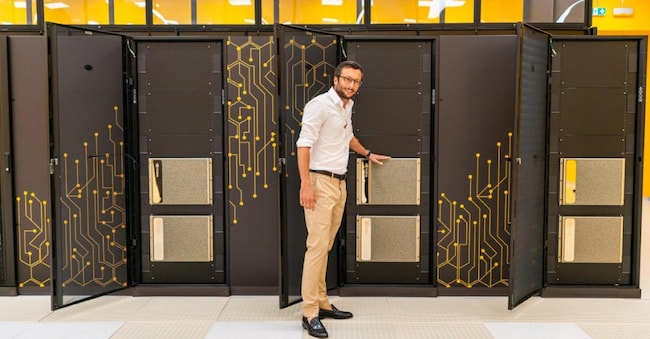
A municipality of just over 11,000 inhabitants near Bergamo. Fastweb's gamble to set itself up as the 'Italian way' to artificial intelligence starts from Ponte San Pietro - or Pòt San Piero as the signs at the entrance to the town read. The ribbon-cutting ceremony gave the official start to "NeXXt AI Factory": the citadel of artificial intelligence made by Fastweb that takes shape within the Aruba data centre. It is here that the Nvidia Dgx SuperPOD 'supercomputer' for generative artificial intelligence is housed, which will be made available to companies, start-ups and institutions.
Business Market Compass
."We will be commercially ready in the fourth quarter of this year," Fastweb CEO Walter Renna points out, emphasising that "the business model is totally open, we want to give companies and the public administration the opportunity to decide at what level they want to invest: they can only have space in the cloud, there are those who want our language model and those who, we hope, will want to create vertical applications with us. As for the investment, no financial details are given. According to rumours circulated and collected by Sole 24 Ore, the purchase of the Nvidia supercomputer should have required a commitment of around 60 million euros. Conditional of obligation, given that the figure is not officially known and Renna yesterday merely recalled that the investment 'is part of that 25% that we invest each year in infrastructure' necessary for digital development.
Tim Enterprise
In any case, it is a scalable infrastructure, therefore augmentable, designed to create, develop and manage business services almost tailor made. 'The goal,' explains Renna, 'is not to compete with ChatGpt for the consumer. We want to create our own model for businesses, with the certainty that Italian culture and language will be respected. At the heart of this project is quality'. No consumer, then, but a compass turned towards the business segment. Where, it is inevitable, Swisscom's subsidiary will end up clashing head-on with the new Tim, only services and no more network. "Tim Enterprise? It will be a good competition, heated as always. Although on the subject of artificial intelligence, as far as I know, we are further ahead, because we started a year ago and today we are putting this strategy on the ground, and we hope to accelerate it as much as possible."
The Italian way to artificial intelligence
.In terms of revenues, Fastweb expects to 'exceed double figures in three years. It is a market that is growing very rapidly and is now worth 500 million, but we expect it to reach 2 billion in five years'. All thanks to applications and services created thanks to the use of a supercomputer that, without going into technicalities, is in fact a powerful infrastructure on which to run an all-Italian brain (the so-called 'Llm' or founding models) that Fastweb has declared its intention to put into operation, respecting the sovereignty of data, trained on Italian data and recognising the rights of all the data providers involved, including publishers.
Five-year partnership with Mondadori
Mondadori, Istat and Edizioni Bignami are the first partnerships on which disclosure was made. There are also collaborations with La Sapienza University of Rome and the University of Milan-Bicocca. But the list does not stop there. With the Segrate-based company, in particular, the agreement is multi-year and goes beyond the use of material (from sites and not from books, the rights of use of which belong to the authors) to create its own Llm (Large Language Model, the basis of artificial intelligence systems) Miia (Italian Artificial Intelligence Model). If Fastweb will use Mondadori's material to train supercomputers by enlarging and perfecting the 'language', on the other hand, Fininvest's subsidiary will be able to have a technical aid and also in terms of consultancy, especially for its offer on the line of editorial products in which the focus is on food.


