Use

FBI searches Bolton, former adviser now Trump rival. President: 'I didn't know about the raid, but he's a thug'

Former national security adviser criticises tycoon over Ukraine conflict as federal investigative agency enters his home. FBI director tweets: 'No one is above the law. FBI agents in action"

5' min read

5' min read

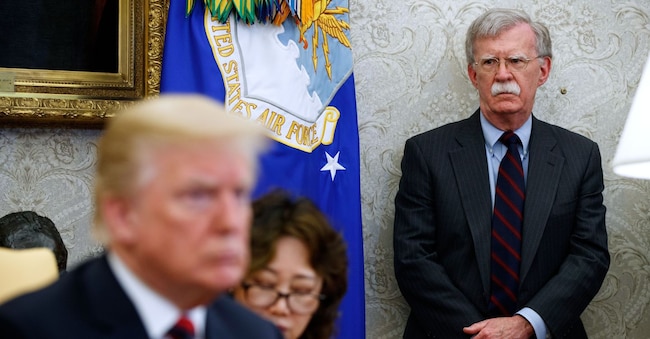
FBI agents raided the Maryland home and Washington office of John Bolton, 76, former national security adviser to President Trump. The operation, which began around 7 a.m. local time today, 22 August, is part of a high-profile investigation into the handling of classified documents that had already begun years ago, but which the Biden administration had shut down "for political reasons", according to a senior US official. This was revealed by the New York Post, later confirmed by other international newspapers. At the moment, Bolton has neither been arrested nor formally charged.

While the agents were in action, the director of the FBI, Kash Patel, appointed by Trump in February 2025, wrote on X: "No one is above the law. FBI agents in action". No explicit reference to the affair, but the connection seemed immediate to many observers. "I didn't know about the raid. I don't want to get involved. I am not a fan, he is a thug. He's not smart and he's not patriotic,' the US president commented.

Loading...
Usa, Trump porta pizza e hamburger alla Guardia Nazionale: "Divertiamoci, poi torniamo al lavoro"

Bolton posts message critical of Trump during raid

Bolton's X account posted a message at 7:32am in which criticised Trump's approach to Russia's war against Ukraine, just as FBI agents were inside his home. It is unclear whether this was a planned post. This is the text of the message, translated:

"Russia has not changed its goal: to drag Ukraine into a new Russian empire. Moscow has asked Ukraine to cede the territory it already holds and the rest of Donetsk, which it has failed to conquer. Zelensky will never do this. In the meantime, the meetings will continue because Trump wants the Nobel Peace Prize, but I see no progress in these talks'.

Bolton has not spared attacks on the tycoon in recent months. Like when he harshly challenged the report by the director of intelligence, Tulsi Gabbard, according to which Barack Obama allegedly orchestrated a long 'plot' against Trump. Or when, speaking of the summit with Vladimir Putin, he accused the tycoon of going so far as to ventilate the cession of Alaska to Moscow.

Trump, for his part, has never made a secret of his resentment towards Bolton, so much so as to call him 'stupid' and guilty of 'blowing up the Middle East'.

Who is really John Bolton

.

John Bolton is no ordinary former aide. Born in Baltimore in 1948, the son of a modest family, a graduate of Yale, he has always been considered a Republican hawk: an advocate of military force, star-spangled unilateralism and a muscular approach to international relations.

In the 1980s he joined the Reagan administration, embodying the aggressive spirit of the Cold War, in the 1990s he was a lawyer and analyst, with George W. Bush he held key positions in the State Department. In 2005, he became US ambassador to the UN.

Throughout his career there is one constant: the belief that America should act alone if necessary, even outside multilateral constraints. A philosophy that has made him divisive, but also a leading voice for the harder wing of the Republican Party (GOP).

When Trump appoints him National Security Adviser in 2018, many predict fireworks. And indeed, after little more than a year, relations fray. Bolton pushes for a hard line against Iran, North Korea and Russia; the Potus, on the other hand, seeks impact meetings with Kim Jong-un, openings with Moscow and even a deal with the Taliban.

The differences explode and Bolton leaves the White House in September 2019. Since then, he has become one of the tycoon's fiercest critics, whom he accuses of poor preparation, pursuing personal goals - such as a Nobel Peace Prize - and putting national security on the back burner. Until the publication, in 2020, of his memoir, The Room Where It Happened (Simon & Schuster).

The Book of 2020: Charges for Disclosure of National Secrets

The Room Where It Happened came out in June 2020 after a very tough legal battle. The Trump administration attempted to block it on the grounds that it contained classified information and violated so-called 'prepublication review', the procedure that requires those who have held sensitive positions to submit their writings to government scrutiny before publication. In the book, Bolton recounts his 453 days at the president's side, revealing some behind-the-scenes footage of the Trumpian White House coming straight from the room - the room - where every whisper can become an order and every silence a strategy: private talks, fragility in negotiations with Putin and Xi Jinping, and the Potus' obsession with re-election.

All - or almost - summed up in one sentence: 'I am hard-pressed to identify a significant decision by Trump during my tenure that was not dictated by electoral calculations'.

The Justice Department files a civil suit to confiscate the proceeds of the book, but Judge Royce Lamberth denies the stop, while reprimanding Bolton for not following the rules. In 2021, under Biden, the lawsuit is dismissed.

The book soon became a bestseller and the former Trump advisor began appearing regularly on cable news as he criticised the president's national security and foreign policy.

Kash Patel, a hawk at the Bureau

.

In all this, the figure of Kash Patel is central. A lawyer and former defence official, Patel has been a Trump loyalist for years. Appointed director of the FBI in February 2025, he promised to 'clean up' the bureau from the legacies of what he calls the 'deep state', ridding the federal government of corruption and exposing cover-ups. Just yesterday, he had accused former director James Comey of authorising the leak of classified documents "misleading Congress" shortly before the 2016 election

Trump's strategy against 'enemies'

.

But there is a precise strategy behind the raid on the Bolton house. Indeed, the Trump administration has turned the federal judiciary into a battleground against its opponents, with the White House striking out in waves in recent months. In January 2025, the president torpedoed 17 inspectors general of various departments, key internal control figures. In March, security clearances - the authorisations that allow government officials, military personnel, federal employees or outside consultants to access classified information in the United States - were revoked from dozens of lawyers and law firms that had played a role in the Russiagate investigations or civil cases against the tycoon. IIn May, the Justice Department even indicted a Wisconsin judge and a New Jersey congresswoman, drawing accusations of 'intimidating use' of justice.

Then, last week, Trump went even further. He commissioned the Washington D.C. police department and ordered the National Guard to patrol the streets of the capital. At the same time, the DoJ opened an investigation into whether crime data had been manipulated, after weeks of presidential accusations - never substantiated - of violent escalation in the city.

A few days later, the Potus called for the resignation of Federal Reserve board member Lisa Cook, bringing up alleged mortgage fraud cases. In the same vein, New York Attorney General Letitia James, who had led the civil action against the Trump group for corporate fraud, is now under investigation by the Justice Department.

Meanwhile, just yesterday, 21 August,the Court of Appeal overturned the maxi-sanction imposed on the president for falsifying company documents, overturning one of the heaviest civil sentences that had befallen him in recent years.

Brand connect

Loading...

Newsletter

Notizie e approfondimenti sugli avvenimenti politici, economici e finanziari.

Iscriviti