
The Fed does not touch rates: unchanged at 5.25-5.50%. Only one cut expected in 2024
Only a rate cut of 25 basis points is expected in 2024. This is what emerges from the dot-plots, the tables attached to the monetary policy decision. In March, the Fed had planned three cuts
3' min read
3' min read
Firm rates in the US. The Fed's monetary policy committee (FOMC) did not disappoint expectations and left Fed funds rates unchanged at 5.25-5.50 per cent, the highest level since 2001, and indicated a slower tightening scenario than the one drawn up in March. The official communiqué issued after the meeting indicated only a slight change from that of May: the progress in recent months on the inflation front, which was absent in the previous release, is now indicated as 'modest'.
A cut (or maybe two) by the end of the year
The weight of the inflation data, which has reared its head slightly in recent months, raising fears of a very bumpy return to the target, has changed the entire scenario of the rate normalisation manoeuvre. Only one cut is planned for 2024: the median of the 'dots' - the graphs with which each governor indicates his forecasts for future monetary policy - points to 5.0-5.25% and no longer to 4.5-4.75% in March. Eight out of nineteen governors, however, indicated a lower value of 4.75%-5%, corresponding to a second cut, while only seven indicate only one cut. Four would leave rates unchanged until December. Decisions will continue to be made 'meeting after meeting', based on the data.
"More data are needed to be confident"
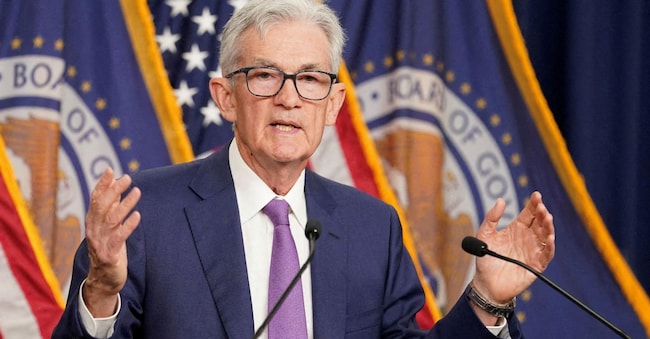
."Inflation data at the beginning of this year were higher than expected, although the most recent data have declined somewhat," Chairman Jerome Powell told a press conference. "We need," he added, "to see more positive data to bolster our confidence that inflation is moving sustainably towards 2 per cent. We know that reducing monetary policy tightening too soon or too much could result in a reversal of the progress we have seen in inflation. At the same time, reducing tightening too late or too little could unduly weaken economic activity and employment".
The key remains the labour market: "We obviously watch the labour market and the economy as a whole, but the labour market very carefully" and "we see," the president said, "a gradual cooling, a gradual movement towards a better balance": "Wages," he added, "are still moving at a pace above the sustainable pace, which would be that of the inflation trend and that of the productivity trend".
Upwardly revised final goal
.At the end of next year, as a consequence of this year's slower tightening, rates could fall to 4-4.25% - corresponding to four cuts of 25 basis points - and no longer to 3.75-3.50% (corresponding to five cuts). In 2026, the median aims at 3-3.25%, with another point cut, as in March: a level that can be reached, however, with four cuts and not only three.
The final target has also changed, however: the long-term rate, which can be considered as an implicit target, has risen again to 2.75%, from 2.50-275% in March and 2.50% in December. This is a sign that some governors believe the very characteristics of the US economy have changed, probably in relation to the performance of the labour market. Powell, however, urged not to give too much importance to these data - indeed very scattered - because it is difficult to identify which shocks are temporary and which structural: the rise reflects the overall idea that interest rates may not return to pre-pandemic, very low levels
Inflation revised upwards
Inflation - as measured by the PCE index - is projected at 2.6% this year (adjusted upwards from 2.4% in March), 2.3% in 2025 (from 2.2%) and 2% in 2026. Core inflation, similarly, is projected at 2.8% this year (up from 2.6%), 2.3% next year (up from 2.2%) and 2% in 2026. These are 'very conservative' projections, he explained: the overall Pce index is already at 2.6%, the core is already at 2.75%. The range of the projections suggests that the Fed, after the latest data, does not see much progress by the end of the year: the corridor is 2.5-3% for overall inflation (2.2-2.9% in March) and 2.7-3.2% for core (2.4-30% in March). GDP 2024 is projected to grow by 2.1% and to grow by 2% in 2025 and 2026, unchanged from the March estimates. Unemployment is forecast at 4% in 2024, 4.2% in 2026 (from 4.1%) and 4.1% in 2026 (from 4%).


