
Warsh’s Fed defies Trump: it raises interest rates and promises to do so again
The Fed has raised interest rates by 25 basis points to 3.75 per cent–4 per cent, the first rise since July 2023

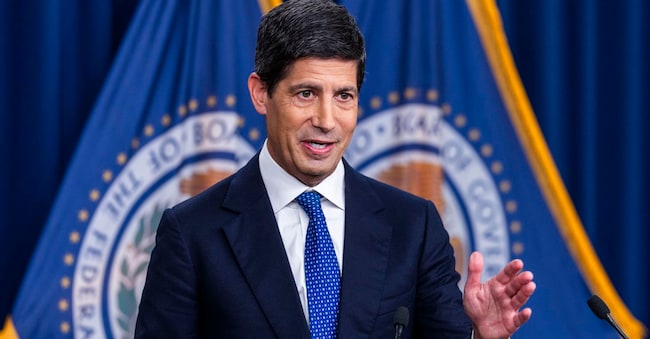
An immediate rate rise. Another effectively announced by the end of the year. The Federal Reserve’s September meeting raised the Fed Funds rate range to 3.75 per cent–4 per cent, from the previous 3.50 per cent–3.75 per cent, with the decision taken unanimously: including the vote of the current chairman, Kevin Warsh, who, having been appointed by Donald Trump, appeared set to gradually steer monetary policy towards a more accommodative stance. The September rise is the first since July 2023, when a series of six cuts totalling 175 basis points began.
Another rise by the end of the year
Even more interesting are the ‘dots’ – the projections, represented by dots on a graph, of the members of the FOMC, the Fed’s monetary policy committee: the median of the interest rate projections now points to 4.125 per cent by the end of the year, corresponding to the 4–4.25 per cent range: sixteen out of eighteen governors – including those who, on a rotating basis, do not have the right to vote – believe a further rise is necessary by the end of the year. Warsh, however, as in June, did not provide his own forecast. Rates are then expected to remain on hold next year – though eight central bankers are forecasting a third rise – before falling to 3.75–4 per cent in 2028 and to 3.5–3.75 per cent in 2029. The long-term rate, which can be regarded as an implicit target of monetary policy, has risen to 3.25 per cent: as recently as June, it was just over three per cent. ‘I do not intend to prejudge future decisions,’ Warsh said at a press conference, reiterating his opposition to any form of forward guidance: ‘I am committed to following a discipline, a set of principles.’
Prices still inflated
The statement issued at the end of the meeting – now rather terse under the new chairmanship – slightly revised the assessment of inflation: in July, it was high relative to the 2 per cent target, due to supply-side shocks that had affected prices in certain sectors. In September, price trends are simply described as ‘high’, with no further details. ‘This summer’s inflation data do not indicate to me,’ Warsh went on to explain, ‘that underlying trends have improved significantly. Based on the latest CPI and PPI data, the year-on-year change in headline PCE prices (to be published on 30 September, Ed. ) was probably around 3.6 per cent in August. Core inflation as measured by the PCE and that measured by the CPI stand at around 3.2 per cent and 2.4 per cent respectively. Too many categories continue to record increases of more than 3 per cent, both on a half-yearly and a yearly basis.”
Accommodative financial conditions
Warsh also believes that financial conditions are not tight: “I find it difficult to describe them” as tight, he said. “We have reduced the degree of accommodation so that financial and credit conditions are more consistent with our ultimate objectives. That was the decision. That was our assessment. We will continue to assess the situation going forward.”
‘The problem is inflation’
Economic growth continues to be regarded as robust, thanks to ‘domestic spending’ that has proved resilient to the uncertainty caused by geopolitical tensions. Productivity growth and capital investment were both described as ‘strong’ in June. In the September statement, the former retains the adjective ‘strong’, which emphasises the intensity of the increase, whilst the latter is described as ‘robust’, as if to highlight its qualitative solidity and consistency. The assessment of the labour market remains unchanged: ‘Employment growth has kept pace with that of the labour force, and the unemployment rate has remained broadly unchanged’, and claims for unemployment benefits – Warsh added – ‘are at levels consistent with full employment’. “Inflation is the problem,” commented the chairman.


