
Feh, how bad do we suck?
Poor humans, brought up swallowing terrible stories, in which all the worst is said about them.... Is it any wonder they grow up evil? The ruthless US humourist Shalom Auslander tries to turn that narrative on its head in a hilarious memoir
by Lara Ricci
4' min read
4' min read
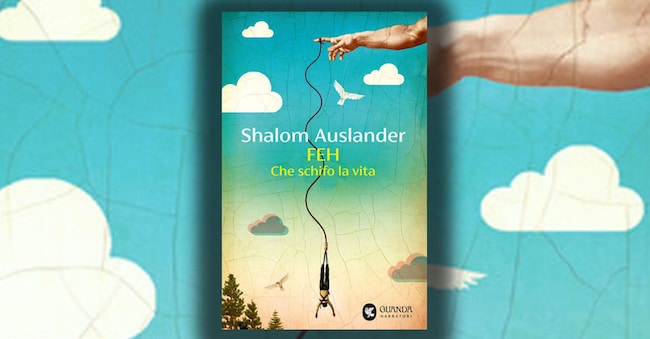
Life is already complicated and, as if that were not enough, the poor little Shalom Auslander has been told since childhood that he is feh: a shit (in Yiddish). So that now, as an adult, when his wife says 'I love you' he replies: 'We'll deal with your problems later'; when his children exclaim 'We love you, Daddy', he thinks: 'idiots'. He is certainly not the only one in the world who has grown up convinced that he is rubbish. It is the Bible, "the most influential book ever written, the best-selling book of the year, every year" - according to "Time" magazine - that has been repeating this to everyone for thousands of years, Auslander notes in Feh, what a crap life, memoir of a former child growing up in a strict dysfunctional family of orthodox American Jews. You know, on Friday God created man, but the material was almost finished: there was just a little mud left over. He kneaded something, but not much came out.... What did God think of the son? wonders Auslander. 'Here's a clue: He named him Adam, from the Hebrew word Adamah, which means loam and also mud. He had named his son mud (...). Mud was not happy in God's world. He had nothing to do. He was lonely. Before long, he began to get on God's nerves'.
God then made the woman. "He called her Chava, from Chai, the Hebrew word meaning alive (...). Alive is not exactly praise, but it is still better than Mud. Now they were a couple. The Mud. Minimum quality. Economy packaging. The first thing Mud did was break the rules. Well, one rule. One time only. Anyway, God got very angry. "Get out of here," he said. The Mud people were kicked out, but things went from bad to worse. They had children. Two boys. The older one killed the younger one. The first born of a man, and what does he do? He kills. He stabs. Slaughters. These are my ancestors. This is my mishpacha. Which in Hebrew means family'.
Can we imagine how he feels, the petty Auslander, brought up this way? Perhaps not, we cannot because we are immersed in the same story. The one for which man is bad, a disgusting, despicable, self-destructive being. The one told by the Bible, or even Schopenhauer, or capitalism, which tells 'stories as destructive as those in the Bible'. Stories based on two axioms, Auslander theorises: 1. Man is lazy (corollary: he is poor because he is lazy); 2. Man has earned it (corollary: he is rich because he works hard).
Therefore furious, iconoclastic, the author of Feh. How life sucks dismantles the history he was brought up with with black humour. Ever since he was a child, laughter has been salvation for him: 'my underwater respirator, my David's sling against the Goliath of being, created by God, I am sure, on the evening of the sixth day, when he realised that without laughter the man he had made that afternoon would not have survived a week. I imagine a Genesis before the Genesis, a prequel, Genesis 0.1, in which Adam does not steal from the divine tree, but hangs himself from a branch'.
There are two types of laughter that the author elicits with his wacky, hilarious leap from one topic to another with surprising analogies - the first is like that of his wife Orli: 'free, unrestrained and total, lustful, devilish and joyful'; the second is like that in which his friend Phil occasionally erupts, which will end badly: 'shrill, desperate, forced, the laughter of one who would rather scream with rage'. Auslander masterfully balances them (even if the second part of the memoir is less successful, and only recovers in the finale) and thus leads the reader to imagine a different story from the one we are used to, mindful of what Nigerian writer Chimamanda Ngozi Adichie writes about the risk of a single narrative: "Stories, she says - how they are told, who tells them, when they are told - depend on power. Power is the ability not only to tell another person's story, but to make it the definitive story of that person. It is a way, he says, to destroy a people, to diminish them, to dehumanise them'.


