
European Elections in Spain: Feijoo's Populars Advance, Sanchez's Socialists Resist
Alberto Nunez Feijoo's Populars gain ground, but Pedro Sanchez's Socialists maintain their position in the European elections in Spain

2' min read
2' min read
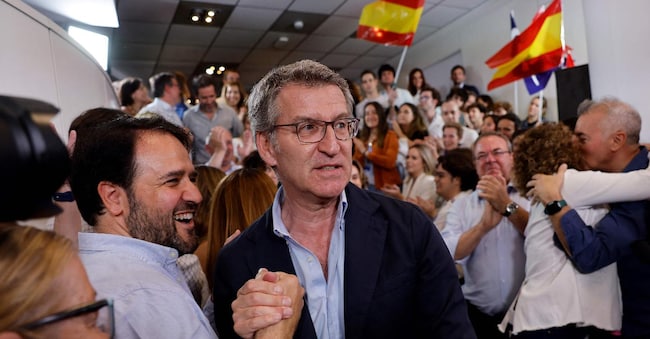
Advancing are the Populars of Alberto Nunez Feijoo but holding the Socialists of Pedro Sanchez . And despite Vox's new leap, the right gains little or nothing in the European elections in Spain.
The People's Party, at the end of the poll, prevailed with 34.2% of the votes equal to 22 seats, a clear increase compared to the previous 13, obtained, however, totally swallowing up the former allies of Ciudadanos who disappear from the European Parliament. The Socialist Party remains stable with 30.2% of the vote and 20 seats in the EU Parliament. Vox grows with 9.6 per cent of the votes, equal to six MEPs, twice as many as it had. On the left, Yolanda Diaz with Sumar will have three seats, Podemos two. Three seats also for Ahora Republicas, a coalition of regional independence forces.
One of the big news is the emergence with three seats of the Salf party - which stands for Se Acabò la Fiesta, the party is over - led by social media agitator, Luis Perez, aka Alvise Perez.
The Socialist leader appeared at the polling station with his wife Begona Gomez, who is under investigation in a corruption and influence-peddling affair that has shaken the election campaign. "I call for participation to stop the reactionary wave: Spanish citizens will show that they are for progress, to look forward and not backward," Sanchez said yesterday. In recent days the premier himself, harshly criticised by the oppositions, had said: 'After having stopped the ultra-right in Spain, it is time to go back and give a lesson to the world, an example to Europe of how we can stop the international ultra-right'.
'I don't remember an election campaign as focused on European issues as this one: the economy, the green turn, but above all the foundations of Europe with the opposition between the sovereignist right and the left,' explains Oriol Bartomeus, director of the Institute of Political and Social Sciences at the Autonomous University of Barcelona. 'Sanchez,' Bartomeus adds, 'has appealed to the Spanish people to stop the advance of the right, partly replicating the strategy he followed in the last Spanish elections: there he was defeated by the Populars but then took his revenge by succeeding in setting up a government coalition. In Europe we will see what strategies the Spanish conservatives will follow'.


