
Femicide and consent laws complete the Italian legal framework
The final approvals for the new regulations are expected on 25 November, but already new forms of violence against women are being born on digital

Key points
A double signal from a united Parliament, regardless of political affiliations, on the occasion of the International Day Against Violence Against Women: on 25 November the Chamber of Deputies will unanimously approve the law introducing the autonomous crime of feminicide and the compulsory training of magistrates; the Senate, again unanimously, is expected to pass (the conference of group leaders is convened at 12.30 p.m.) the measure amending Article 609-bis of the Penal Code by providing for the absence of 'free and present' consent as the basis of the crime of rape. A bipartisan page for women, which completes a regulatory framework that has been strengthening since the 1990s. With a beacon - the transposition of the Istanbul Convention with Law 77/2013, which recognises violence against women as a violation of human rights - and a progressive refinement of the tools to combat it, which has seen in the Red Code (Law 69/2019) a crucial landing place.
The Crime of Femicide
Now there is a further qualitative leap, also cultural. In the Penal Code, with the new Article 577 bis proposed by Ministers Eugenia Roccella and Carlo Nordio, feminicide is named and typified, punished with life imprisonment, as the killing of a woman 'when the act is committed as an act of hatred or discrimination or prevarication or as an act of control or possession or domination as a woman, or in relation to the woman's refusal to establish or maintain an emotional relationship or as an act of limitation of her individual freedom'. A revolution, accompanied by other innovations: the mitigation of the possible balance between aggravating and mitigating factors, the strengthening of the use of the precautionary measure of house arrest to protect the victims of spy crimes, the mandatory training for magistrates, with the involvement of the Higher School of the Judiciary.
Free and Present Consent
Equally disruptive is the text on consent, the result of the pact between the leaders of the main parties, Prime Minister Giorgia Meloni and Dem secretary Elly Schlein: to the conditions on which the crime of sexual violence is based - violence, threat or abuse of authority - the absence of free and current consent of the victim is added. Only yes is yes. 'The text,' explains Paola Di Nicola, judge at the Supreme Court and expert on violence against women, 'aligns Italy with the principles of logic and law imposed at supranational level, because it establishes at legislative level what the Supreme Court has been interpreting for ten years, namely that consent to the sexual act is an act of autonomy and freedom that can be revoked at any time. This is the only crime for which consent is assumed by the perpetrator for cultural reasons. This is not the case for trespassing. The law restores value to the mutual listening of persons and bodies. When in doubt about consent, one must stop, otherwise it is a crime. With the law, the word of rape victims takes on value and silence is no longer consent'.
Digital is real
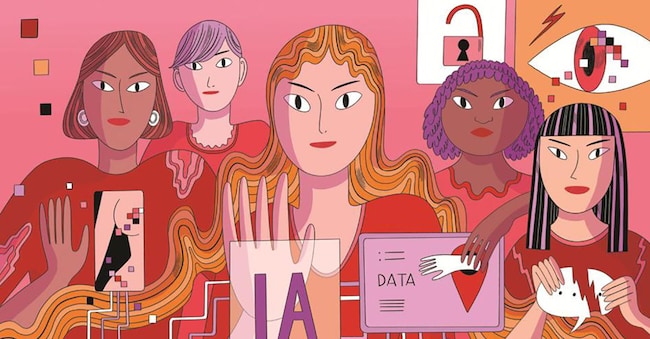
While the legislator intervenes, however, the frontiers of violence are already moving further afield. And they run on the web. From online harassment to cyberstalking, from doxing (the practice of seeking and disseminating private information) to deepfake (when an image or video is manipulated by artificial intelligence): there are many nuances to the new forms of digital abuse. Women, especially those politically exposed - think of the mayor of Genoa, Silvia Salis, who read web insults directed at her - are inundated with humiliating and sexist comments. Not only. Women who have been 'stripped' by Ai on the Social Media Girls site include Chiara Ferragni, Michelle Hunzicker, Angelina Mango, Nunzia Di Girolamo. In the Facebook group 'My Wife' alleged husbands and partners were spreading intimate photos of their partners without consent. On the 'Phica.Eu' platform, pictures of women, even famous ones, were circulating, spiced with violent and sexist comments. These are all examples, worryingly on the rise, of 'digital violence' against women, daughter of the same culture from which physical, psychological, verbal and economic violence originates. The digital world, is the recent comment of Un Women, "for millions of women and girls has become a world of abuse. Digital violence is spreading at an alarming rate, fuelled by artificial intelligence, anonymity and the absence of effective laws and accountability'.
Data on the phenomenon
Some data show the growth of the phenomenon. According to an ISTAT report published in 2024, slightly more than half of the harassment suffered by women outside work occurs through technology (email, chat or social media). A report by the Postal Police reveals that in Italy, in the first ten months of 2023, there were 371 complaints, with 'a worrying increase of 24%'. Hate speech is mainly directed against women, as shown by the Vox Diritti report that analysed the period January-November 2024. According to the new Toluna survey promoted by Samsung, 47% of Italian women between the ages of 16 and 55 have suffered at least one episode, a figure that rises to 59% in the 16-24 age bracket. The most common forms are: sending unsolicited sexual content (19%); online emotional manipulation (15%), body shaming and hate speech (15%).


