
Feralpi, 220 million relaunch on the German economy
Feralpi Stahl subsidiary's new zero-emission rolling mill inaugurated - Pasini: 'We believe in Germany's growth potential, we ask the EU for concrete actions on scrap and energy'
5' min read
5' min read
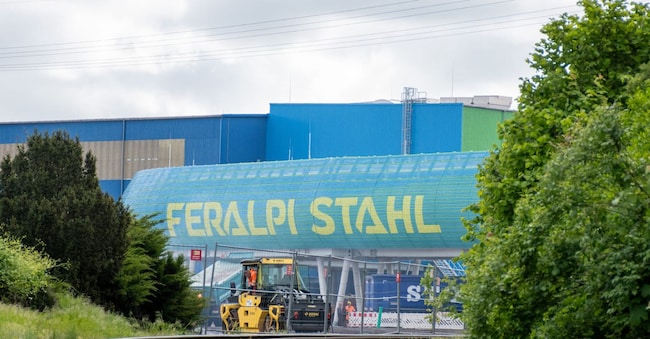
A EUR 220 million relaunch on the future of European industry. Feralpi has inaugurated in Riesa, just over two hours' drive from Berlin, a new rolling mill whose technological and environmental features mark a milestone not only in the history of the Italian steelmaking group, but also on the path towards a new season of European industrial rediscovery, and one with a low environmental impact. For Feralpi, this is the largest single investment in its history in Germany, and Feralpi Stahl - already a key player in the 1990s in the German reconstruction following the relaunch of the Brescia group, which took over the legacy of what was a former GDR kombinat - is ready to be, once again, the pivot of an industrial rediscovery. The new rolling mill, with zero direct emissions (Scope 1), supplied by the Italian company Danieli, represents a significant technological leap: it is the first in the entire German market to make continuous rolling possible by welding billets and is equipped with a zero-emission inductive furnace system. A 300-metre long induction-heated roller way directly connects the new rolling mill to the existing continuous casting plant. This hot continuous process is electrically powered, thus avoiding direct CO2 emissions. In the future,' the German company's engineers explain, 'it will also be possible to produce a hot-rolled coil weighing eight tonnes, a product that in turn will set new standards in the market.
The scenographic impact of the plant is remarkable, with the 300 metres of roller 'overhead', completely enclosed and insulated, that serve to accompany the steel from the continuous casting to the rolling mill. 'I call it the underground,' says Feralpi Group president Giuseppe Pasini proudly, raising his eyes upwards. 'The inauguration of this new plant in Riesa testifies to our long-term vision and our constant commitment to invest in advanced technologies to strengthen our competitiveness on the global market and pursue increasingly sustainable production. You may not realise it, but an eight-tonne coil means 25 kilometres of wire. The preconditions for this started in 1992, with the commitment to employ around 300 people and produce 500,000 tonnes by taking over the Riesa plant from the privatisation plan as part of German unification. "At that time in Berlin there was Kohl, a man of great vision and strategic ability,' recalls Pasini. 'Thirty years later, with almost a thousand people at work and 1.3 million tonnes produced, 27-28% of the German market, we have not only hit the target, but have gone further. With this plant we have employed another hundred people, strengthening the union with this community of which I feel a full part. Now the German state, with the installation of the new chancellery led by Friedrich Merz, is aiming to resurrect as an industrial locomotive and to act as a driving force for the entire European Union, with the announced EUR 1 billion fiscal stimulus plan. 'We need a boost especially in the construction and civil engineering sector,' added Feralpi Stahl's general manager Uwe Reinecke in turn. In Germany we are in the third year of recession, but here in Riesa we have been among the few not to lay off workers'.
Speaking to the 500 or so people present at the inaugural ceremony (during which he recalled the figure of Giampiero Benedetti, the chairman of Danieli who died a year ago) Pasini then stated that he 'firmly believes in Germany's growth potential and we want to be a driving force behind this economic revival,' said the chairman. 'However, in order to translate this confidence into concrete results, synergetic action with German and European policy is indispensable. Time is up, there are no more alibis. In particular, we consider it crucial to urgently address the issue of expensive energy, which heavily affects the competitiveness of our industry, and to recognise the centrality of ferrous scrap as a strategic raw material for a circular economy and resilient manufacturing. Only with targeted support on these two fronts will we be able to unfurl our full potential and contribute significantly to a prosperous and sustainable future for Germany and Europe. Not to mention the need for a trade policy system that defends us from the risk of Chinese products invading due to the trade war with the US. We demand a safeguard system that also extends to downstream products'. 2024 was a complicated year for the entire Italian and European steel industry. Against this backdrop, Feralpi saw revenues drop slightly, to 1.7 billion. 'The year did not go very well,' Pasini acknowledges, 'especially on the margins front. The German pole, within the Group, is now worth 45%, a decrease compared to the past. Germany has suffered more than Italy, in the current context, penalised by some questionable choices made by Chancellor Scholz. We have many expectations in the new government that has just taken office, especially in terms of infrastructure relaunch'.
Saxony's Minister-President Michael Kretschmer, who spoke at the opening, emphasised that 'the investment in the new spooler shows the company's confidence in Saxony as an industrial location'. In an area in which, as in many other German regions, the equilibrium that has governed it for decades has collapsed (in Saxony AfD has grown to 30%, and is the second largest party after the Cdu), the Italian group's investment emerges as 'a strong signal in difficult economic times,' summarised the political leader. 'That is why it is so important for me that industries like Feralpi Stahl continue to find conditions that allow the creation of value and technological transformation with fair competition in the future. After all,' he added, 'this is what guarantees our economic sovereignty, the prudent use of resources and jobs in industry. The objectives formulated in the coalition agreement make me confident that the new federal government will act quickly on the points that are also crucial for the steel industry. This applies in particular,' he concluded, 'to competitive energy prices and the duration of licensing procedures.
Tommaso Foti, Minister for European Affairs, the NRP and Cohesion Policies, also spoke at the ceremony (there was a large Italian contingent, with many steel entrepreneurs and the president of Federacciai himself, Antonio Gozzi). 'The moment is difficult, the geopolitical framework has changed, Europe is losing centrality,' he said. 'We cannot, at this juncture, run the risk of losing our industrial vocation, just as energy autonomy is a value to be defended. The ideological conflict between business and the environment must be overcome, and this investment is the declination of what must be our approach to sustainability. The real challenge is to find the tools and concrete actions that allow an idea to be declined and translated into action. This initiative on the Italy-Germany axis,' he added, 'confirms the strong bond between the two countries and this is the path on which we will continue with the new government. We also need greater solidarity within Europe: the Union must go back to being political, going back to guiding even choices that may not provide immediate consensus, but which are necessary'.

