Supercar

Ferrari 12Cilindri, the new 830 hp super gran turismo coupé or spider: all the details

The manufacturer from Maranello unveils its new V12, replaces the 812 Superfast, boasts an 830 hp engine and is immediately offered in coupe or spider version

by Mario Cianflone

Ferrari 12Cilindri, la nuova supercar da 830 cavalli

9' min read

9' min read

Thermal, naturally aspirated, no hybrids to contaminate its Ferrari purity and a name, '12Cilindri', that says it all: Ferrari's past, present and future. Starting with the V12, the most iconic engine, the one loved and favoured by Enzo Ferrari from the very beginning of the legend. V12 was also the 166, the first 'red' to leave the gates of Maranello. And now, in the midst of an era of electric engines, lithium ion-powered superpowers and synthetic, freeze-dried sounds, Ferrari is returning to the charge with the V12, and declining it in the new 12Cilindri, a hyperbolic gran turismo that proudly thermalises the petrol super-engine (now with 830 bhp at 9,250 revs!) and while confirming the arrival of the electric, continues to bet on a technology that combines tradition, fascination and performance.

Ferrari 12Cilindri: positioning and innovations

The new 12Cilindri, replaces the 812 Superfast and debuts immediately in two variants: the coupé and the Spider with a retractable roof. And everything is spiced up with luxury and aerodynamics with a wow-worthy style that integrates form and function. One example? The two movable wings at the rear that, managed by software and silicon intelligence, keep the car glued to the road when needed without dirtying its line with questionable fixed wings. These mobile appendages allow two configurations: Low Drag (LD) and High Downforce (HD). In LD mode, the movable element aligns with the body to reduce drag, while in HD mode, maximum vertical load is generated to ensure optimum aerodynamic balance. Among the innovations are four independent steered wheels, and this, thanks to a 20mm shorter wheelbase than the 812 Superfast, improves the dynamic behaviour of the Italian super gran turismo. And with rear-wheel drive, these tricks are essential
Loading...

Ferrari 12Cilindri: the style

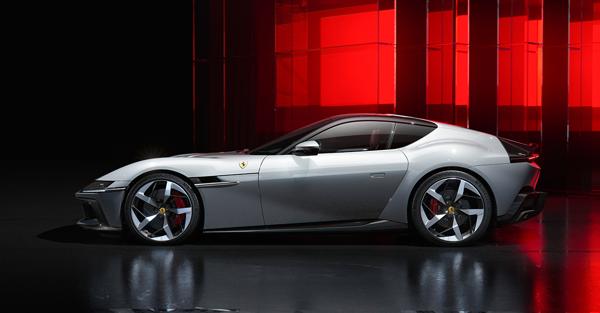
The new Ferrari displays breathtaking styling and is the fruit of the team led by chief designer Flavio Manzoni. The front end, which exhibits some references to the Daytona 365 GTB 4 of 1968, is dominated by a very long bonnet (bonnet wing) while the side with a double parallel rib connects to the muscular rear distinguished by a 'black screen', a black panel integrated in a delta theme with the roof, where at the ends there are two movable wings at the light clusters and inserted into the rear window. This is a choice that combines form and function: aerodynamic load management and clean, elegant styling that a high fixer could hardly give.

The 12Cilindri aims to redefine stylistic codes of Ferrari's previous mid-engined V12s. In particular, the front bonnet has an extremely smooth surface, with fluid lines emerging from the volumes of the mudguards. The absence of cuts gives the car a clean, uncluttered appearance, interrupted only by the presence of two air intakes for engine cooling. The front end loses some of the characteristic features of the pure Ferraris (citing the legendary Daytona), such as the eye-shaped headlights and the grille that recalls a mouth, in favour of more modern and sophisticated geometries. The rear, on the other hand, stands out for its purity and the harmonious integration of the headlights within a blade that crosses the entire volume, creating an effect of great elegance and modernity.

Ferrari 12Cilindri, le foto della nuova super gran turismo da 830 cavalli

Photogallery36 foto

Instead of a rear spoiler, as mentioned, two active appendages have been adopted which, integrated into the rear window, produce an effect with a characteristic delta theme, giving the car a high-tech appearance.
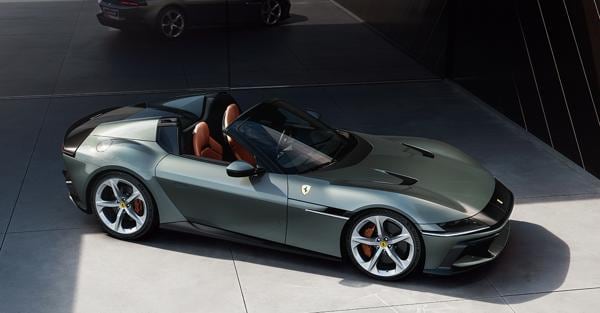
The Centro Stile Ferrari, headed by Flavio Manzoni, has achieved a bold design revolution with the creation of the Ferrari 12Cilindri, a car that redefines the stylistic codes of Ferrari's previous mid-engined V12s. This new creation is distinguished by a more sophisticated yet rigorous language that creates an unprecedented effect of stylistic unity.

Essential master lines govern the geometries of the car, creating a harmonious interconnection of volumes. The clean, uncluttered flanks extend along the entire length of the car, with wings treated with great geometric precision. Although they retain the classic Ferrari look, the 12Cilindri's mudguards present a more functional and modern approach, generating a striking visual effect.

The front bonnet has an extremely smooth surface, with fluid lines emerging from the volumes of the mudguards. The absence of cuts in the muscles gives the car a clean and uncluttered appearance, interrupted only by the presence of two air intakes for cooling the engine.

The front end loses some characteristic Ferrari features, such as the eye-shaped headlights and the grille resembling a mouth, in favour of more modern and sophisticated geometries. The rear, on the other hand, stands out for its purity and the harmonious integration of the headlights within a blade that crosses the entire volume, creating an effect of great elegance and modernity.

Instead of a traditional rear spoiler, two active appendages have been adopted which, integrated into the rear window, produce an effect with a characteristic delta theme, giving the car a more technological appearance.

Ferrari 12Cilindri, updated V12 engine

.

The engine is an evolution of the classic V12 made in Ferrari and boasts a 65° angle between the cylinder banks. Designated F140HD, it has a displacement of 6,496 cc and delivers 830 hp at 9,250 rpm with a maximum torque of 678 Nm at 7,250 rpm and a specific power of 128 hp/litre.

The new 12-cylinder, thanks to a power-to-weight ratio of 1.88 kg/hp, sprints from 0-100 km/h in 2.9 seconds and reaches 200 km/h in 7.9 seconds. Top speed? Over 340 km/h. On the powertrain level, two innovations are the intelligent torque curve management system (ATS, Aspirated Torque Shaping) and the F1 automatic transmission with double clutch and 8-speed gearbox equipped with an operating logic that makes lightning fast gear changes. Torque management was one of the cornerstones of the project, along with aerodynamics. Ferrari's engineers worked to optimise the consistency and linearity of torque delivery at all revs. obviously, the 12-cylinder was designed to exasperate the appeal of the unique Ferrari V12 sound. And here, too, Maranello's thermal pride is rediscovered as it confirms the electric car for 2025

The V12 works at a maximum speed of 9500 rpm and relies on the use of lightweight, high-performance materials, such as titanium for the connecting rods and a special aluminium alloy for the pistons. This choice not only reduces the engine's overall weight, but also improves its responsiveness and ability to deliver power in a rapid and controlled manner.

But the real innovation lies in the 'sliding finger' technology, developed by Ferrari on the basis of experience gained in Formula 1. This device optimises the opening and closing of the valves, ensuring greater mechanical efficiency thanks to the diamond-like carbon (DLC) coating, which reduces the coefficient of friction.

One of the most significant innovations Ferrari has come up with for its 12Cilindri is the introduction of software that allows the maximum torque to be altered according to the gear engaged. This allows the driver to feel a progressive and linear thrust as the gear ratio increases, creating a unique and involving driving experience, typical of a Ferrari. In fact, Ferrari's engineers have worked hard to optimise torque delivery at all engine speeds, ensuring a smooth and powerful response in all situations. The result is a peak of power reached at maximum revs, but constant and uniform torque throughout the rev range.

The sensation of continuous, endless acceleration, a distinctive feature of Ferrari's V12 engines, has in fact been further refined thanks to the ATS (Aspirated Torque Shaping) torque structure control. This technology has allowed the engineers to shape the torque curve in third and fourth gears without compromising acceleration, resulting in increased driving pleasure.

Optimising the mechanical efficiency of the engine and oil circuit was key to reducing emissions and fuel consumption. Thanks to the calibration of the variable displacement oil pump, it is possible to vary the amount of oil circulating in the engine according to engine speed and load, resulting in significant energy savings. This, combined with the new configuration of the oil tank and pump hydraulic circuit, has minimised pressure losses and optimised system functionality under all operating conditions.

The 350 bar GDI system, consisting of two petrol pumps and four rails equipped with pressure sensors, provides continuous feedback to the pressure control system. This system, together with the sophisticated petrol quality recognition strategy, maximises the thermodynamic efficiency of the engine and reduces emissions.

As for the gearbox, an eight-speed Dual Clutch Transmission (DCT) version was chosen, already popular on other cars in the Ferrari range. According to Ferrari, thanks to the new bevel gear, there has been a 12 per cent increase in ground torque, benefiting longitudinal performance and shift times.

Ferrari 12Cilindri, the interior and dashboard and man-machine interface

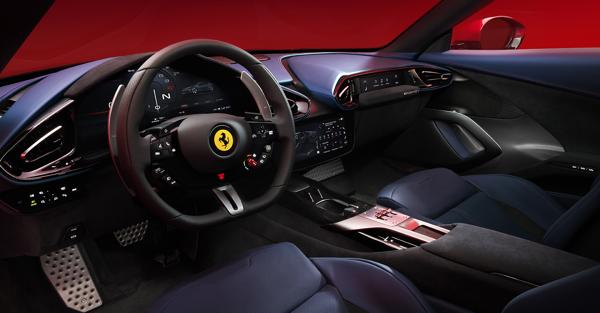
The cockpit of the 12Cilindri is organised into three levels of interior design: the first comprises the upper part of the dashboard, which merges with the door panels; the second is the central area, while the third includes the tubs and seats. The choice of materials and colour combinations determines the character of the interior, which can be elegant or sporty depending on the customer's preference. Special attention has been paid to environmental sustainability, with the extensive use of recyclable materials, including Alcantara made from 65% recycled polyester. The interior is inspired by dual cockpit architecture, with an almost symmetrical cabin composed of two dedicated modules, one for the pilot and one for the passenger.

The interior is dominated by a dashboard with a dual cockpit architecture. The man-machine interface features a 15.6" instrument cluster that provides driving information and vehicle dynamics and is matched by a steering wheel with capacitive controls (already seen in the latest generation Ferraris) and a physical manettino. In the centre of the dashboard is an infotainment system with a 10.25" touch display that offers compatibility with Apple Carplay and Android Auto, while the passenger has an 8.8" screen. And if the sound of the V12 is not enough, there is, as an option, a sophisticated 1,600 watt Burmester sound system.

Ferrari 12Cilindri, aerodynamics and rear wings

In the design of the Ferrari 12Cilindri, aerodynamics was conceived not only to optimise performance, but also to ensure an understated and elegant design. One of the distinctive features of the rear end is the 25 mm nolder on the bonnet, which provides the air recompression necessary to maintain aerodynamic efficiency when resistance is minimal. Mobile rear appendages allow the car to assume two load configurations, while the aerodynamic floor is designed to optimise the exit of hot air from the front radiators. Low-pressure zones behind the front tyres are exploited to create openings that reduce drag and increase vertical load.

Ferrari 12Cilindri, the cooling systems

.

In the design process of the Ferrari 12Cilindri, the focus on cooling the engine and auxiliary components led to a revolution in the car's cooling system.One of the main changes was the optimisation of the seven air intakes at the front bottom. The space between the longitudinal elements of the chassis was dedicated to the engine water radiator and the condenser of the air conditioning circuit, served by the central opening. This new layout allows better air distribution and more efficient cooling. In addition, the oil cooler has been divided into two elements positioned in front of the front wheels, with side intakes also divided into two parts: one for cooling the engine oil cooler and the other for the braking system.

Ferrari 12Cilindri, a software-defined supercar

.

Ferrari 12Cilindri is at the forefront of the front-engined berlinetta scene thanks to the implementation of advanced dynamic controllers. The introduction of the brake-by-wire system allows the adoption of the latest innovations in the range, such as the ABS Evo presented on the 296 GTB and the 6w-CDS sensor, which provides maximum precision to the Virtual Short Wheelbase (PCV) 3.0 and Side Slip Control (SSC) 8.0 systems. This results in shorter stopping distances and greater repeatability of the braking action.

As mentioned, the Aspirated Torque Shaping system, (ATS) a new Ferrari logic, maximises the linearity of delivery of the legendary naturally aspirated V12 through electronic control. The SSC 8.0 system, a new evolution of Ferrari's famous controller, allows the systems to communicate with each other, defining the best way to operate to maximise the car's overall performance. By integrating the controllers found on the Ferrari 12Cilindri, the SSC 8.0 creates a natural synergy with the new ABS Evo.

Optimised to increase estimation accuracy and learning speed, the SSC 8.0 offers better control on very low-grip surfaces, improving yaw management in corners and responsiveness when changing direction.

Ferrari 12Cilindri, the chassis

.

The chassis of the Ferrari 12Cilindri, characterised by a 20 mm shorter wheelbase than the 812 Superfast, represents a complete innovation. Special attention was paid to the geometry of the cast components, such as the shock towers and struts, in order to improve torsional stiffness and reduce overall weight. The independent four-wheel steering system (4WS), already introduced on the special 812 Competizione series, adjusts the movement of each wheel independently to improve yaw management and increase cornering readiness.

The aluminium frame structure ensures excellent performance in terms of noise, vibration and harshness (NVH), as well as high safety standards. In addition, its design has resulted in cleaner load lines, improving stiffness without increasing weight compared to previous models. The Ferrari 12Cilindri can be fitted with Michelin Pilot Sport S5 and Goodyear Eagle F1 Supersport tyres, both developed in sizes new to the Maranello marque: 275/35ZR21 at the front and 315/35ZR21 at the rear.

Ferrari 12Cilindri, the price

.

The price: 395,000 euro for the closed and 435,000 for the open one, obviously excluding customisation. The bill can therefore easily reach half a million euros. An elite car, of course, that is already unofficially a success. According to rumours and unconfirmed rumours, it seems that Ferrari has received over a thousand expressions of interest for a sum approaching 500 million euro. Among other things, the lucky customers have the chance to garage both the Spider and the Coupé but they have to decide which of the two they want delivered first so as not to exclude the other Ferraristi on the waiting list.

Copyright reserved ©
Loading...

Brand connect

Loading...

Newsletter

Notizie e approfondimenti sugli avvenimenti politici, economici e finanziari.

Iscriviti