
Ferrari Amalfi, the heir to the Roma debuts. Everything you need to know: features, performance and prices
The manufacturer from Maranello launches the new coupé at the bottom of the range: elegant lines, 640 hp V8 engine strictly thermal and on board comfort and digital technology
by Mario Cianflone, posted in Maranello
6' min read
6' min read
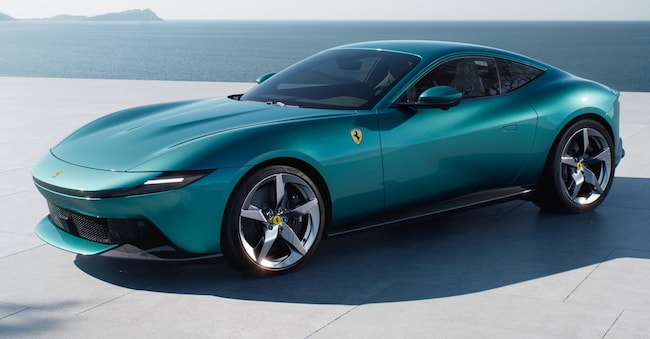
Born five years ago, the Ferrari Roma had the task of proposing a performance but elegant car in the Prancing Horse range that was less conspicuous in terms of lines and sound than the classic, certainly not minimalist, approach of the cars made in Maranello. Now the Roma gives way to its heir. It is called the Amalfi and inherits the best of what was defined as a Formula 1 car in evening dress and introduces modifications and improvements that enhance its style and performance without distorting its elegant and highly polished design, the result of the work of the team led by Flavio Manzoni. It would be reductive to call it a restyling but it is markedly an evolution of the previous model. In fact, the Amalfi takes the best of the Roma to a higher level while remaining the most accessible car in the Ferrari range, accessible and obviously relative given that the price list starts at 240,000 euro and considering the customisations the bill can increase even more.
Among the confirmations of the Amalfi is the twin-turbo eight-cylinder V-cylinder engine, rigorously thermic without any electrification that weighs and is not needed and the still clean styling but now with a greater focus on aerodynamics and rear loading achieved thanks to an active wing at the rear. But let's go into detail
Ferrari Amalfi, the V8 evolves
.As mentioned, the beating heart of the new Ferrari Amalfi is an evolved version of the 3,855 cm³ twin-turbo V8 belonging to the F154 family. The engine now develops 640 hp at 7,500 rpm, with a specific power output of 166 hp/litre and a limiter that activates at 7,600 rpm.
Much of the performance leap is due to the advanced turbocharging system, which independently manages the rotational speed of the two turbochargers. These now reach up to 171,000 rpm. The result is a noticeable improvement in throttle responsiveness. Pressure management is entrusted to the engine control unit, already adopted by Ferrari on the 296 GTB, the Purosangue and the more recent 12Cilindri.
At the same time, Ferrari has concentrated on reducing the moving masses to the bone. Starting with the camshafts. which have now been lightened and have saved a good 1.3 kg, for a total dry weight of the car of 1,470 kg. Meanwhile, the crankcase has been redesigned to eliminate non-structural material. An absolute novelty is the low viscosity oil, never before used in combination with a V8 engine from the Prancing Horse. This oil, according to Ferrari, improves cold resistance by 30 per cent and optimises efficiency during the warm-up phase.


